A spa has three therapists, and each turns a room around in her own way. A changes the towels first and then wipes the bed; B wipes the bed first and then gathers the dirty towels, dropping them onto the freshly wiped bed. The morning shift opens up and forgets to switch on the dehumidifier; the evening shift goes home and forgets to switch off the towel steamer. Nobody is doing it wrong on purpose: nobody has ever written down "this is how to do it right". When the owner is away, quality depends on each person's memory. This lesson helps you turn what you learned at Levels 1–3 into written standard procedures that can be checked and taught.
By the end of this lesson, you will be able to:
- Write a complete SOP, with steps that begin with a verb and have a pass standard.
- Draft opening, closing and between-client room turnaround SOPs for your own spa.
- Design a short shift checklist that can be completed in 3–5 minutes.
- Control quality through random observation, scoring sheets, client feedback forms and tracking of comments.
- Train therapists using SOPs, update SOPs with version control, and keep records tidy.
What an SOP is and when you need one
An SOP (Standard Operating Procedure) is a document describing who does what, in what order and to what standard for a repeated task. A checklist is a condensed version of the SOP that you tick off as you work. The SOP is for teaching and reference; the checklist is for doing and checking.
Not every task needs an SOP. Write one first for tasks that have one of these three features:
- Safety-related: cleaning, disinfection, room turnaround, using devices, handling incidents, allergies.
- Repeated daily by several people: opening, closing, welcoming clients, payment.
- Often complained about or often done wrong: double bookings, forgetting to complete records, delivering the wrong service.
A small spa should start with 6–10 core SOPs rather than compiling a thick manual that nobody reads. You already have the technical procedures for each service (massage, facials) from Levels 1–3; the SOP only needs to refer to them and add the operational part.
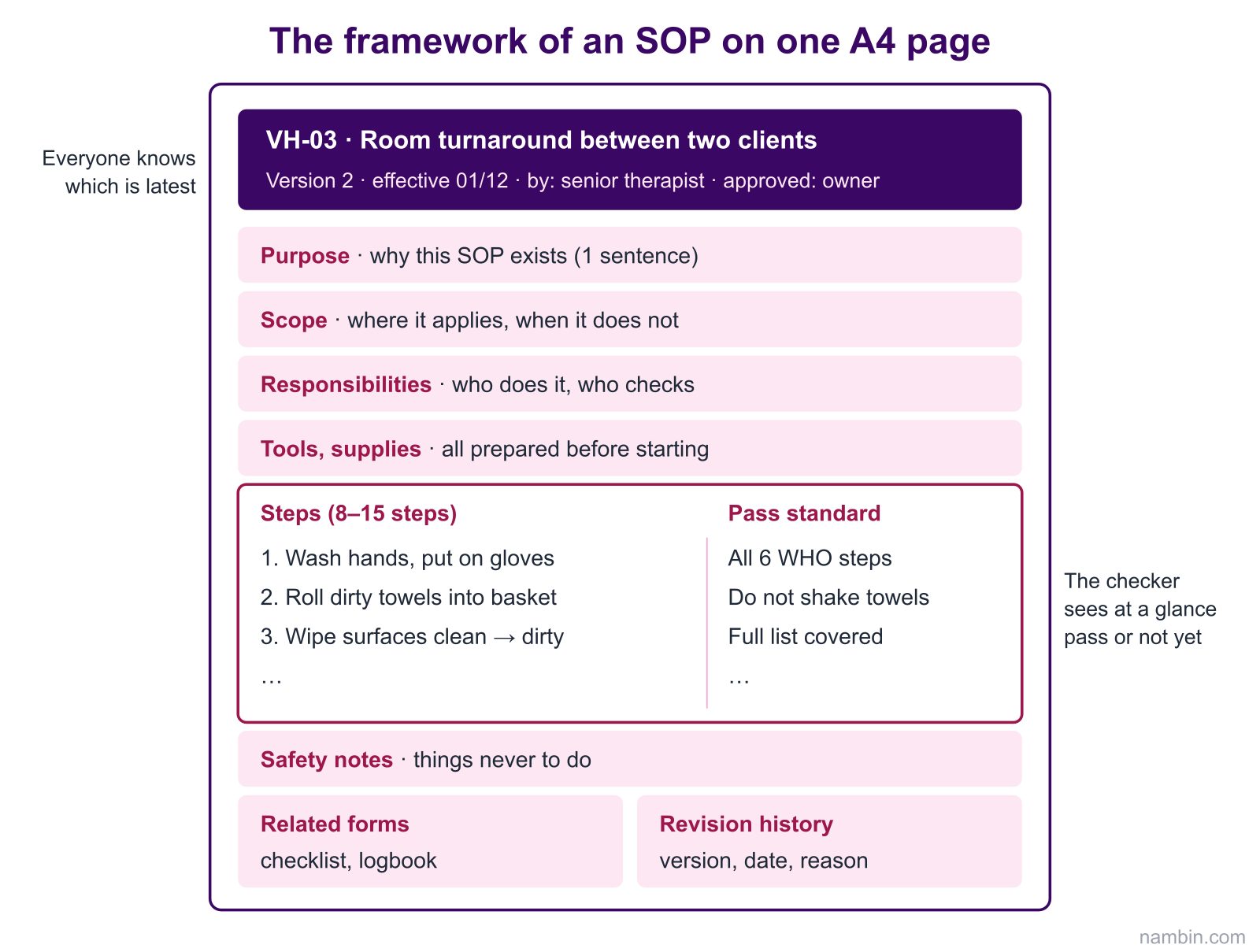
The structure of an SOP
| Section | Content | Example (between-client room turnaround SOP) |
|---|---|---|
| Header | Name, code, version, effective date, author, approver | OP-03 · Room turnaround between clients · version 2 · effective 01/12 · author: head therapist · approved by: spa owner |
| Purpose | Why this SOP exists, in one sentence | A clean, safe room, ready for the next client within 15 minutes |
| Scope | Where and for which services it applies, and when it does not apply | All massage and facial rooms; does not apply to incidents involving blood or body fluids (use the incident SOP) |
| Responsibilities | Who does it, who checks it | The therapist who has just served the client does it; the receptionist or head therapist carries out random checks |
| Tools and materials | List of what must be ready before starting | Gloves, lidded dirty towel basket, surface disinfectant diluted according to the label, colour-coded cleaning cloths, a set of clean towels |
| Steps | Numbered, each beginning with a verb, with a pass standard | See the room turnaround SOP table below |
| Safety notes | Things never to do | Never mix two chemicals; never shake out dirty towels in the room |
| Related forms | Accompanying checklist and logbook | Room checklist on the back of the door |
| Revision history | Version number, date, what changed, reason | Version 2: added a step to wipe the door handle, following a client's comment |
Five rules for writing steps
- One action per step, beginning with a verb: "Gather", "Wipe", "Check", "Record". Do not write "The room should be cleaned".
- Specific and measurable: "Wipe the bed surface, headrest, instrument table and door handle" rather than "wipe the surfaces". "Leave the disinfectant for the full contact time stated on the label" rather than "wipe thoroughly".
- In order from clean to dirty and from top to bottom, following the principle you learned at Level 1.
- Each step has a pass standard: the checker can see at a glance whether it has been met.
- Short: an operational SOP should fit on one side of A4, about 8–15 steps. If it is longer, split it into two SOPs.
Example: opening SOP
A good opening means that when the first client walks in, everything is ready: rooms clean and fresh-smelling, enough towels, hot water, and a clear booking schedule showing who is serving whom. Example for a spa that opens at 10:00, with the opener arriving at 9:30.
| Step | Action | Pass standard |
|---|---|---|
| 1 | Open the doors, switch off the alarm (if any), switch on the lights and air conditioning, air the rooms | Comfortable room temperature before 10:00, no damp smell |
| 2 | Do a safety walk-round: sockets, device cables, dry floors, escape routes, fire extinguishers | No exposed cables, floors not slippery, escape routes not blocked |
| 3 | Wash your hands, check the treatment rooms against the room checklist | Beds covered with clean towels, instrument tables disinfected, bins with new liners |
| 4 | Switch on the towel steamer and the oil or stone heater as instructed by the manufacturer | Working temperature reached before the first client; switch-on time recorded |
| 5 | Check the number of clean towels, disposables and opened cosmetics | Enough for the day's bookings plus spares; products within their period after opening |
| 6 | Read the booking schedule and special notes in client records (allergies, pregnancy, personal requests) | The therapist responsible for each client has been informed |
| 7 | Hold a 5-minute start-of-shift briefing: allocate tasks, highlight 1 quality point for the week | Everyone present knows their tasks |
| 8 | Sign the opening checklist | All boxes completed, with name and time |
Example: closing SOP
| Step | Action | Pass standard |
|---|---|---|
| 1 | Turn the room around after the last client using the room turnaround SOP, then do the end-of-day deep clean according to the schedule | All rooms clean, floors dry |
| 2 | Gather dirty towels into laundry bags and count the towels sent out or put into the machine | Number of towels recorded in the laundry log |
| 3 | Clean and disinfect reusable tools using the procedure learned at Level 1; leave to dry and store covered | No tools left wet overnight |
| 4 | Close and return opened cosmetics to their proper storage place | No open bottles or jars left on the table |
| 5 | Switch off the towel steamer, heaters and devices; unplug equipment that does not need to run overnight | Indicator lights on all devices are off |
| 6 | Reconcile revenue and number of services with the booking schedule; record any incidents and complaints of the day | Figures match; incidents recorded in the log as learned at Level 3 |
| 7 | Empty the bins and replace the liners; check the windows, lock the doors, set the alarm | No waste left in the rooms; doors locked |
| 8 | Sign the closing checklist and note anything to hand over to the morning shift | Name, time and handover notes recorded |
Photo: 維基小霸王 / Wikimedia Commons, CC BY-SA 4.0

The between-client room turnaround SOP
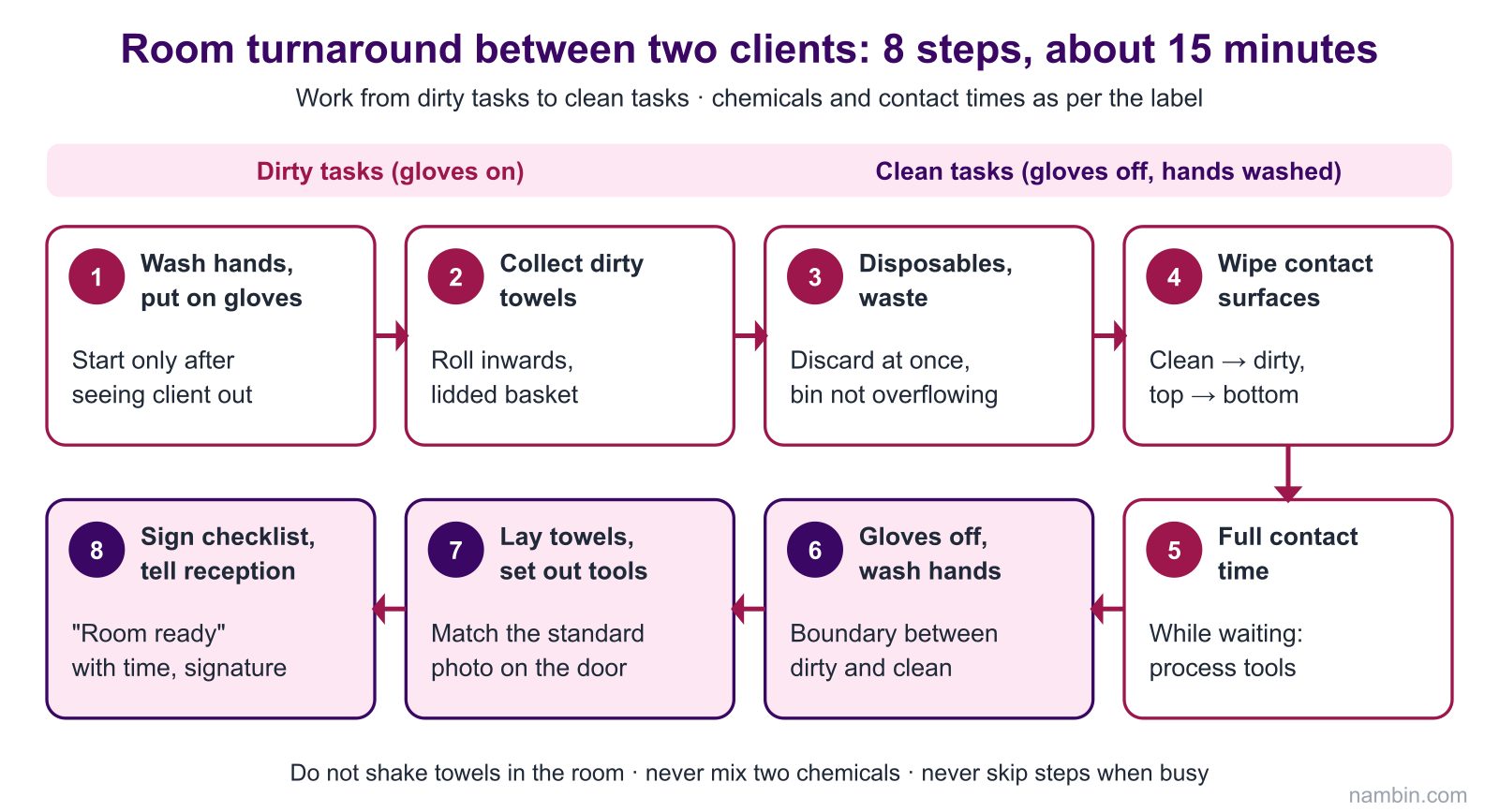
This is the most important SOP for safety, and it also directly affects the number of bed-minutes you can sell (previous lesson). The example below is for a single-bed massage room, with a target of about 15 minutes. Chemicals, concentrations and contact times follow the manufacturer's label and the disinfection procedure you learned at Level 1; the SOP simply names the products the spa is using.
| Step | Action | Pass standard |
|---|---|---|
| 1 | See the client out, wash your hands, put on gloves | Hands washed using all 6 WHO steps |
| 2 | Roll dirty towels from the outside in and place them in the lidded basket | Towels not shaken out; dirty towels never put on the floor or a chair |
| 3 | Discard disposables, gather the waste, tie the bag if full | Bin not overflowing |
| 4 | Wipe contact surfaces from clean to dirty, top to bottom: door handle, instrument table, pump bottles, bed surface, headrest, stool | No surface on the list missed |
| 5 | Leave the disinfectant for the full contact time on the label while cleaning reusable tools | Surfaces stay wet for the time stated on the label |
| 6 | Remove gloves, wash your hands | Clean towels never touched while wearing dirty gloves |
| 7 | Lay clean towels, set out disinfected tools and products for the next client; air the room, adjust the temperature | The room looks exactly like the standard photo on the back of the door |
| 8 | Tick the room checklist and tell reception "room ready" | Time and initials recorded |
Tip for keeping to 15 minutes without skipping steps: prepare a "room kit" (towels folded in the order they will be laid, a tray of disinfected tools) before the previous client finishes, and put a standard photo of the ready room on the back of the door for therapists to compare against.

Photo: Matt @ PEK from Taipei, Taiwan / Wikimedia Commons, CC BY-SA 2.0

Shift checklists: short and usable straight away
A two-page checklist will be ticked just for show. A good checklist has 10–15 lines, each one something visible, and can be completed in 3–5 minutes.
| Check item (opening) | Pass | Not passed: action taken |
|---|---|---|
| Floors dry, escape routes clear, fire extinguishers in place | ☐ | |
| Each room: bed covered with clean towels, instrument table disinfected | ☐ | |
| Bins with new liners and lids | ☐ | |
| Enough clean towels for booked clients + spares | ☐ | |
| Towel steamer and heaters switched on and at temperature | ☐ | |
| Opened cosmetics labelled with opening date and within shelf life | ☐ | |
| Hand soap and hand sanitiser full | ☐ | |
| First-aid kit complete and in date | ☐ | |
| Booking schedule and special notes read | ☐ | |
| Checked by, time, signature | ||
The "Not passed: action taken" column is the most important one: a fail with a clear note of the action taken is good; ticking "pass" just for show is bad. Tell your staff this from the very beginning.
Quality control: three sources of information
An SOP is only worth something if it is followed. The manager needs to know what is really happening through three sources, each one making up for the weaknesses of the others.
1. Random observation with a scoring sheet
The manager or head therapist observes part of a shift and scores each step of the SOP. Example frequency: each therapist is observed once a week, on a randomly chosen day and service. For services with a client present, observe only the parts that do not compromise the client's privacy (welcoming, preparation, room turnaround, record keeping), or obtain the client's consent in advance.
| Room turnaround SOP step | Pass (1) / Not yet (0) | Mandatory safety step |
|---|---|---|
| 1. Wash hands, put on gloves | Yes | |
| 2. Roll dirty towels, place in lidded basket | Yes | |
| 3. Gather waste | ||
| 4. Wipe all surfaces in order | Yes | |
| 5. Full contact time | Yes | |
| 6. Remove gloves, wash hands before touching clean towels | Yes | |
| 7. Room matches the standard photo | ||
| 8. Sign checklist, inform reception |
Suggested assessment: pass when every mandatory safety step is passed and the total score is 7/8 or more. Failing a safety step is a fail even if the total score is high. After scoring, talk to the therapist privately the same day: praise what was done well first, point out one thing to correct, and have them redo it on the spot.
2. Client feedback forms
A paper form or a message after the service, 3–5 questions, answered by the client in under 1 minute. For example, on a 1–5 scale: the room was clean; the therapist was respectful and explained clearly; hand pressure and temperature were right; I would recommend the spa to friends; plus a free comments box. Do not ask questions clients cannot answer honestly ("Did the therapist follow the correct procedure?").
3. Comments and complaints
Every comment at the desk, every message and every review on social media and online maps is recorded in a shared log. You learned how to handle complaints at Level 3; as a manager, your job is to find what keeps recurring: if three clients in a month say the room is cold, fix the opening SOP rather than just apologising to each one.
Monthly tracking table
| Indicator | How to calculate | What it is used for |
|---|---|---|
| Observation pass rate | Number of observations passed ÷ total number of observations | Shows which SOPs are often done wrong and which therapists need more coaching |
| Average client feedback score | Average score for each question | Shows which question scores lowest so you can improve it first |
| Number of complaints by category | Count by category: hygiene, attitude, price, booking, technique | Find recurring causes |
| Checklist completion rate | Number of shifts with a fully signed checklist ÷ total number of shifts | Shows whether checklists are really being used |
Do not turn quality control into a tool for punishment. When staff are afraid of penalties, they hide mistakes and tick checklists for show; the manager loses exactly the information he or she needs most.
Training, updating SOPs and keeping records
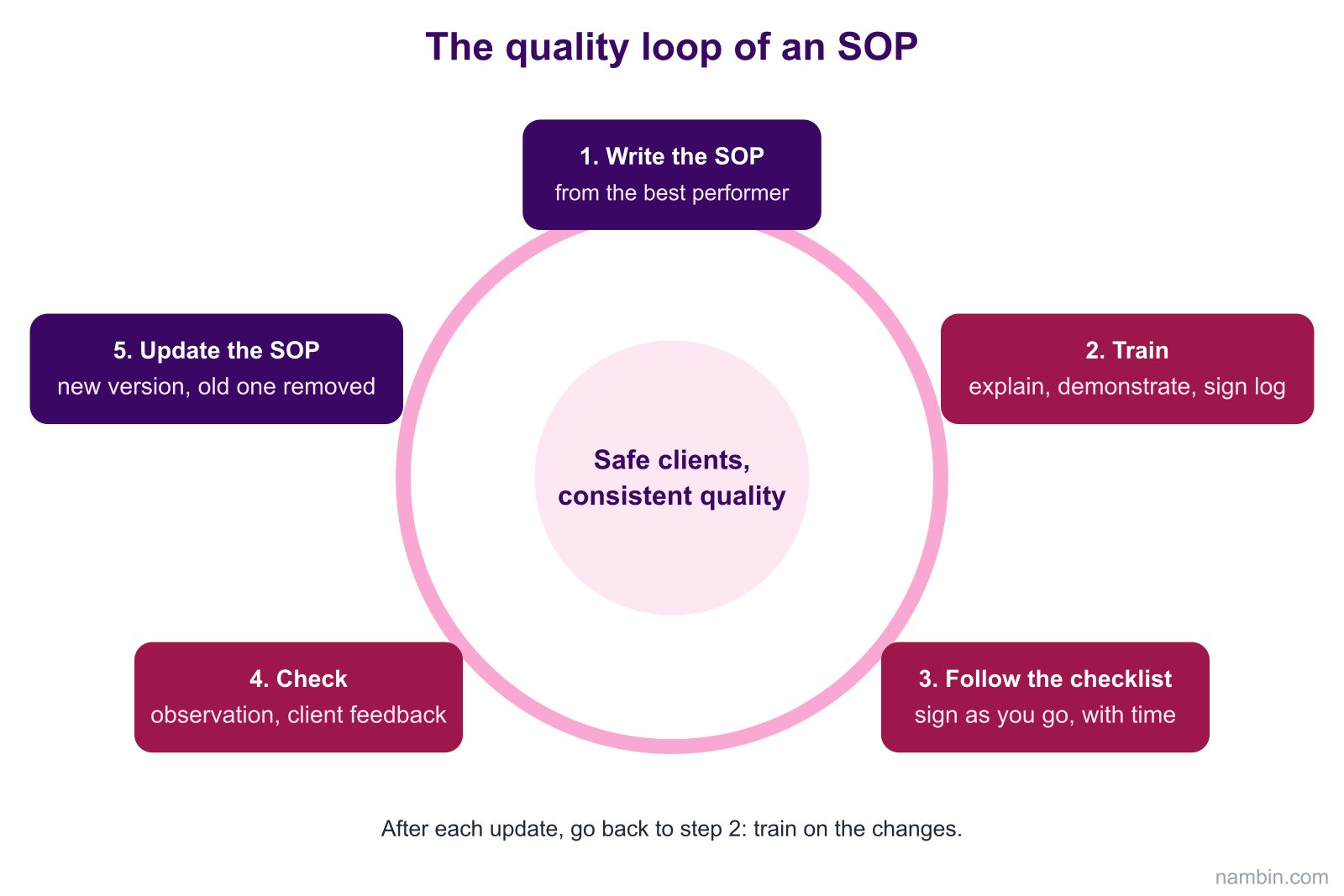
Training with SOPs
- Explain: read the SOP together with the staff member and give the reason for each step, especially the safety steps.
- Demonstrate: the trainer performs the whole procedure, saying each step out loud.
- Do it together: the staff member does it, with the trainer beside them giving prompts.
- Supervised practice: the staff member works alone while the trainer scores with the observation sheet.
- Sign-off: after passing 2 consecutive observations, sign the training log, recording the SOP name and version.
When to update an SOP
- After an incident or complaint caused by the procedure.
- When products, chemicals or devices change (contact times and dilution may be different).
- When the authorities issue new regulations.
- When observation shows that many people are doing it differently from the SOP: the SOP may be unrealistic and need fixing, not just reminders.
- At regular reviews, for example every 6–12 months, even if nothing has changed.
Each time you revise: increase the version number, record the effective date and reason in the revision history, withdraw the old version from the rooms and the desk, retrain on the changes and sign the log. Two versions on the wall at the same time are a source of confusion.
Record keeping
| Record | Where it is kept | Notes |
|---|---|---|
| Current set of SOPs | One folder at the desk and one digital copy | Keep only the current version; store old versions separately in an "obsolete" folder |
| Opening, closing and room checklists | Monthly folders | The spa sets its own retention period, for example at least 12 months |
| Observation sheets, training log | Each staff member's file | Used for appraisals and promotion |
| Client feedback forms, comments log | Monthly folders or a spreadsheet | Never record health information in the shared comments log |
| The premises' legal documents | A separate folder somewhere easy to reach | A spa offering massage keeps its security and order documentation under Decree 96/2016/ND-CP (security and order conditions for certain businesses, including massage services), as amended by Decree 56/2023/ND-CP, ready to present at inspection |
Records containing client names and details are personal data: keep them in a locked place or a folder with access controls, and never photograph them and send them to a group chat.
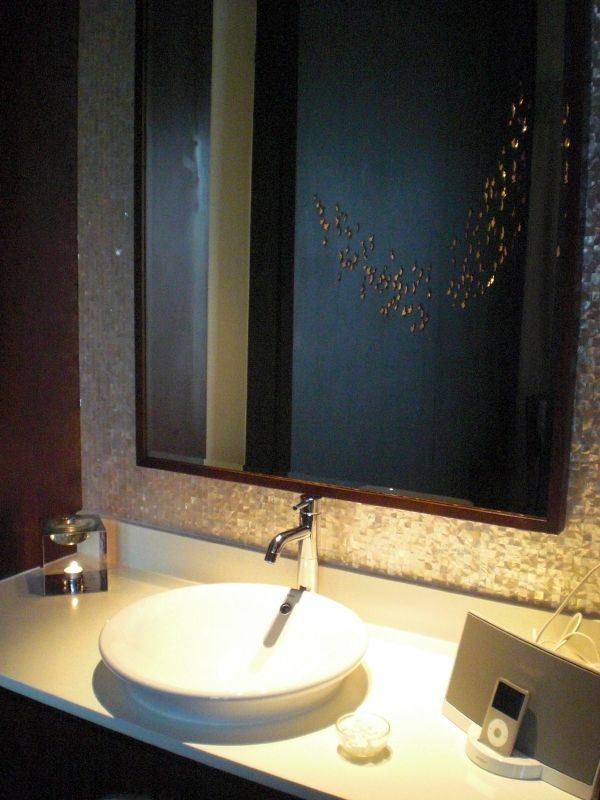
Photo: Matt @ PEK from Taipei, Taiwan / Wikimedia Commons, CC BY-SA 2.0

Writing and introducing a new SOP
- Choose the task using the three criteria: safety-related, repeated daily, often done wrong or often complained about.
- Observe the person who does it best, recording each step and the time taken.
- Write a draft using the standard template, one verb per step, with pass standards; refer to existing technical procedures rather than copying them out.
- Have 2 other people try it using the draft, with no further explanation; wherever they ask a question is where the SOP is unclear.
- Revise it and condense it into a checklist of 10–15 lines.
- Approve it and record the version and effective date; put the checklist up where the work is done.
- Train using the 5 steps and sign the log.
- Observe at random more often in the first month, then less often; review after 1 month.
Common mistakes with SOPs and quality control
| Mistake | Why it is wrong or dangerous | The right way |
|---|---|---|
| SOP copied from the internet, long and unlike how the spa really works | Nobody follows it; the SOP becomes paperwork for show | Write it from how the best person currently works, and have others try it |
| Steps written in general terms ("clean thoroughly") | Everyone interprets it differently; it cannot be checked | Specific verbs, a list of surfaces, pass standards |
| Checklist signed in advance for the whole week | Loses its control function and hides mistakes | Sign when the work is done, with the time; the manager checks at random |
| Cutting room turnaround short when busy | Risk of cross-infection; the next client sees dirt | Keep all the steps, prepare the room kit in advance, space bookings according to bed-minutes |
| Observing only with advance notice | You see a "performance", not reality | Observe at random, respecting client privacy |
| Using observation results to fine staff immediately | Staff hide mistakes; real information is lost | Coach and redo on the spot; disciplinary action only for deliberate repetition |
| Revising the SOP without withdrawing the old version or retraining | Two ways of working side by side; mistakes are likely | Increase the version, withdraw the old one, train on the changes, sign the log |
Pass criteria for this lesson
You pass this lesson when you can do the following in front of your supervisor:
- Write an operational SOP for your own spa with all 9 sections of the standard template, 8–15 steps, each beginning with a verb and with a pass standard, in 45 minutes.
- Have someone unfamiliar with the task try that SOP; they perform at least 90% of the steps correctly without asking any questions.
- Carry out room turnaround between clients using the 8-step SOP in about 15 minutes, passing every mandatory safety step on the observation sheet.
- Condense an SOP into a 10–15-line checklist that can be completed in no more than 5 minutes.
- Carry out one random observation with a scoring sheet and give feedback to the therapist in no more than 5 minutes, in this order: what was done well, one thing to correct, redo on the spot.
- Name at least 4 situations that require an SOP update and 4 things you must do when issuing a new version.
Frequently asked questions
My spa has only 2–3 people. Do I need SOPs?
Yes, but few and short. Start with the room turnaround, opening, closing and incident handling SOPs. When you hire someone new or are away for a few days, these SOPs are what keep quality up.
What if older, long-serving staff refuse to follow the SOPs?
Invite them to help write them. Long-serving staff are often the people who do the work best; when the SOP is based on how they work and they sign as its author, they become the guardians of the SOP instead of resisting it.
Should I use software or paper?
Paper is simple and can be put up exactly where the work is done. Software or a spreadsheet is convenient for monthly statistics. Many small spas use both: paper checklists on the spot, with the figures entered into a spreadsheet at the end of each week.
Further reading
Review the cleaning procedure that underpins the room turnaround SOP in the lesson Cleaning and disinfection procedures for spa tools and treatment rooms, and see how skills are scored in the lesson Spa safety and service skills assessment: 20 self-check questions, a practical test and a marking scheme.