Hanh opened a 4-bed spa in a district on the edge of the city centre. In her first year she paid her therapists the familiar way: a low basic salary plus 10% commission on every package sold. Sales went up every month, but in month eight three things happened in a row: a client posted online that two therapists had "cornered" her on the treatment bed to sell her a 30-session package; two highly skilled therapists resigned because "I'm not good at selling, so I earn less than the new girl"; and a young therapist quit after a male client made obscene remarks to her and she did not know whom to report it to. Hanh realised that the way you pay people is not only about money: it teaches staff how to behave towards clients.
Level 3 taught ethical consultative selling from the therapist's point of view. This lesson sits in the small spa owner's chair: designing pay, bonuses and appraisal so that therapists want to stay, clients are served honestly, and the spa still makes a profit.
By the end of this lesson, you will be able to:
- Compare three pay models and choose the one that suits your spa.
- Calculate a sample payslip with clearly stated assumptions, where every line can be checked.
- Design commission that does not push therapists to pressure clients.
- Build balanced KPIs across 4 groups: quality, returning clients, compliance and revenue.
- State the principles on contracts, working hours and social insurance under the Labour Code 2019.
- Build a therapist grade ladder, a cap on clients per shift and a procedure to protect therapists from harassing clients.
Why the way you pay decides the quality of service
People do what is measured and paid for. If income depends on package sales, therapists put their energy into selling packages; if you pay only per session, therapists accept sessions even when their hands are already tired; if pay is entirely fixed, the good people leave.
For a small spa, losing one good therapist means losing regular clients, plus the time to recruit and several months to train a replacement. The right question is "how do we pay so that therapists work correctly, stay for a long time and clients come back?"
Three principles for designing spa pay:
- A fixed part you can live on: the fixed salary must be enough that therapists do not have to pressure clients just to get through the month, and must not be lower than the regional minimum wage published by the Government for the area where the spa is located.
- A variable part that rewards the right behaviour: reward quality, returning clients and following procedures, not only sales.
- Transparent and checkable: therapists can work out their own pay from the session log, the feedback forms and the written pay policy.
Three common pay models in spas
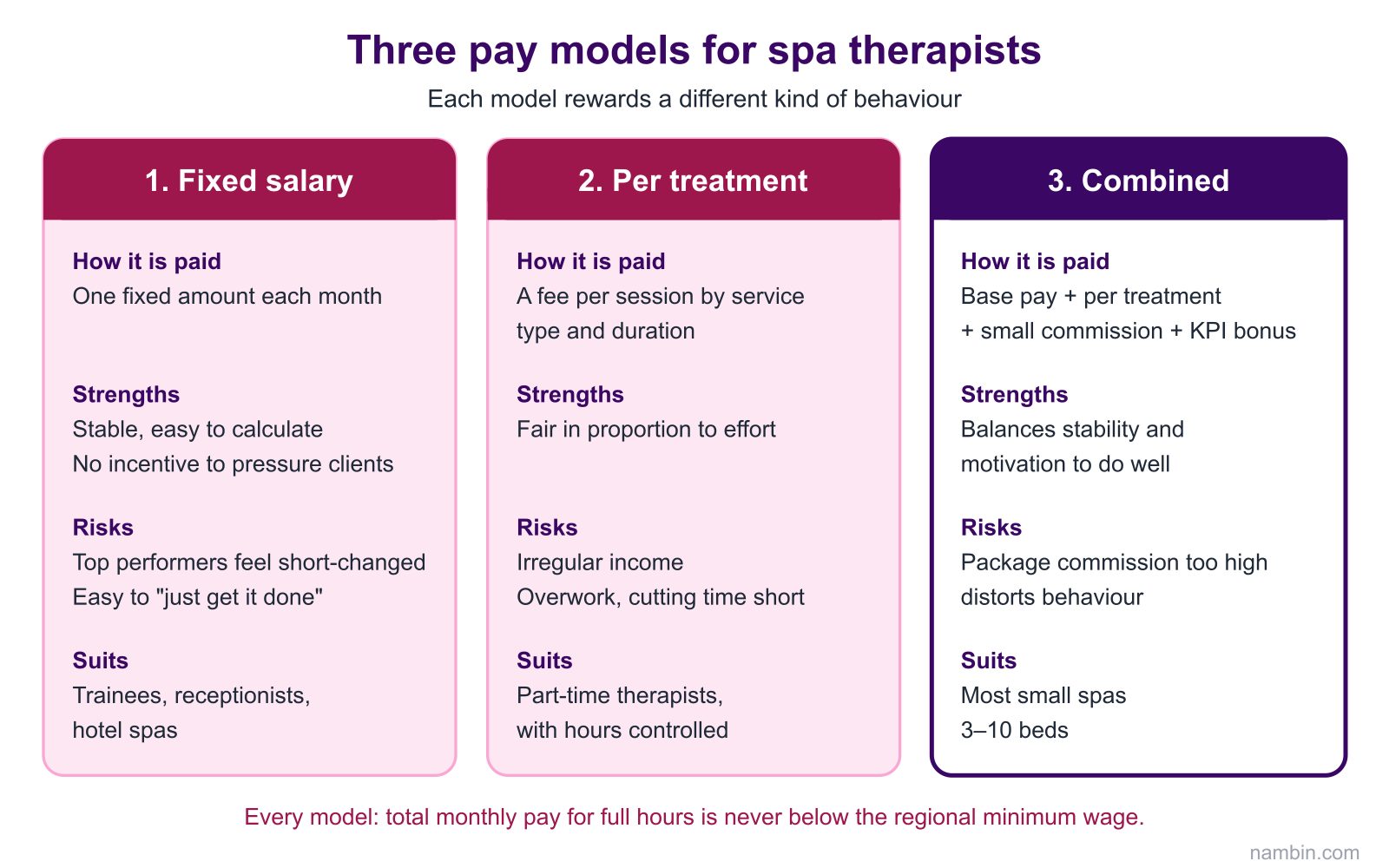
Fixed salary is easy to calculate and creates no incentive to pressure clients, but hard-working and lazy staff receive the same. Pay per session (piece rate per treatment) is fair in terms of effort, but income drops in quiet months, and therapists tend to compete for clients, take on more than they can handle and cut session time short; with pure per-session pay, the owner must still ensure that a month of full working hours pays no less than the regional minimum wage. The combined model is the most flexible but also the easiest to get wrong: if package commission makes up most of the income, it brings you straight back to Hanh's problem.
| Model | Strengths | Main risks | Suits |
|---|---|---|---|
| Fixed | Stable, no incentive to pressure clients | Good staff feel it is unfair, little motivation | Trainees, receptionists, hotel spas |
| Per session | Fair in terms of effort | Irregular income, overwork, cutting session time | Part-time freelance therapists, with hours controlled |
| Combined | Balances stability and motivation | Package commission set too high distorts behaviour | Most small spas with 3–10 beds |
A worked pay example with assumed figures
The figures below are assumptions for calculation practice only, not recommended pay levels or market rates. When applying this, the owner replaces them with their own figures and checks against the current regional minimum wage.
Assumptions: therapist Lan, therapist grade 2, works 26 days in the month according to the shift rota.
- Basic salary: 5,000,000 VND/month (assumed to be no lower than the regional minimum wage where the spa is located).
- Session pay: 40,000 VND for each 60-minute session, 50,000 VND for each 90-minute session. This month Lan did 80 sessions of 60 minutes and 20 sessions of 90 minutes.
- Retail product commission: 5% of the product sales Lan advised on, this month 6,000,000 VND.
- Treatment programme commission: 3% of the value of treatment sessions actually used by clients during the month that Lan was responsible for, this month 10,000,000 VND.
- KPI bonus: 1,000,000 VND if the KPI score is 85 or above, 500,000 VND if it is from 70 to below 85, no bonus if below 70. This month Lan scored 88 points.
| Item | Calculation | Amount (VND) |
|---|---|---|
| Basic salary | As per contract | 5,000,000 |
| 60-minute sessions | 80 × 40,000 | 3,200,000 |
| 90-minute sessions | 20 × 50,000 | 1,000,000 |
| Product commission | 6,000,000 × 5% | 300,000 |
| Commission on treatment sessions used | 10,000,000 × 3% | 300,000 |
| KPI bonus | 88 points, band ≥ 85 | 1,000,000 |
| Total gross income before deductions | 10,800,000 |
From this total, the spa deducts the employee's share of social insurance, health insurance and unemployment insurance at the rates set by law, plus personal income tax if income reaches the taxable threshold. This lesson does not give specific rates because the rates and the contribution base may change; the spa's accountant or accounting service checks the current regulations.
Look at the structure: the basic salary and session pay make up 9,200,000 of the 10,800,000, about 85%. The two commissions together come to 600,000, less than 6%. That is deliberate: Lan earns her living through her skill and hard work, and commission is only an extra. The KPI bonus of 1,000,000 is the third-largest item, and it rewards quality, not sales.
Photo: Rakoon / Wikimedia Commons, CC0

Issue an itemised payslip together with the number of sessions from the shift log and the KPI score signed by the manager; a therapist who finds a mistake can query it within the time limit stated in the pay policy, for example 5 working days.
Sales commission: the trap that pushes therapists to pressure clients
Commission is not bad in itself, but commission that is high, paid as soon as the client pays, on large prepaid packages is a formula for pressure selling. A 20 million VND package with 10% commission is 2 million VND, equal to many days of sessions. Therapists will start thinking about selling big packages and overstating results. The manager bears the consequences: complaints, refund demands, bad reviews, and a service liability that has to be delivered over many months.
Designing safer commission
- Pay commission on sessions used, not on money collected up front: therapists benefit when clients come back regularly, and gain nothing from selling packages the client will not use up.
- Low rate with a cap: commission is only a small part of income, with a monthly maximum.
- Claw back on refunds: if a package is cancelled or refunded because the client complains of being pressured, the corresponding commission is deducted, as stated clearly in the policy.
- No commission on packages beyond need: if a package exceeds the number of sessions in the treatment programme designed in the client record, the excess earns no commission.
- Team commission instead of individual commission for retail products, shared by shift, so therapists do not compete for clients.
- Link to the quality score: a therapist who receives a complaint about pressure selling in a month receives no commission for that month.
Set targets for the spa as a whole; do not set individual package-sales targets for each therapist. Therapists learned the rules of ethical consultation (no closing a sale while the client is lying on the bed, one person consulting at a time) at Level 3; the manager's job is to make sure the pay mechanism does not work against those rules.
Balanced KPIs: measuring quality, not only sales
KPIs (key performance indicators) are the numbers you choose to tell whether a therapist is doing well or not yet. A small spa does not need dozens of indicators; 6–8 indicators in 4 groups are enough, as long as they are measurable, therapists understand them, and no group carries more than half of the weighting.
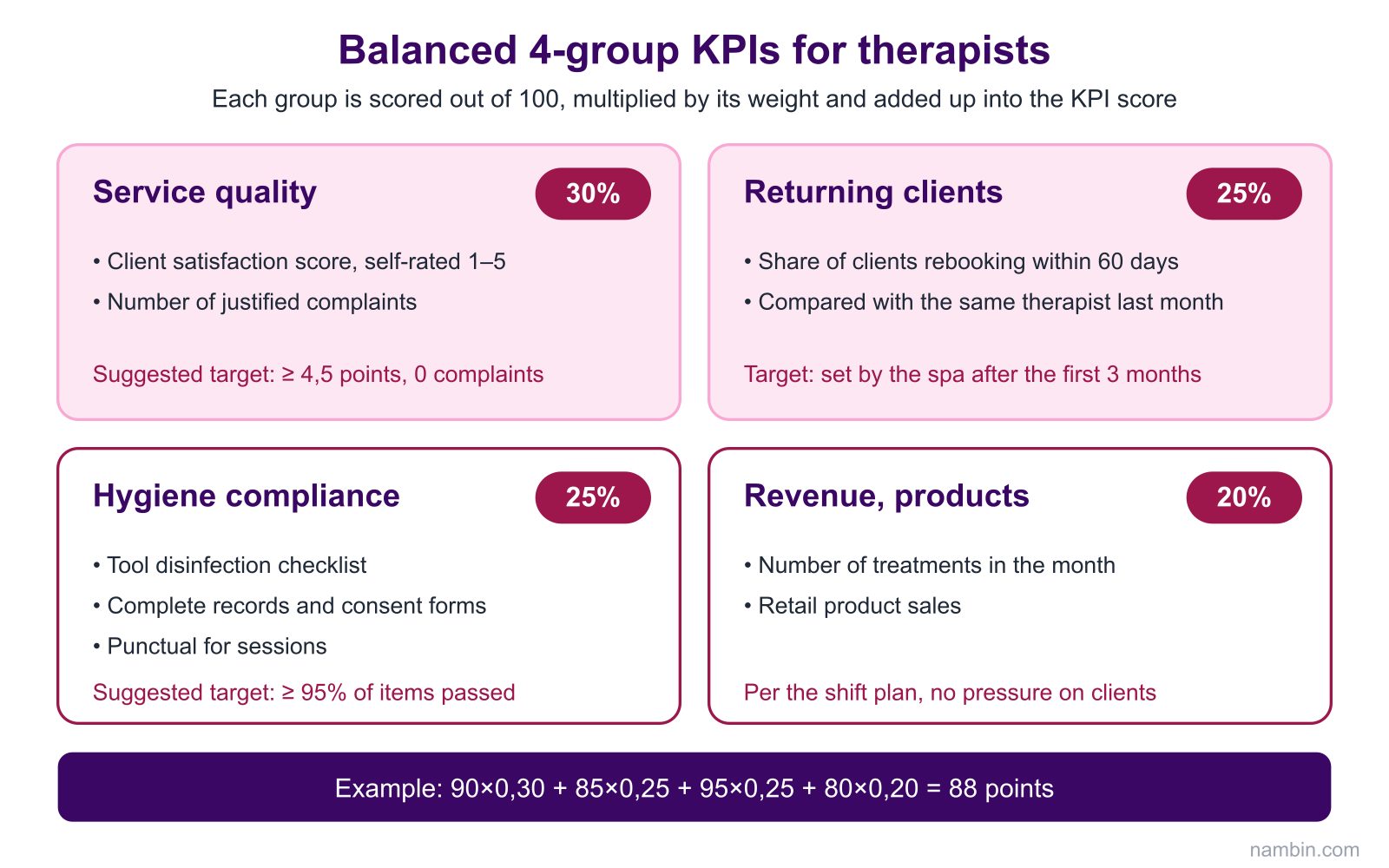
| Group (weighting) | Indicator | How it is measured | Suggested target |
|---|---|---|---|
| Quality (30%) | Satisfaction score after the session; number of justified complaints | 1–5 point feedback form completed by the client themselves or by text message; complaints log | Average ≥ 4.5; 0 justified complaints |
| Returning clients (25%) | Rate of clients rebooking within 60 days | Software or appointment book | Set by the spa based on data from the first 3 months |
| Compliance (25%) | Hygiene and disinfection checklist; complete client records and consent forms; sessions on time | Weekly random checks by the head therapist | ≥ 95% of items passed |
| Revenue (20%) | Number of sessions; retail product sales | Shift log, invoices | According to the shift plan, without pressure |
Example of converting scores: each group is scored out of 100 and then multiplied by its weighting. Lan scores 90 for quality, 85 for returning clients, 95 for compliance and 80 for revenue. KPI score = 90 × 0.30 + 85 × 0.25 + 95 × 0.25 + 80 × 0.20 = 27 + 21.25 + 23.75 + 16 = 88 points, which matches the bonus band in the pay example above.
When measuring: the feedback form is completed by the client alone, without the therapist standing next to them saying "please give me 5 stars"; the return rate depends on the season, so compare each therapist with their own previous month; serious hygiene breaches (using unwashed towels, not disinfecting tools) are handled under separate house rules, not just by deducting points. Each month, hold a private 15-minute meeting with each therapist to go through their score and ask what support they need.
Employment contracts and social insurance: principles every spa owner must know
Hiring therapists "by word of mouth", paying cash and skipping insurance looks like a saving, but it puts both owner and therapist at risk: pay disputes with no evidence, and no benefits when a therapist is ill or pregnant. The section below summarises the spirit of the Labour Code 2019 and social insurance legislation at the level of principles; when drafting contracts, the owner should refer to the current regulations or a qualified adviser.
Employment contracts
- Where there is work, payment of wages, and management and direction, it is an employment relationship, even if it is called "freelance collaborator".
- The contract is made in writing and states clearly the job, the workplace, the term, the wage and how it is paid, allowances, working and rest hours, insurance and training.
- There are indefinite-term and fixed-term contracts. Probation has a time limit and a minimum wage set by law; repeated probation periods to avoid signing a contract are not allowed.
- The pay, bonus and commission policy is written down and communicated before it is applied.
- Do not keep the originals of therapists' identity documents, diplomas or certificates, and do not require a cash deposit: the Labour Code prohibits employers from doing this.
Working hours and rest
- Normal working hours must not exceed 8 hours a day and 48 hours a week.
- Overtime requires the therapist's agreement, is limited, and is paid at a higher rate than normal hours.
- Therapists are entitled to a mid-shift break, weekly rest, public holidays and annual leave. A spa that opens 10–12 hours a day must split the day into shifts.
Social, health and unemployment insurance
- If a therapist falls within the compulsory insurance scheme, the spa must register and pay; the employee's share is deducted from wages and the employer's share is paid by the spa.
- Insurance gives therapists sickness, maternity, occupational accident and retirement benefits: a major reason for good therapists to stay.
- Build insurance costs into your cost price from the moment you set your price list.
Photo: Pedrofuocoandrade / Wikimedia Commons, CC BY 3.0

A therapist grade ladder and training: reasons to stay
Therapists usually leave because they cannot see where they are heading. A grade ladder with criteria and matching income levels answers the question "if I do well, where will I be in a year?"
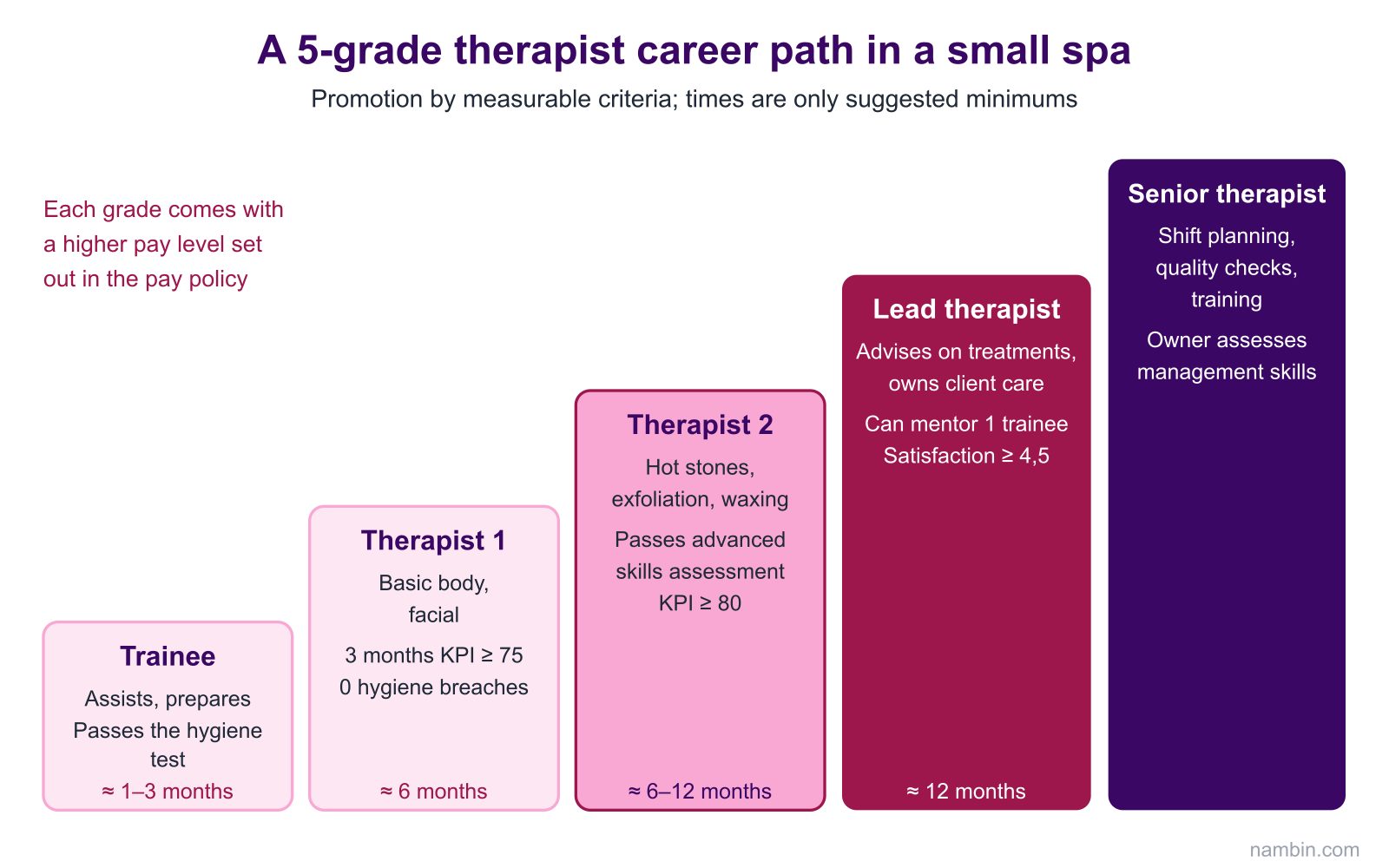
| Grade | Allowed to do | Criteria for the next grade |
|---|---|---|
| Trainee | Prepare rooms and towels, assist senior therapists, foot massage under supervision | Pass the hygiene and disinfection test; perform the basic procedure correctly in front of the head therapist |
| Therapist grade 1 | Body massage, basic skin care | 3 consecutive months with KPI ≥ 75; 0 hygiene breaches |
| Therapist grade 2 | Adds hot stone, exfoliation and waxing services | Pass the skills assessment for advanced services; KPI ≥ 80 |
| Senior therapist | Consults on treatment programmes, takes charge of treatment programme clients | Can mentor 1 trainee; satisfaction score ≥ 4.5 |
| Head therapist | Draws up shifts, checks quality, trains staff | Management ability assessed by the spa owner |
A simple training plan for a small spa
- 1–2 weeks of induction for new starters: house rules, disinfection, client records, the harassment reporting procedure.
- In-house training every month, 1–2 hours, counted as working time.
- A skills assessment every quarter using a marking sheet for each service.
- Support for external certificates; if the spa pays the course fees, draw up a written training agreement on the commitment period and how fees are repaid.
Occupational health: capping the number of clients per shift
Massage is physical labour; the wrists, thumbs, shoulders and lower back take repeated load. Therapists who take on too many sessions will develop pain, gradually work less well, and then leave.
Suggested house rules (the spa adjusts them to its services; these are not limits set by law):
- A maximum of about 5–6 hours of hands-on work on clients in an 8-hour shift, for example no more than 5 body sessions of 60 minutes, with the rest of the time for preparation, cleaning the room and breaks.
- A 10–15-minute break between two sessions to wash hands, stretch, drink water and prepare the room; do not schedule back-to-back sessions without a break.
- No more than 2 firm-pressure or deep-tissue massage sessions in a row; alternate them with lighter services such as facials.
- Allocate sessions fairly with a rotation board instead of letting therapists compete for clients.
- Proper equipment: height-adjustable treatment beds, a stool for facial work, enough towels so nobody has to run off to do laundry mid-shift.
- A therapist who reports pain is moved to lighter work and encouraged to see a doctor, without being seen as lazy.

Photo: Matt @ PEK from Taipei, Taiwan / Wikimedia Commons, CC BY-SA 2.0

Keeping therapists safe from harassing clients
Harassment can be crude language, comments about the body, requests for "extra services", deliberately exposing the body, touching the therapist, or sending propositioning messages after the session. The Labour Code 2019 prohibits sexual harassment in the workplace, and employers are responsible for preventing and dealing with it. For establishments offering massage services, Decree 96/2016/ND-CP (security and order conditions for certain businesses, including massage services), as amended by Decree 56/2023/ND-CP, sets security and public order conditions; a spa that follows these rules is also protecting its therapists and itself.
Prevention before anything happens
- Display the house rules at reception and on the booking page: the spa provides only wellness care and non-invasive beauty services; inappropriate behaviour will lead to the service being stopped.
- Treatment rooms cannot be locked from the inside; there is a call bell to reception within the therapist's reach.
- Reception knows which therapist is in which room and when they are expected to come out.
- Clients with a history of inappropriate behaviour are flagged; the spa has the right to refuse bookings.
- Therapists may choose not to take clients of the opposite sex for body services if they are not comfortable.
Procedure when it happens
- The therapist may stop the session immediately and say the standard phrase they have practised: "This behaviour is not in line with the spa's rules, so I am stopping the session." Leave the room; no further explanation is needed.
- Report to the manager or reception immediately using the call bell or in person. The manager goes to deal with the client; the therapist is never left to face them alone.
- The manager deals with the client: politely and firmly, asks the client to pay for the part of the service used, according to the house rules, and to leave the spa. If the client threatens anyone or behaves seriously, report it to the ward police.
- Write an incident report on the same day: time, room, the therapist's account, witnesses, and footage from cameras in common areas if available. Keep it confidential; only managers may see it.
- Support the therapist: let them take the rest of the shift off if needed, with no pay deduction and no blaming ("you must have done something"). Check in with the therapist again after 1–2 days.
- Learn from it at the shift meeting, without naming the therapist, so the whole team knows the spa stands by people who do the right thing.
Most important of all: therapists must trust that stopping a session because of harassment will never cost them money or get them blamed.
Common mistakes in managing people at small spas
| Mistake | Why it is dangerous or wrong | The right way |
|---|---|---|
| 10% commission on packages, paid as soon as the client pays | Pushes therapists to pressure-sell big packages; complaints; the service liability balloons | Low commission, paid on sessions used, with a cap and claw-back on refunds |
| Individual sales targets for each therapist | Therapists compete for clients and overstate results | Targets for the whole spa; balanced individual KPIs across 4 groups |
| Hiring therapists without a contract and paying cash | No evidence in a dispute; therapists have no insurance | Written contracts, a written pay policy, insurance paid as required |
| Keeping original certificates or demanding a deposit to "keep" staff | Breaches the Labour Code; destroys trust | Retain staff with a grade ladder, training and a good working environment |
| Scheduling back-to-back sessions without breaks on busy days | Therapists develop pain, work less well, suffer long-term injury | Cap sessions per shift; 10–15-minute breaks between sessions |
| Telling therapists to "humour the client a bit" when the client is inappropriate | Puts therapists in danger; may break the law | Therapists may stop the session; the manager deals with the client and writes an incident report |
Pass criteria for this lesson
You pass this lesson when you can do the following in front of your instructor:
- Correctly calculate a 6-line sample payslip from a set of assumptions given by the instructor, with an error of 0 VND, within 10 minutes.
- Correctly calculate the weighted 4-group KPI score for 2 hypothetical therapists and assign the correct bonus band.
- Identify at least 4 risk points in a sample commission policy and rewrite them as at least 4 safer rules.
- State at least 5 items that must be in a therapist's employment contract and 2 things the Labour Code prohibits employers from doing.
- Draw up an 8-hour shift schedule for 3 therapists, each doing no more than 5 body sessions of 60 minutes, with 10–15-minute breaks between sessions.
- Role-play as manager handling a situation where a client harasses a therapist, following all 6/6 steps, including an incident report.
Frequently asked questions
If we drop commission completely, will therapists still want to recommend products?
Keep a small commission on retail products, shared as a team. Therapists still have a reason to recommend products, but no reason to pressure clients.
Does a spa with only 2–3 therapists need a written pay policy?
Yes, even if it is only 1–2 pages. The smaller the spa, the more easily pay disagreements turn personal.
What if a therapist asks to work as a "freelancer" to avoid insurance deductions?
The label does not change the substance. If the therapist works shifts, under the spa's direction, and receives regular pay, it is an employment relationship. Explain the benefits of insurance to the therapist, and consult a qualified adviser on the specific case before doing anything that departs from the rules.
Further reading
See the career path from the therapist's point of view in the lesson Spa vocational certificates and career path: from therapist to opening a small spa, and review service standards when setting compliance KPIs in the lesson Spa safety and service skills test: 20 self-check questions, a practical exam and a marking scheme.