Tuan and his wife have run a 5-bed spa for two years. Client records live in three notebooks at reception, an Excel file on the receptionist's laptop and a few Zalo chat groups. Then came one bad week: the receptionist resigned and took the laptop with her, a therapist moved to the spa across the road and started messaging former clients, and a client arrived with a 20-session package form demanding a refund, saying she had used only 6 sessions while the notebook said 11. Nobody could prove who was right. At the end of the month, Tuan also discovered that the money from packages sold over Tet (Lunar New Year) had all been spent on renovating the rooms, while more than a hundred sessions that clients had already paid for had not yet been delivered.
At Levels 1–3 you learned to keep client records, consent forms and client confidentiality from the therapist's point of view. This lesson takes the spa owner's point of view: choosing a storage system, who can see what, how to back up, and how to manage prepaid packages so they are transparent for clients and safe for cash flow.
By the end of this lesson, you will be able to:
- Choose a record-keeping system (paper, software or a combination) and decide which data may be collected.
- Draw up a role-based access table and a backup schedule following the 3-2-1 rule.
- Write a complete prepaid package form: number of sessions, expiry date, suspension, transfer and refunds.
- Track sessions used with the client's signature and calculate refunds using a formula published in advance.
- Explain why prepaid money is a service liability (unearned revenue) and keep cash flow safe.
- State the main principles of the Law on Protection of Consumer Rights 2023 and Decree 13/2023/ND-CP on personal data protection that apply here.
Client records are an asset and a responsibility
Client records include contact details, the health questionnaire, contraindications, allergies, consent forms, notes from each session, before-and-after photos (if the client agrees) and package history. They help therapists work safely and help the spa keep its clients. But the health questionnaire is information about health status, which belongs to the category of sensitive personal data; if it leaks, the client is harmed, the spa loses its reputation and may face penalties.
The first principle: collect only what the service needs. A spa offering massage and skin care needs to know about allergies, relevant underlying conditions, pregnancy and medication that affects the skin; it does not need ID card numbers, income or marital status. Every box on the form must be able to answer the question "what is this collected for?"
Paper, software or a combination
| Criterion | Paper records | Spa management software |
|---|---|---|
| Initial cost | Low: notebooks, folders, a lockable cabinet | Monthly subscription fee, a computer or tablet |
| Client signature | Handwritten, clear, hard to dispute | Signed on screen or confirmed by OTP code, depending on the software |
| Access rights | Only via the cabinet key | Individual accounts, role-based rights, a log of who viewed what |
| Backup | Must be photographed or scanned regularly; easily lost to damp or fire | Usually backed up on a server; you should still export a copy regularly |
| Package tracking | Added and subtracted by hand, error-prone | Deducts sessions automatically, warns of expiry |
| Main risks | Lost notebooks, strangers reading them at reception | Leaked passwords, former staff still holding accounts, the provider closing its service |
A spa with fewer than 5 beds can start on paper, as long as it has a lockable cabinet and a procedure for photographing and storing records. Once there are more than a few hundred active clients or many packages being sold, software usually saves effort and reduces errors. The common approach is a combination: health questionnaires and consent forms are signed on paper and kept in a locked cabinet, and also entered into software to track appointments, packages and session notes. When choosing software, ask the provider: where is the data stored, can it be exported, and how do you get your data back if you stop subscribing?
Photo: MarkBuckawicki / Wikimedia Commons, CC0

Access rights and backups
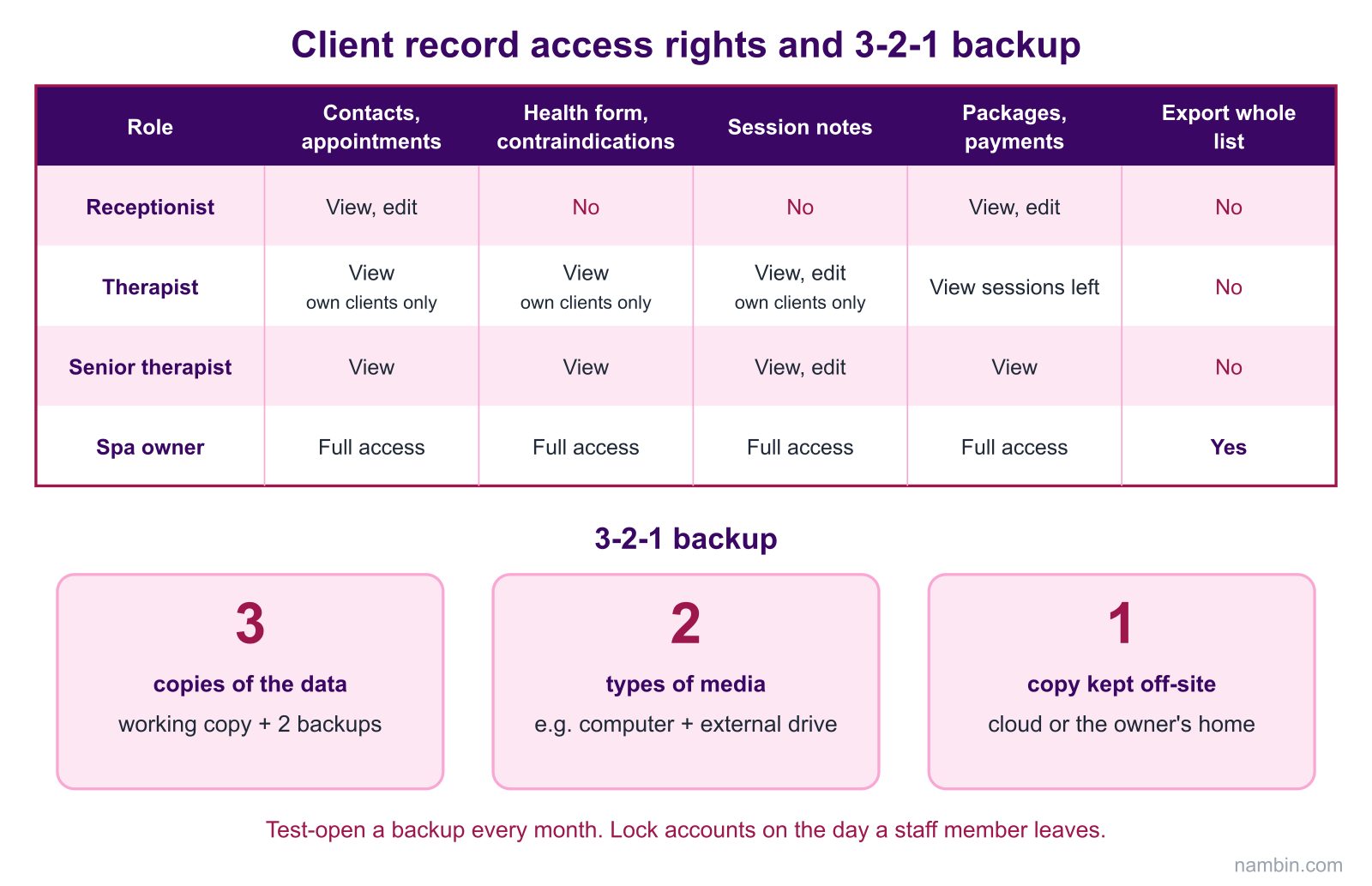
Access rights mean that each person can see only what they need for their own job. The receptionist needs the name, phone number, appointments and number of sessions remaining; they do not need to read the health questionnaire. A therapist needs the contraindications, allergies and previous session notes of the client they are currently treating; they do not need to download the phone list of all clients.
Minimum access rules
- One account per person, no shared "spa123" password. Only with individual accounts can you know who viewed or changed what.
- The right to export data (download lists, print everything) belongs only to the spa owner or a person authorised in writing.
- On the day an employee leaves: lock their account, change shared passwords (Wi-Fi, reception computer), collect the spa's devices, and remind them of the confidentiality commitment in their contract.
- Do not keep client records on personal phones or personal Zalo accounts. Contact clients through the spa's number or accounts.
- The reception screen faces away from clients and locks automatically after a few minutes of inactivity.
Backing up with the 3-2-1 rule
The 3-2-1 rule is an easy-to-remember way to back up: keep 3 copies of the data (the working copy and 2 backups), on 2 different types of media (for example a computer and an external hard drive), with 1 copy kept outside the spa (a cloud storage service with a strong password, or a hard drive the owner keeps at home). A small spa can do it like this:
- At the end of each day: the software syncs automatically to the provider's server, or the receptionist photographs the forms signed that day using the spa's device.
- At the end of each week: the owner exports the data to an external hard drive that is password-protected or encrypted.
- Every month: try opening one backup to make sure it can be read. A backup that has never been test-opened should be treated as if it does not exist.
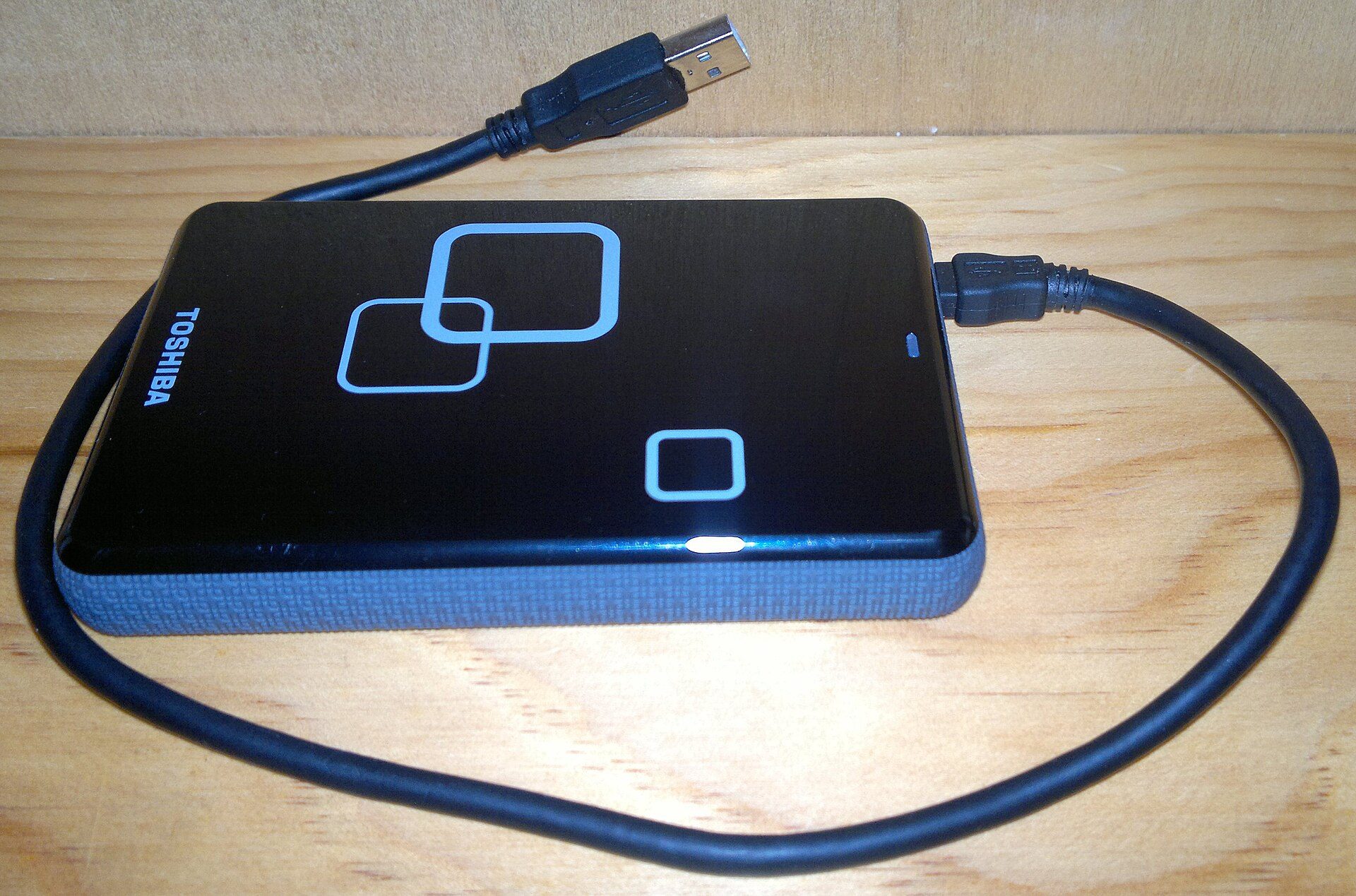
Photo: Editor182 ( talk ) / Wikimedia Commons, Public domain

Decree 13/2023/ND-CP: the principles a spa owner needs to know
Decree 13/2023/ND-CP on personal data protection sets out principles that a spa, as the party collecting and processing client data, must follow. At the level of principles:
- Obtain the client's consent for each purpose, clearly and voluntarily. Consent to use the health questionnaire for safe service is different from consent to receive promotional messages, which is different again from consent to use photos in advertising.
- Use data only for the stated purpose, collect the minimum and keep it only as long as necessary.
- Health information is sensitive data and needs stronger protection.
- Clients have the right to be informed, to view, to request correction, to request deletion and to withdraw consent (for example to stop receiving messages). The spa needs a person and a way to handle these requests.
- When data leaks (a lost device, a hack, an employee taking the client list), the spa must deal with it and notify as required, not stay silent.
Personal data law is being further developed at the level of statute, so spa owners should check the current regulations or ask a qualified adviser when drafting consent forms and the privacy policy. The general spirit does not change: collect little, use it correctly, guard it tightly, and respect the client's rights.
Prepaid treatment packages: what the form must state
A prepaid package is when the client pays once for several sessions. The Law on Protection of Consumer Rights 2023 requires businesses to provide complete and accurate information before a transaction; when using standard-form contracts or general terms and conditions, these must be made public and the client given enough time to read them, and terms that are unreasonably disadvantageous to the client (for example allowing the spa to change the service at will or excluding all liability) may be invalid. A good package form is one that a stranger could read and understand.
| Item on the form | Example of clear wording | Vague wording that invites disputes |
|---|---|---|
| Service name, length of each session | Hydrating facial, 75 minutes/session | "Skin treatment programme" |
| Number of sessions, package price, single-session price | 10 sessions, 4,000,000 VND; single session 500,000 VND | "Special offer package" |
| Expiry date | 6 months from the date of purchase, until 15/05/2027 | "Use as you like" |
| Suspension | Can be suspended for up to 3 months for health reasons or pregnancy, with advance notice | Not stated |
| Transfer | Can be transferred to another person; the recipient completes a new health questionnaire | Not stated |
| Refunds | A clear formula (see below), refund paid within 7 working days | "No refunds, no exchanges" without telling the client in advance |
| If the spa closes or moves | Advance notice, refund of unused sessions | Not stated |
| Signatures | Client and spa representative, each keeps a copy | Only the spa keeps it |
The figures in the table are examples; each spa sets its own policy, writes it clearly and applies it equally to every client.
Photo: Blogtrepreneur / Wikimedia Commons, CC BY 2.0

Tracking sessions used with the client's signature
A dispute like "I've only used 6 sessions" can only be resolved when every session carries the client's confirming signature. The back of the package form (or the software screen) has a tracking table: session number, date, service, therapist, client signature and sessions remaining.
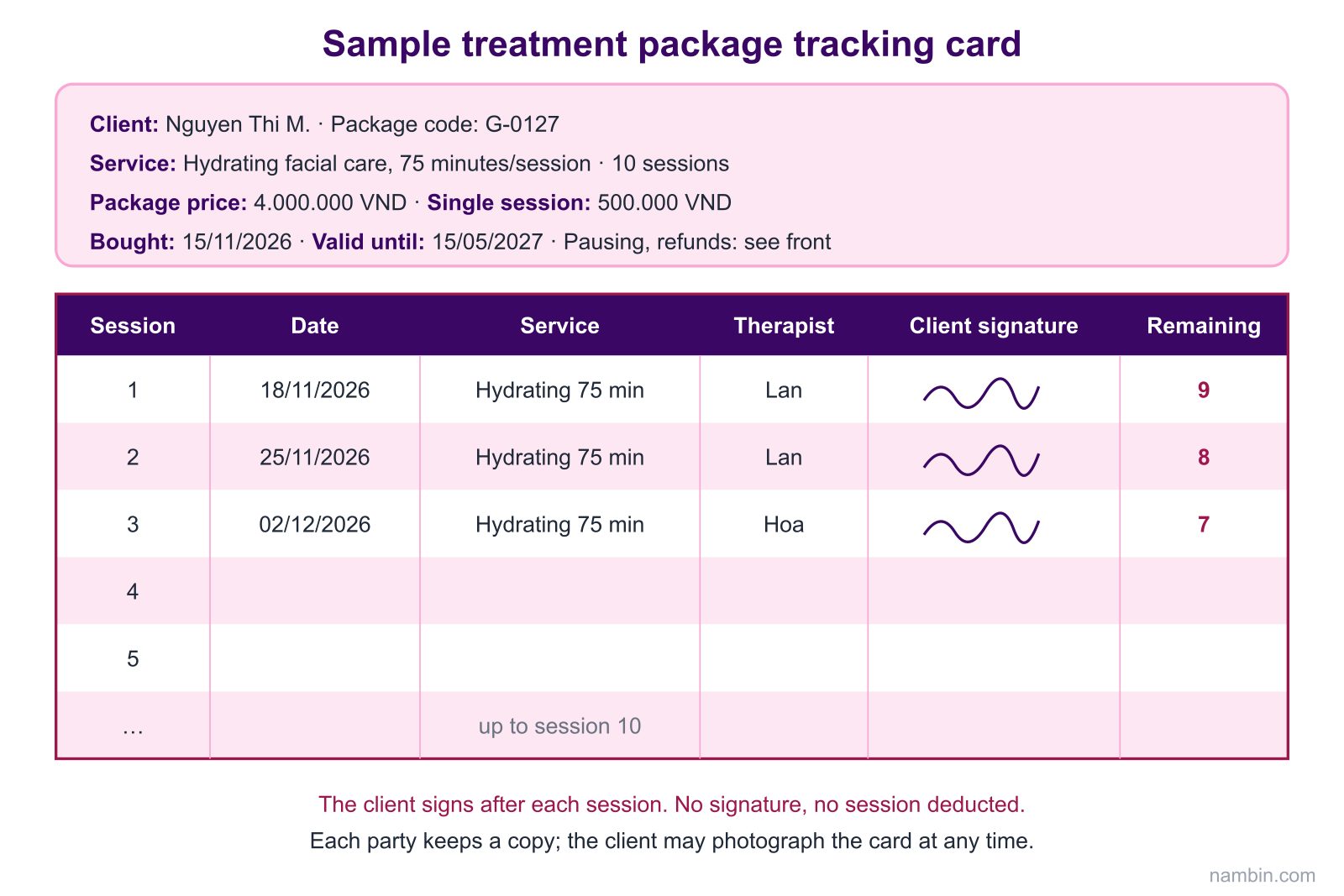
- The client pays at reception and receives an invoice or receipt showing the package code. The money goes into the spa's account or till, not into an employee's personal account.
- The receptionist fills in the package form and reads out the expiry, suspension and refund terms to the client; both parties sign and the client keeps a copy.
- At each session, once the treatment is finished, the client signs that session's line; the receptionist writes the number of sessions remaining and enters it into the software the same day.
- The software or notebook flags packages 30 days before they expire; the receptionist messages the client once through a channel the client has agreed to.
- At the end of the month, the manager checks the number of signed sessions on the forms against the sessions therapists have reported for pay; any discrepancy is investigated immediately.
A worked refund example with assumed figures
Assumptions: a 10-session package priced at 4,000,000 VND (that is, 400,000 VND/session at the package price), with a published single-session price of 500,000 VND. The client has signed for 3 sessions and asks for a refund because she is being relocated for work.
- Method A, deducting at the package price: 4,000,000 − 3 × 400,000 = 2,800,000 VND refunded.
- Method B, deducting at the single-session price: 4,000,000 − 3 × 500,000 = 2,500,000 VND refunded. The reasoning: the client received the package discount but did not use the full package.
Both methods can be acceptable if they are written on the form from the start and the client has read them before signing. What is not acceptable is inventing the method only when the client asks for a refund, or adding a "fee" that was never mentioned.
Prepaid money is a service liability, not yet revenue
This is something many small spa owners get wrong. When a client pays 4,000,000 VND for 10 sessions, the spa has not yet earned 4,000,000. The spa owes the client 10 sessions of service. In accounting this is called unearned revenue (deferred revenue): a liability to be repaid in services. Only when the client has used each session does the spa recognise the corresponding revenue, in this example 400,000 VND per session.
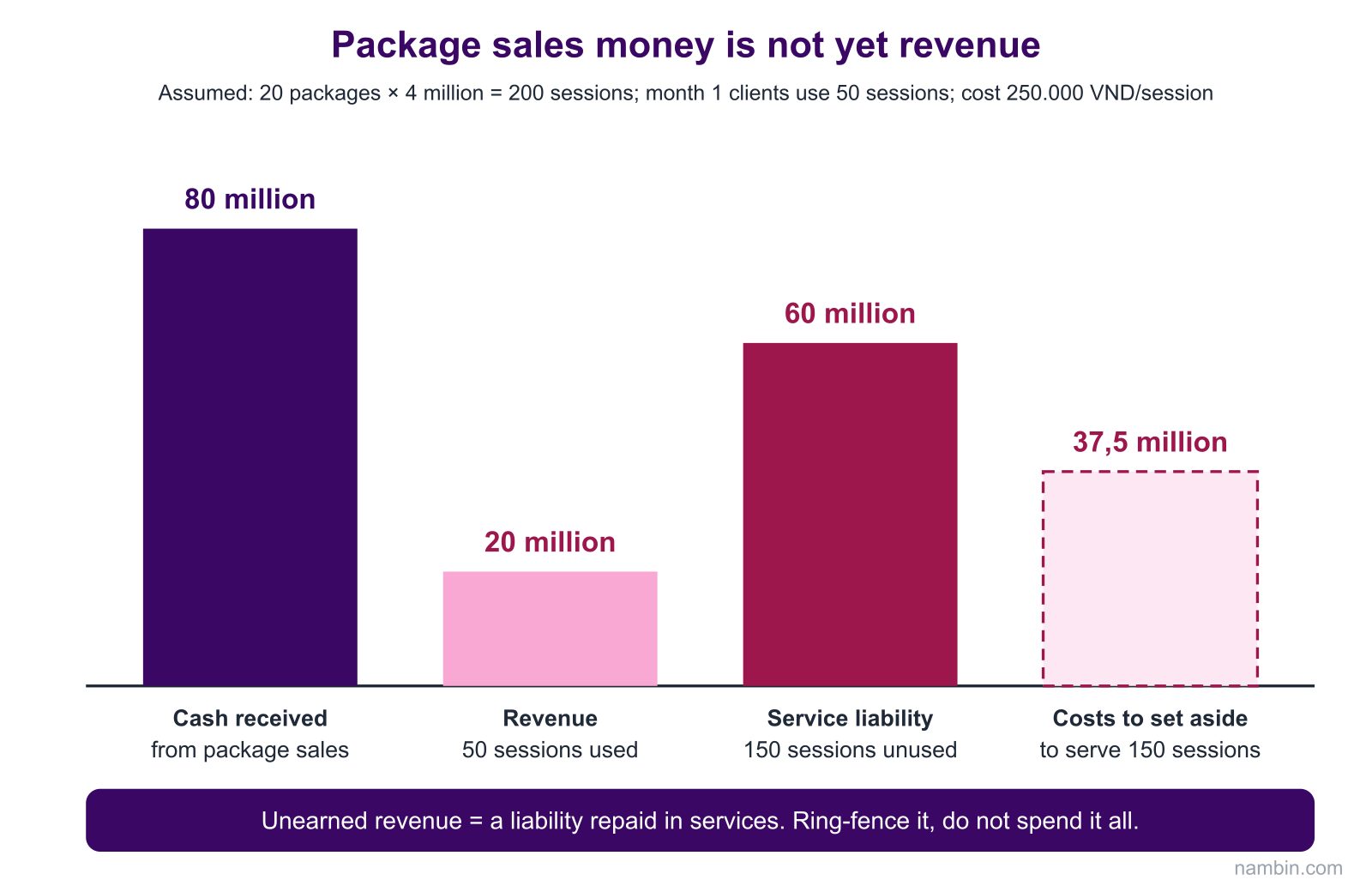
A worked cash-flow example with assumed figures
Assumptions: in January the spa sells 20 packages × 4,000,000 = 80,000,000 VND, a total of 200 sessions to deliver. In January clients use 50 sessions. The direct cost of delivering one session (therapist session pay, products, towels, electricity and water) is assumed to be 250,000 VND.
| Item | Calculation | Amount (VND) |
|---|---|---|
| Cash received from package sales | 20 × 4,000,000 | 80,000,000 |
| Revenue earned in January | 50 sessions × 400,000 | 20,000,000 |
| Remaining service liability (unearned revenue) | 150 sessions × 400,000 | 60,000,000 |
| Expected cost of delivering the remaining 150 sessions | 150 × 250,000 | 37,500,000 |
If the owner sees 80 million in the account and spends it all on renovations, as Tuan did, then in the following months the spa still has to pay therapist session pay and buy products for 150 sessions without any new income from those sessions. That is when a spa has to sell new packages to fund the old ones, a very dangerous spiral, and the reason many spas close down leaving clients holding package forms they can no longer use.
Keeping cash flow safe
- Separate the funds: keep at least the cost of delivering the sessions still owed (37,500,000 in the example) in a separate account, not used for investment.
- Report three figures every month: total sessions still owed, the value of the service liability, and the balance of the reserve fund.
- Limit package size: do not sell packages whose number of sessions or validity exceeds the spa's capacity to deliver (number of beds, number of therapists).
- Ask an accountant to record unearned revenue correctly and to file taxes according to the rules for the spa's type of business (household business or company).
Common mistakes in managing records and packages
| Mistake | Why it is dangerous or wrong | The right way |
|---|---|---|
| Health questionnaires left at reception where other clients can see them | Sensitive data leaks | A locked cabinet in the manager's office; role-based software access |
| The whole spa shares one password | No way of knowing who viewed or changed what; leavers can still log in | One account per person, locked on the day they leave |
| Client records on a therapist's personal Zalo | A departing therapist takes clients with them; data is out of control | Contact clients through the spa's number and accounts |
| Backing up but never test-opening the backup | You only find out the copy is broken when you need it | Test a restore every month |
| Package forms with no expiry date or refund policy | Disputes and client complaints | State every item; the client signs and keeps a copy |
| Deducting sessions without the client's signature | No way to prove how many sessions were used | The client signs after every session |
| Treating package money as profit and spending it all | Not enough money to deliver the sessions still owed | Separate reserve fund; monthly service liability report |
Pass criteria for this lesson
You pass this lesson when you can do the following in front of your instructor:
- Draw up an access table for 4 roles (receptionist, therapist, head therapist, spa owner) with 3 levels, view – edit – export, with no role having more rights than its job requires.
- Describe a 3-2-1 backup schedule for your spa, correctly stating the 3 copies, 2 media, 1 copy outside the spa, and the restore-test schedule.
- Write a prepaid package form covering all 8/8 items in the table, within 15 minutes.
- Correctly calculate the refund using both Method A and Method B for 2 hypothetical cases, with an error of 0 VND.
- Correctly calculate revenue earned, the service liability and the costs to be set aside for a hypothetical month.
- State at least 4 principles on personal data and 2 requirements on information and standard-form contracts under the Law on Protection of Consumer Rights 2023.
Frequently asked questions
How long should client records be kept before they can be destroyed?
Keep them for as long as the service requires and long enough to resolve any complaints that may arise; the spa sets its own retention period, states it in the privacy policy, and asks a qualified adviser about retention periods for accounting documents. When destroying records, destroy them completely: shred the paper, and delete the backups too.
What if a client asks for their data to be deleted but still has unused sessions in a package?
Explain that the spa needs to keep the package information and health questionnaire to deliver the remaining sessions safely. You can stop sending promotional messages straight away. When the package ends or is refunded, delete what is no longer needed.
Should we sell packages with no time limit to please clients?
No. A package with no expiry is a service liability with no known end. Set an expiry date that is reasonable for the number of sessions, together with a suspension policy for valid reasons.
Further reading
Review the health questionnaire from the service point of view in the lesson Spa client consultation and the health questionnaire: asking the right questions to work safely, and how to follow a multi-session treatment programme in the lesson Delivering a complete 90-minute spa treatment: from welcoming the client to the client record.