The owner of a four-bed spa in Binh Thanh District says: "Every weekend we are fully booked, yet at the end of the month, after paying the rent and wages, there is almost nothing left." Asked how she sets her prices, she replies: "The shop next door charges 350 thousand for a 60-minute massage, so I charge 330 to be cheaper." That is the most common way small spas set prices, and it is also why many busy spas still lose money. The shop next door's price is based on their costs, not yours. At Level 4 you must be able to answer for yourself: how much a service costs the spa, and what price makes a profit.
By the end of this lesson, you will be able to:
- Break down the cost of a service into three parts: direct costs, therapist pay and allocated fixed costs.
- Calculate the cost of cosmetics from the actual dose used, and the cost of towels and disposables for each service.
- Calculate the fixed cost per bed-minute based on utilisation, including room turnaround time.
- Set the selling price from a target profit margin, and distinguish profit margin from markup on cost.
- Calculate the number of client visits needed to break even each month, and understand how utilisation affects profit and loss.
- Design a concise menu with clearly displayed prices, no hidden surcharges and no claims of treatment results.
Why cost by the bed-minute
What a spa really sells is the time of a treatment bed with a therapist standing beside it. Premises, electricity, reception and booking software all cost money whether the bed has a client or not. An empty bed at 3 pm on a Tuesday is a cost already paid that can never be "saved up" and sold later.
So the most sensible unit of costing is the bed-minute: one bed occupied for one minute, including both service time and room turnaround time. A 60-minute massage that needs 15 minutes of turnaround occupies the bed for 75 minutes; nobody pays separately for those 15 minutes, so they must be built into the price.
Three concepts you will use throughout this lesson:
- Available bed-minutes: number of beds × opening minutes per day × opening days in the month.
- Sold bed-minutes: the total number of bed-minutes actually occupied by clients, including service time and turnaround time after each client.
- Utilisation: sold bed-minutes ÷ available bed-minutes, expressed as a percentage. Also called occupancy.
The three layers of a service's cost
Cost (what it costs to deliver one service) has three layers. The first two vary with each client, so they are called variable costs. The third layer is fixed costs: they must be paid every month and are then spread evenly across the sold bed-minutes.
| Cost layer | Includes | How to calculate |
|---|---|---|
| 1. Direct costs | Cosmetics and massage oil by dose; towel laundering; disposables (paper bed covers, paper briefs, gloves, cotton pads, headbands); tea and water offered to clients | Dose × price per ml or gram; number of towels × laundering cost per towel; add up each disposable item |
| 2. Therapist pay | Per-treatment fee ("tour" fee), service commission, or the share of basic salary converted into service minutes | Service minutes × pay rate per minute, or the fixed per-treatment fee for each service |
| 3. Allocated fixed costs | Rent, electricity and water, reception and manager salaries, depreciation of beds and devices, maintenance, software, advertising, licence fees | Monthly fixed costs ÷ sold bed-minutes, then multiplied by the bed-minutes the service occupies (including turnaround) |
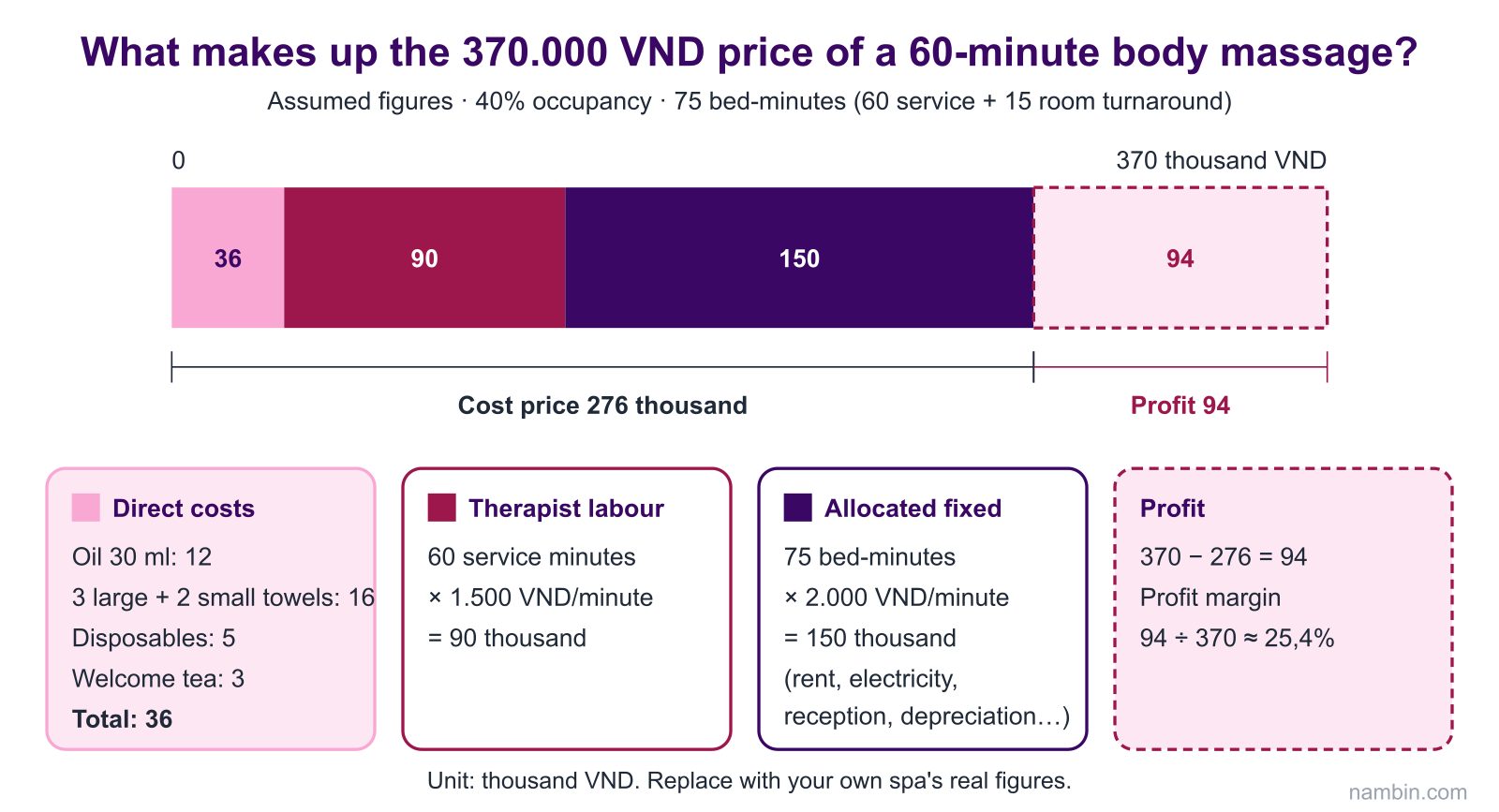
The most common mistake is to count only layers 1 and 2 and forget layer 3, which is usually the heaviest layer for a spa renting a street-front property.
Layer 1: direct costs calculated by dose
Do not estimate "about how many clients one bottle will do". Calculate from the standard dose written in the procedure; the stock management lesson will use this same standard to check for wastage.
How to convert to a price per ml or per gram
- Take the purchase price of one bottle or jar, including tax and delivery.
- Divide by the volume that can actually be used. Pump bottles usually leave some at the bottom; if you typically lose about 5%, divide by 95% of the volume.
- Multiply by the standard dose for the service.
Hypothetical example: ready-blended base massage oil, 1-litre bottle at 400,000 VND, i.e. 400 VND per ml. The standard dose for a 60-minute body massage is 30 ml, so the oil costs 30 × 400 = 12,000 VND. To keep things simple, the examples in this lesson do not deduct what is left at the bottom of the bottle; in practice you should deduct it.
Towels and disposables
Towels carry two kinds of cost: laundering (outsourced, or electricity, water, detergent and labour if you wash in-house) and wear (frayed or stained towels must be replaced). Combine them into a cost per use. Hypothetical example: 4,000 VND per large towel, 2,000 VND per small towel. For disposables, add up each item at its purchase price divided by the number in the pack.
| Item (60-minute body massage) | Standard quantity | Hypothetical unit price | Amount |
|---|---|---|---|
| Blended massage oil | 30 ml | 400 VND/ml | 12,000 VND |
| Large towels (cover, drape, wipe) | 3 | 4,000 VND each | 12,000 VND |
| Small towels | 2 | 2,000 VND each | 4,000 VND |
| Paper briefs, paper bed cover | 1 set | 5,000 VND/set | 5,000 VND |
| Tea offered after the service | 1 serving | 3,000 VND | 3,000 VND |
| Total direct costs | 36,000 VND |
For facials, the cosmetics share is much larger. Hypothetical example for a basic 75-minute facial: cleanser 3 ml × 1,000 VND = 3,000 VND; exfoliant 3 g × 3,000 VND = 9,000 VND; serum 1 ml × 30,000 VND = 30,000 VND; one sheet mask 25,000 VND; moisturiser and sunscreen 2 g × 10,000 VND = 20,000 VND. Total cosmetics 87,000 VND. Add towels (2 large, 3 small) 14,000 VND and disposables (make-up remover pads, gloves, headband, spatulas) 10,000 VND, and the direct cost is 111,000 VND. Cheap products of unknown origin are not a saving worth making.
Layer 2: therapist pay
Small spas in Vietnam usually pay therapists in one of three ways: basic salary, a per-treatment fee (a fixed amount per service, known locally as a "tour" fee), or a low basic salary plus per-treatment fees. Whichever method you use, when costing you convert it into pay per service minute.
- Per-treatment fee: use the exact fee for the service. Hypothetical example: 1,500 VND per service minute, so a 60-minute massage is 90,000 VND.
- Basic salary: take the therapist's total salary and compulsory contributions for the month and divide by the number of minutes the therapist actually spends serving clients (not the minutes present). If a therapist is present for 8 hours but serves clients for only 5, divide by 5 hours.
With a basic salary, the time the therapist spends waiting for clients is really a fixed cost; you may put it into layer 3 instead, as long as you do not count it twice. Do not squeeze prices by cutting therapist pay: when income is low, skill and attitude are the first things to decline.
Layer 3: fixed costs divided by sold bed-minutes
This is the layer that decides profit or loss, and it is also the layer that depends on utilisation. With the same rent, each bed-minute carries less in a busy month and more in a quiet one.
Hypothetical example: a 4-bed spa
All figures below are hypothetical numbers for practising the calculation, not market prices. Replace them with your own spa's real figures.
| Monthly fixed cost item | Hypothetical amount |
|---|---|
| Rent | 25,000,000 VND |
| Reception and manager salaries (including compulsory contributions) | 16,000,000 VND |
| Electricity, water, internet | 7,000,000 VND |
| Depreciation of beds, devices and furniture, plus maintenance | 4,600,000 VND |
| Booking software, advertising, fees, other expenses | 5,000,000 VND |
| Total fixed costs | 57,600,000 VND |
- Available bed-minutes: the spa opens 10:00–20:00, i.e. 10 hours = 600 minutes a day, 30 days a month. 4 beds × 600 minutes × 30 days = 72,000 bed-minutes.
- Sold bed-minutes: last month's booking log shows total service time plus turnaround of 28,800 minutes. Utilisation = 28,800 ÷ 72,000 = 40%.
- Fixed cost per bed-minute: 57,600,000 ÷ 28,800 = 2,000 VND.
- Allocation to the service: a 60-minute massage plus 15 minutes of turnaround is 75 bed-minutes, carrying 75 × 2,000 = 150,000 VND of fixed costs.
Note step 3: divide by sold bed-minutes. Dividing by the 72,000 available minutes gives 800 VND per minute, which assumes the beds are 100% full; the resulting price is far too low and the spa slowly loses money without knowing why.
When utilisation changes, the cost per minute changes
| Utilisation | Sold bed-minutes | Fixed cost per minute | Share carried by a 75-bed-minute session |
|---|---|---|---|
| 30% | 21,600 | about 2,667 VND | 200,000 VND |
| 40% | 28,800 | 2,000 VND | 150,000 VND |
| 50% | 36,000 | 1,600 VND | 120,000 VND |
| 60% | 43,200 | about 1,333 VND | 100,000 VND |
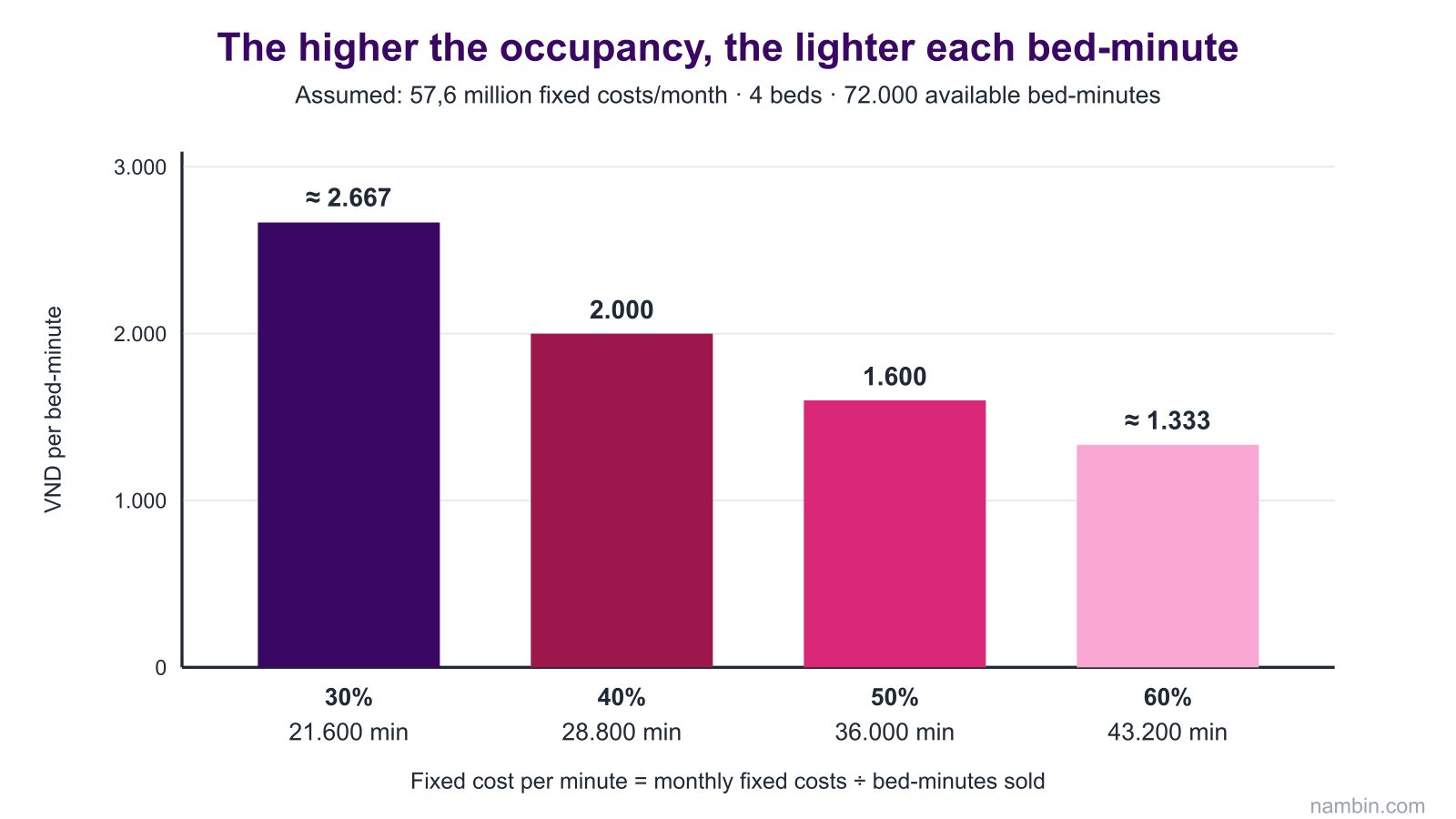
When setting prices, use the actual average utilisation of the last 2–3 months, not the figure from your busiest month.
Turnaround time is money
You learned room turnaround between clients (changing towels, wiping contact surfaces, disinfecting tools, airing the room) at Level 1. Do not cut cleaning steps short to "save minutes"; if you want to be faster, prepare towel and tool trays in advance and write a room turnaround SOP (next lesson). Every client visit takes almost the same turnaround time, so the shorter the service, the more "expensive" this part becomes per service minute.
From cost to selling price: profit margin
Add up the three layers for the hypothetical 60-minute body massage:
- Direct costs: 36,000 VND
- Therapist pay: 60 × 1,500 = 90,000 VND
- Fixed costs: 75 × 2,000 = 150,000 VND
- Cost: 36,000 + 90,000 + 150,000 = 276,000 VND
Profit margin is not the same as markup
Profit margin is profit calculated on the selling price. Markup is profit calculated on cost. The two give different results, and confusing them is a very common mistake.
- For a 25% profit margin: selling price = cost ÷ (1 − 25%) = 276,000 ÷ 0.75 = 368,000 VND. Round to a listed price of 370,000 VND. Profit 370,000 − 276,000 = 94,000 VND, profit margin 94,000 ÷ 370,000 ≈ 25.4%.
- If you simply "add 25% to cost": 276,000 × 1.25 = 345,000 VND. Profit 69,000 VND, but the profit margin is only 69,000 ÷ 345,000 = 20%.
The profit margin must be enough to cover tax under your business form, card and e-wallet fees, a reserve for client cancellations and member discounts, and only then leave a profit for the owner. For your specific tax obligations, ask your accountant or the tax office.
The selling price must pass three tests
- Market test: compare with spas in the same segment in your area; if yours is much higher, review your costs before cutting the price.
- Client test: will your clients pay that price for your current quality?
- Low-utilisation test: if utilisation drops to 30%, does this price still make a profit? At 370,000 VND, the cost would then be 36,000 + 90,000 + 200,000 = 326,000 VND, profit 44,000 VND, a profit margin of only about 11.9%. If it rises to 60%, the cost is 226,000 VND, profit 144,000 VND, a profit margin of about 38.9%.
A costing table for the whole menu
Do the same for each service and you will see things that are invisible when you price by feel. All figures below are hypothetical: 40% utilisation, fixed cost 2,000 VND per bed-minute, therapist pay 1,500 VND per service minute, 15 minutes' turnaround, target profit margin 25%.
| Service | Bed-minutes | Direct | Therapist pay | Fixed | Cost | Listed price | Profit margin |
|---|---|---|---|---|---|---|---|
| Neck and shoulder massage 30 minutes | 30 + 15 = 45 | 19,000 | 45,000 | 90,000 | 154,000 | 210,000 | about 26.7% |
| Body massage 60 minutes | 60 + 15 = 75 | 36,000 | 90,000 | 150,000 | 276,000 | 370,000 | about 25.4% |
| Body massage 90 minutes | 90 + 15 = 105 | 40,000 | 135,000 | 210,000 | 385,000 | 520,000 | about 26.0% |
| Basic facial 75 minutes | 75 + 15 = 90 | 111,000 | 112,500 | 180,000 | 403,500 | 540,000 | about 25.3% |
Three lessons from the table:
- Short services cost more per minute: the cost per service minute of a 30-minute massage is 154,000 ÷ 30 ≈ 5,133 VND, against 276,000 ÷ 60 = 4,600 VND for 60 minutes, because the 15 minutes of turnaround are spread over fewer minutes. Do not price 30 minutes at half the 60-minute price.
- Long services do not need one and a half times the price: the cost of 90 minutes is 385,000 VND, lower than 1.5 times the 60-minute cost (414,000 VND), because the room is still turned around only once.
- Facials depend on cosmetics: change the serum or mask and the cost changes immediately; it must be recalculated.
Break-even point: how many clients you need each month
The contribution of a service is the selling price minus variable costs (layers 1 and 2). It is the amount each client visit contributes towards fixed costs; only once fixed costs are covered is what remains profit.
- Contribution of a 60-minute body massage: 370,000 − (36,000 + 90,000) = 244,000 VND.
- Break-even visits if this were the only service sold: 57,600,000 ÷ 244,000 ≈ 236.1, rounded up to 237 visits a month, about 8 visits a day.
- Converted into utilisation: 237 × 75 = 17,775 bed-minutes, i.e. 17,775 ÷ 72,000 ≈ 24.7% utilisation.
In other words, the spa must fill about a quarter of its bed time just to avoid a loss. This figure helps you decide whether to add beds or extend opening hours: each extra bed increases fixed costs and only pays off when there are clients to fill it.
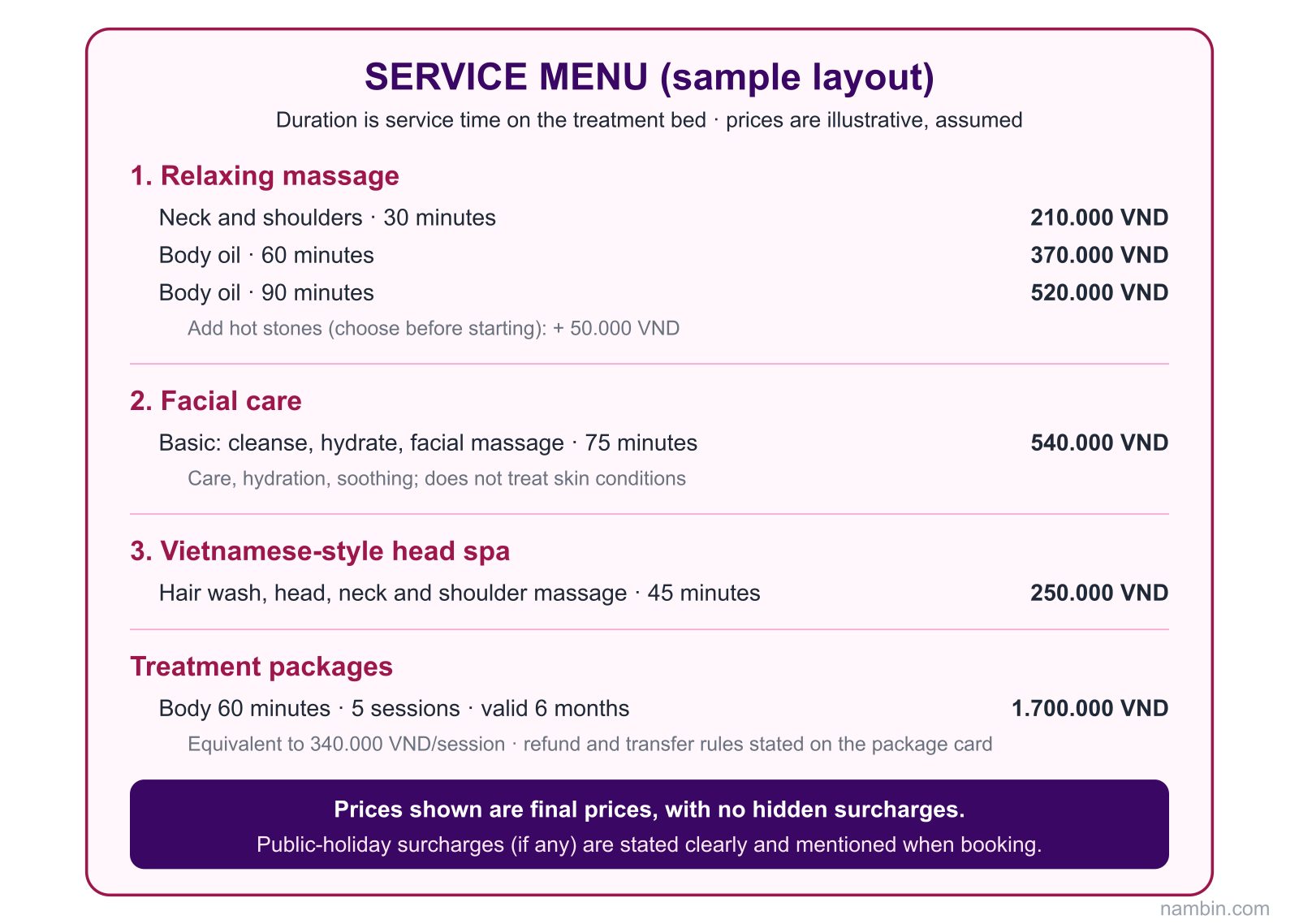
Designing a concise menu with clear prices and no hidden surcharges
A three-page menu, "miracle" service names and prices shown as "from 199k" put clients off and easily lead to disputes at payment.
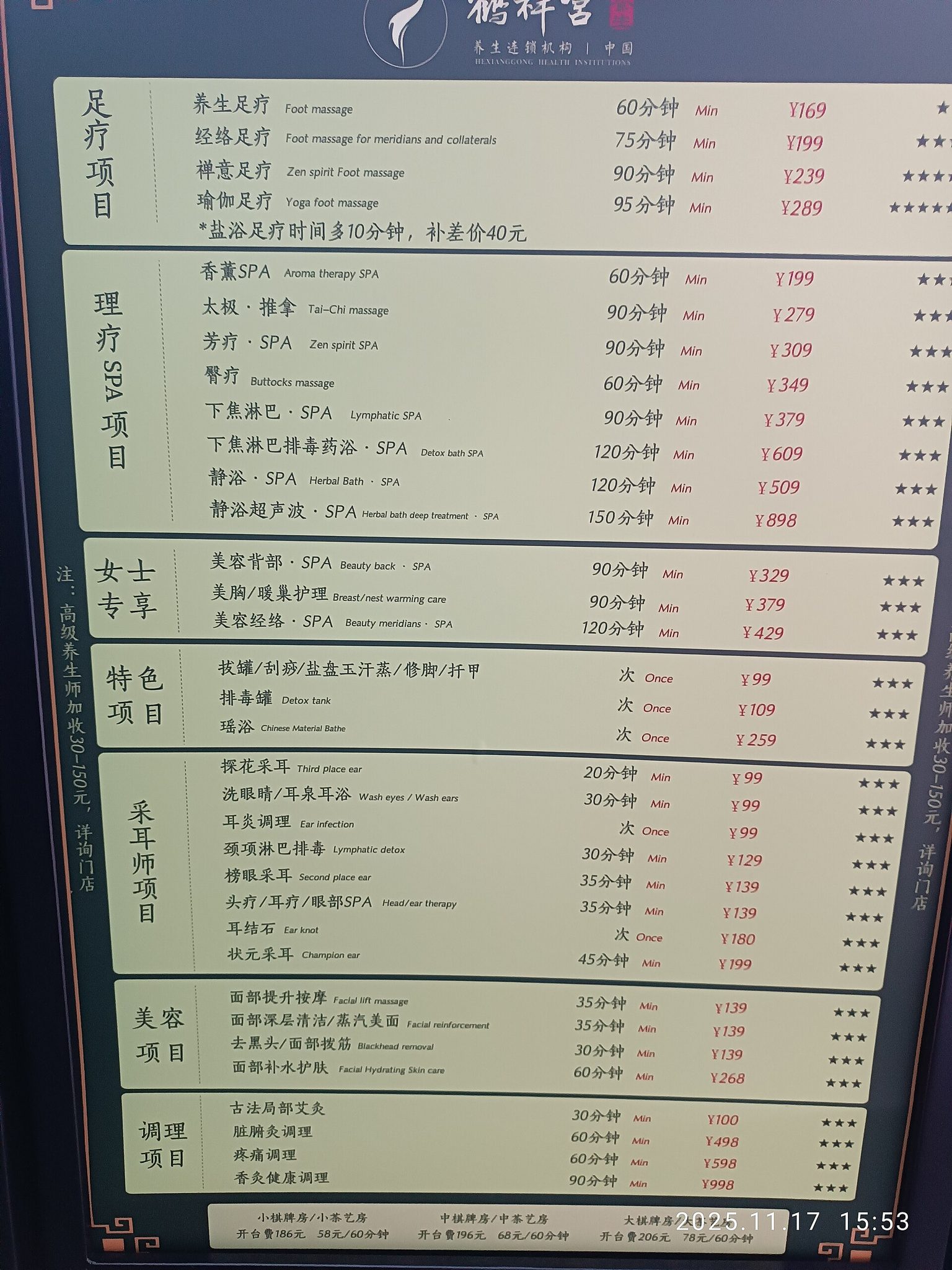
Photo: BEien Sahwo TAoo MMP / Wikimedia Commons, CC0

Design principles
- Few but clear: a small spa should keep about 8–15 services in 3–4 groups. Consider dropping services that few people buy but that need their own cosmetics, because every extra product means extra stock.
- Each service shows everything: an easy-to-understand name, time on the treatment bed, the main steps, the price.
- The listed price is the price the client pays: no "from…", and no client finding out on arrival that it "does not include essential oil or hot towels". Optional extras (for example hot stones) are shown with their name and price right alongside.
- Surcharges disclosed in advance: holiday or out-of-hours surcharges, if any, are printed on the menu and repeated at booking. No fees appear for the first time at the desk.
- Treatment programme packages stated clearly: number of sessions, package price, price per session, validity period, refund or transfer rules.
- Honest descriptions: write "relaxing, helps ease muscle tension, hydrating, soothing"; do not write "melasma treatment", "rapid fat loss" or "cures back pain". The Advertising Law 2012 requires advertising to be truthful and not misleading; treatment belongs to licensed medical examination and treatment facilities under the Law on Medical Examination and Treatment No. 15/2023/QH15.
- Consistent everywhere: the printed menu, the price board at the desk, the social media page and the booking page all show the same price; when you change it, change it everywhere on the same day.
Promotions that do not destroy your prices
Promotions should be used to fill off-peak hours, when the beds would be empty anyway, for example 15% off from 10:00–14:00 on weekdays. The discounted price must be above variable costs: a 60-minute massage at 15% off is 314,500 VND; minus variable costs of 126,000 VND it still contributes 188,500 VND. Discount below variable costs and every client who comes in increases your loss. State the promotion's conditions clearly on the offer itself.
Photo: Matt @ PEK from Taipei, Taiwan / Wikimedia Commons, CC BY-SA 2.0

Pricing procedure for a new service
- Write the service procedure: steps, durations, total service minutes.
- Set the material standards: have 2–3 therapists try it out, measure the amounts actually used, and fix the standard dose.
- Calculate direct costs from invoiced purchase prices, and therapist pay according to the pay method in use.
- Measure the actual turnaround time (hot stones and mud wraps usually take longer) and add it to the bed-minutes.
- Multiply the bed-minutes by the fixed cost per minute at the most recent average utilisation.
- Set the price from the target profit margin, round it, and run the three tests.
- Put it on the menu with an honest description; note the costing date so you can review it every quarter or whenever costs change.
Photo: Missvain / Wikimedia Commons, CC BY 4.0

Common mistakes in pricing and menu design
| Mistake | Why it is wrong or dangerous | The right way |
|---|---|---|
| Taking the shop next door's price and knocking a little off | Every spa's costs are different; you can easily sell below cost without knowing | Calculate your own cost first; use competitors' prices only for comparison |
| Counting only cosmetics and therapist fees | Leaves out fixed costs, usually the heaviest layer | Always add all three layers |
| Dividing fixed costs by available bed-minutes | Implicitly assumes 100% full beds; the price is far too low | Divide by sold bed-minutes at actual utilisation |
| Not counting turnaround time | Every visit leaves 10–20 bed-minutes that nobody has paid for | Bed-minutes = service minutes + turnaround minutes |
| Confusing profit margin with markup | You think you make 25% but actually make only 20% | Selling price = cost ÷ (1 − profit margin) |
| Pricing 30 minutes at half the 60-minute price | The short service loses money because it carries the full turnaround time | Cost each service separately by bed-minutes |
| Writing "prices from…", adding surcharges at the desk | Clients feel cheated; disputes and bad reviews | The listed price is the payment price; any surcharges stated clearly in advance |
| Describing services as "treats melasma, reduces fat, cures pain" | False advertising, beyond the scope of a spa | Describe care and relaxation, and state the limits clearly |
Pass criteria for this lesson
You pass this lesson when you can do the following in front of your supervisor:
- Name the 3 layers of cost correctly and give at least 2 examples of each in 3 minutes.
- Using hypothetical figures given by the supervisor, correctly calculate available bed-minutes, utilisation and fixed cost per bed-minute, with a rounding error of no more than 1%, in 10 minutes.
- Draw up a direct cost table by standard quantity for 1 massage service and 1 facial service, covering cosmetics, towels and disposables.
- Correctly calculate the selling price at a 25% profit margin and explain with figures why adding 25% to cost gives only a 20% profit margin.
- Correctly calculate the break-even number of visits for a service and convert it into a utilisation percentage.
- Review a sample menu and identify at least 5/6 planted errors ("from…" prices, hidden surcharges, missing durations, treatment claims, inconsistent prices, a short service priced wrongly).
Frequently asked questions
A newly opened spa has no utilisation figures yet. How do I calculate?
Use a cautious figure, for example 25–30%, together with a lower scenario; after 2–3 months, take the real utilisation from the booking log and recalculate.
Should there be different prices for senior therapists and new therapists?
You can, if senior therapists are paid more and clients can clearly see the difference. State it on the menu (for example "Head therapist: add 50,000 VND") so that clients choose in advance and do not find out only at the desk.
What if my calculated price is much higher than the market?
Review each layer: are cosmetic doses too generous, are towels being overused, is the rent too high for the number of beds, can off-peak hours be filled with promotions? Cutting the price below cost only makes you lose money faster.
Further reading
Review the steps of a session so you can measure bed-minutes correctly in the lesson Delivering a complete 90-minute spa treatment: from welcome to records, and the path from therapist to spa owner in the lesson Spa vocational certificates and career path: from therapist to opening a small spa.