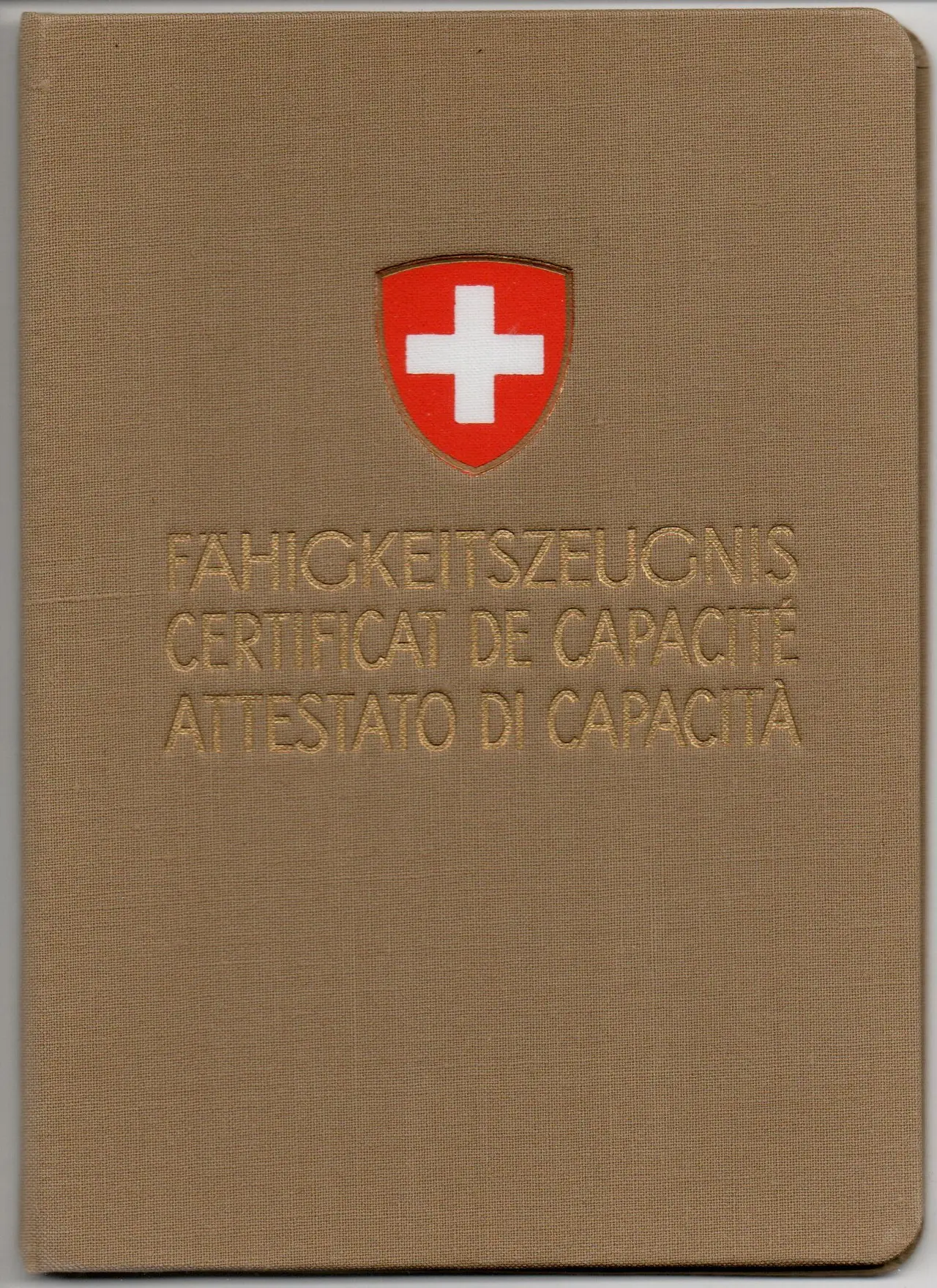
Hanh has worked as a therapist for eight years; her skills are solid and she has many regular clients. The spa owner invites her to become manager: "Please get the staff files ready for the inspection, and recruit two more certified therapists." She opens her drawer: a "7-day course completion" paper from a training centre that has since closed, and two product training papers from a brand. Two weeks later she receives applications with beautifully colour-printed "international diplomas", but she cannot tell whether they are real or fake. At Level 4, the question about certificates is no longer "do I need to study?" but reading the real value of each piece of paper, checking other people's papers, and building a skills portfolio convincing enough to move into management or open your own spa.
The overview article on vocational certificates introduced the types in general terms. This lesson goes deeper: what each international certificate really is, how to tell real from fake, the legal boundaries, and how a manager uses skills portfolios when recruiting and promoting.
By the end of this lesson, you will be able to:
- Distinguish between a vocational certificate, a course completion certificate, an international qualification and a medical practising licence; say what each one proves and what it does not.
- Describe correctly what CIDESCO, ITEC and VTCT are: what kind of organisation, where you study, how you are examined, and how to check the information yourself on the official website.
- Check a certificate or a training centre using 6 steps, and recognise at least 6 warning signs of fake certificates and unaccredited centres.
- Build a skills portfolio including certificates, a practice-hours log, assessments and consented photos.
- Map out the path therapist → head therapist → manager → trainer or spa owner, with the evidence needed at each step.
Four different kinds of paper: don't lump them all together as a "spa diploma"
In the trade, people tend to call every piece of paper a "diploma". A manager has to separate them into four types, because each is issued by a different body and has a different value.
| Type of document | Issued by | What it proves | What it does not prove |
|---|---|---|---|
| Elementary vocational certificate (Vietnamese) | A vocational education institution authorised to train in that trade | The holder has completed a vocational programme with theory, practice and a final exam | Does not permit medical procedures; does not guarantee current skill level |
| Short-course or product-course completion certificate | Training centres, spas, cosmetics brands, equipment manufacturers | The holder attended a course on one technique, one product line or one device | Does not replace a vocational certificate; does not prove a grasp of the fundamentals |
| International qualification (CIDESCO, ITEC, VTCT…) | A foreign organisation, through training providers it has accredited | The holder met that organisation's assessment standard; usually recognised at international resorts and hotels and in some countries | Does not automatically replace documents required under Vietnamese regulations; does not permit medical procedures |
| Medical practising licence | The competent state authority, under the Law on Medical Examination and Treatment No. 15/2023/QH15 | A medically qualified person is permitted to practise within the scope stated on the licence | Spa therapists do not have, and cannot obtain, this type through a spa course |
The principle to remember: a certificate shows you have studied and passed an exam; a skills portfolio shows what you can do now; a medical practising licence shows who is permitted to carry out medical interventions. None of the three can replace another.
Vietnamese elementary vocational certificates: the principles
In Vietnam, formal vocational training sits within the vocational education system, which has elementary, intermediate and college levels. Spa, skin care and massage are usually taught at elementary level. You do not need to know every regulation by heart, but a manager needs to understand these principles:
- The training provider must be authorised. A centre that wants to issue elementary vocational certificates must be authorised by the vocational education authority to provide training, and that authorisation states the trades and levels it may teach. "Having a business licence" is not enough: a business registration certificate is different from a certificate of registration for vocational education activities.
- There is a programme and there is an exam. An elementary course has a curriculum, theory hours, practical hours and a final assessment. Learners who do not pass are not awarded the certificate.
- The certificate is issued by that institution itself, with a serial number and a master register kept at the institution.
- Regulations may change. When preparing staff files or recruitment rules, ask the local vocational education authority rather than relying on posts online.
A spa offering massage is a business line subject to security and public order conditions under Decree 96/2016/ND-CP (security and order conditions for certain businesses, including massage services), as amended by Decree 56/2023/ND-CP, so staff files are often asked for during inspections. Ask the local authorities for the details of the required documents; what you should certainly do is keep a copy of each employee's certificate, checked against the original, noting the date and who checked it.
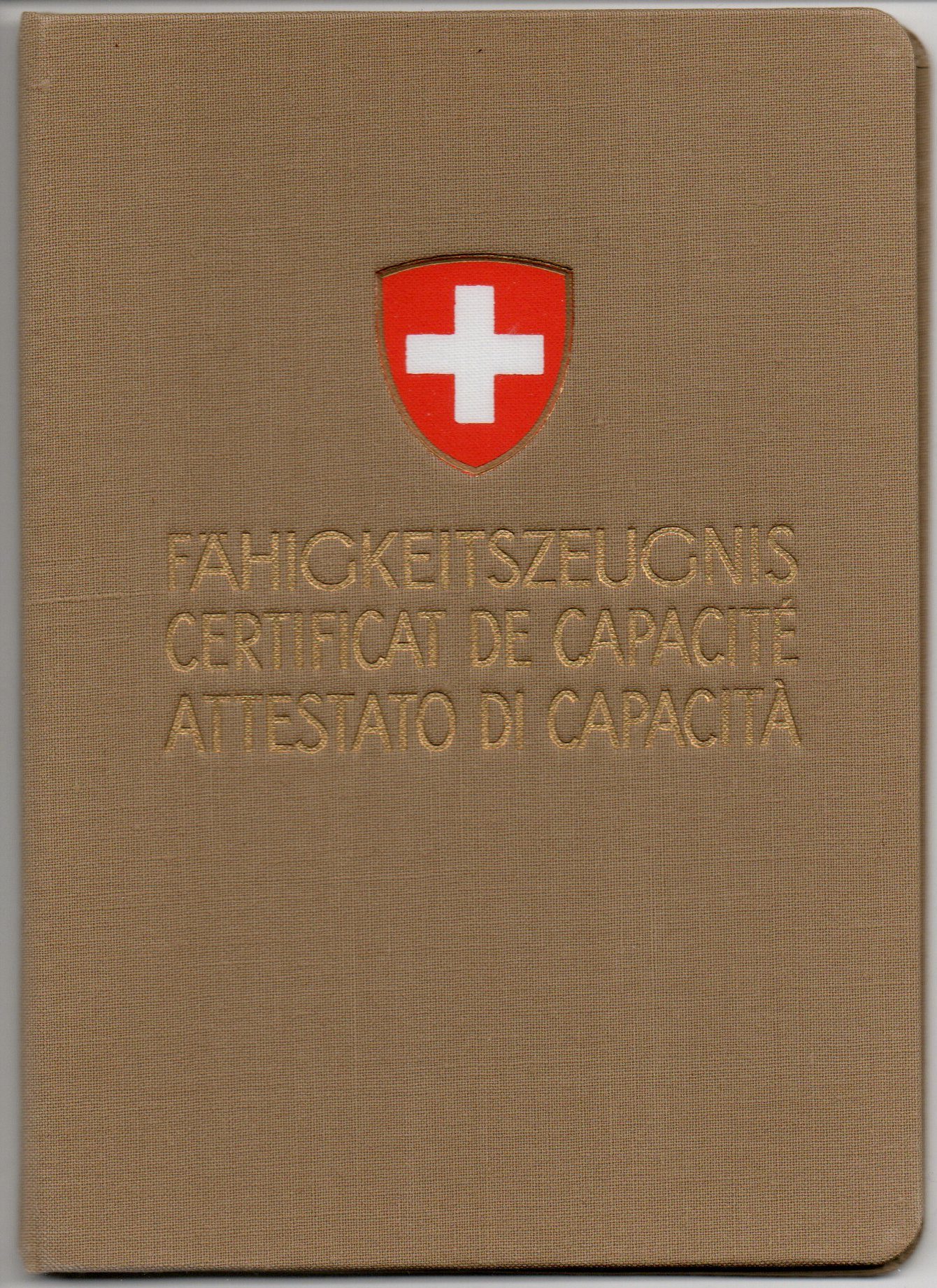
Photo: Paebi / Wikimedia Commons, CC BY-SA 4.0

International qualifications: what are CIDESCO, ITEC and VTCT?
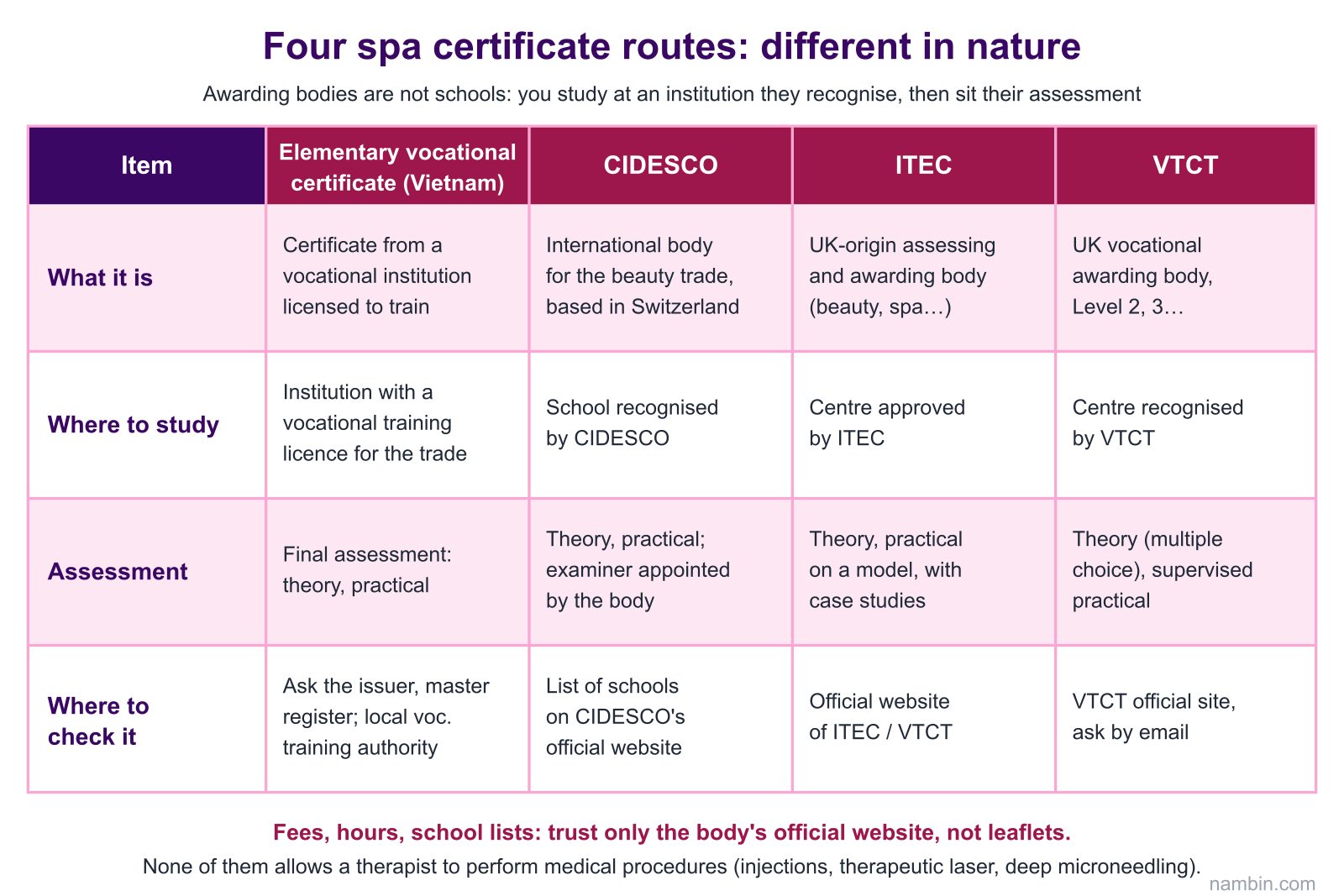
These three names often appear in adverts for "international standard" courses. The most important thing they have in common: none of the three is a school. They are standard-setting and assessment bodies that award qualifications. You study at a training provider accredited by the organisation, then sit an exam to its standard. A centre that says it "issues CIDESCO diplomas" but is not on the accredited list is not giving you that organisation's qualification.
CIDESCO
CIDESCO (the French acronym for the International Committee of Aesthetics and Cosmetology) is an international organisation for the beauty profession, headquartered in Switzerland, with qualifications in beauty therapy and spa therapy. In essence:
- You study at a CIDESCO-accredited school.
- The examination has theory and practical parts, usually with an examiner appointed by the organisation, not just marking by the school's own teachers.
ITEC
ITEC (International Therapy Examination Council) is an assessment and awarding body originating in the UK, specialising in beauty therapy, spa, massage and complementary therapies. According to published information, ITEC is currently part of the same group as VTCT; this structure may change, so check again on the official website. In essence:
- You study at an ITEC-approved centre.
- Assessment includes a theory exam and a practical assessment on a model, plus a portfolio of practical case studies recorded by the learner.
VTCT
VTCT is a UK vocational awarding organisation with qualifications in hairdressing, beauty, spa and other service trades. VTCT qualifications are graded by level (Level 2, Level 3…) within the UK qualifications framework; the higher the level, the greater the knowledge and independence required. In essence:
- You study at a VTCT-approved centre.
- Assessment combines theory (often multiple choice) with supervised practical work, supported by a portfolio of evidence.
What this lesson does not claim
The lesson does not give fees, hours or lists of schools, because that information changes from year to year. Get it from the organisation's official website or from a written reply from the organisation, not from a centre's leaflet.
Photo: Bio06940 / Wikimedia Commons, CC BY 4.0

Should you take an international qualification?
Consider it if you are aiming for international resorts and hotels, working abroad or becoming a trainer. It is not yet necessary if you work in a neighbourhood spa, do not yet have a Vietnamese certificate and your English is still weak. Ask three questions: what new work will this qualification let me do? Does the place I am aiming for really require it? Can I afford the total cost (course fees, exam fees, time off work to study)?
Spotting fake certificates and unaccredited centres
Choosing where to send staff for training and reading applicants' certificates use the same procedure.
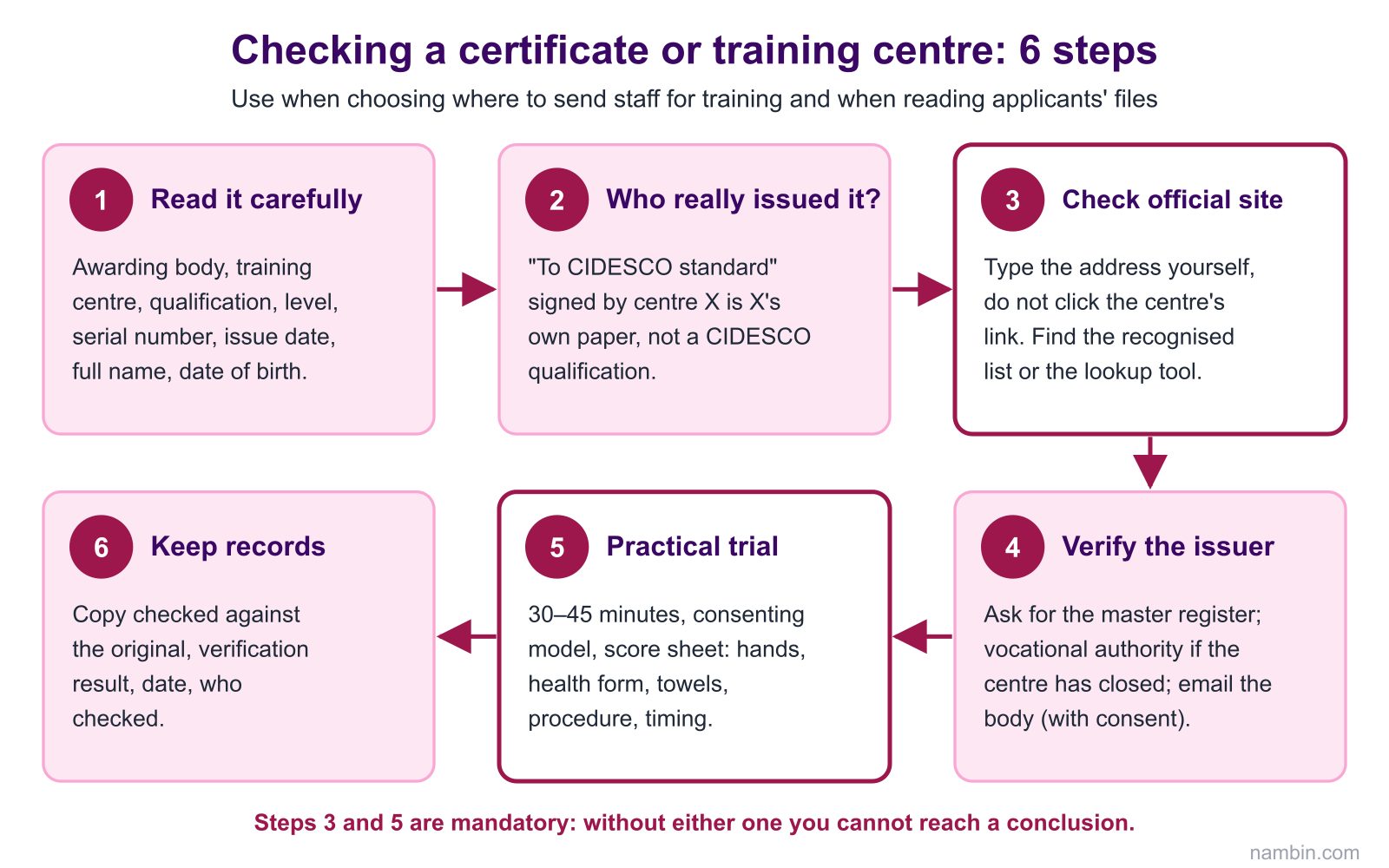
The 6-step procedure
- Read the paper carefully. Name of the issuing body, name of the training provider, name of the qualification, level, serial number, date of issue, the learner's full name and date of birth. A missing serial number or missing training provider name is the first warning sign.
- Identify who really issued it. A paper saying "certificate of course completion to CIDESCO standard" signed by centre X is centre X's paper, not a CIDESCO qualification.
- Search the organisation's official website. Type the official web address yourself; do not click links on the centre's leaflet or messages. Look for the list of accredited schools and centres, or a qualification verification tool if the organisation provides one.
- Verify with the issuer. For Vietnamese certificates: contact the training institution and ask about the master register of certificates issued; if the institution has closed, ask the local vocational education authority. For international qualifications: email the organisation with the serial number and full name, after obtaining the applicant's consent.
- Test practical skills. Ask for a 30–45-minute trial on a consenting model: hand hygiene, going through the health questionnaire, towel draping, one massage or skin-care routine. A genuine certificate with weak skills is still a failed recruitment.
- Keep a record. A copy checked against the original, notes on the verification result, the date and who checked it. This file is what you show during an inspection.
Warning signs
- "International diploma after 5 days", "no exam needed", "pay in full and you get the diploma".
- They cannot name the issuing body, or the body's name cannot be found on any official website.
- The centre is not on the accredited list but explains that it is "waiting for the list to be updated" or is "an exclusive partner".
- Promises to teach injections, deep microneedling or therapeutic laser to people without medical qualifications, with a "licence to practise".
- The paper has no serial number, a pre-printed signature, a blurred stamp, a misspelt organisation name, or a date of issue earlier than the course start date.
- No practical exam, or a practical exam on a plastic mannequin with no real model.
- Fees paid into a personal account, no training contract, no invoice.
When in doubt, do not accuse. Say it neutrally: "Our spa verifies every certificate; would you agree to me contacting the issuer?"
Spa certificates cannot replace a medical practising licence
This is the point many centres deliberately blur. Under the Law on Medical Examination and Treatment No. 15/2023/QH15, medical examination and treatment is carried out by people holding a practising licence, at facilities with an operating licence. Procedures such as injections (filler, botox, needle mesotherapy), surgery, therapeutic laser and IPL, deep microneedling and extraction involving medical intervention fall within that scope.
- No spa certificate — Vietnamese or international, short or long — turns a therapist into someone permitted to carry out these procedures.
- An international qualification may include a module on equipment; that does not mean a therapist in Vietnam is allowed to use that equipment for treatment.
- The manager is responsible for not assigning or advertising services beyond the spa's scope, even if the employee "has a diploma".
Standard phrase for managers: "Your certificate allows you to provide non-invasive care at the spa. Invasive procedures belong to doctors at licensed medical facilities. Our spa does not do them, and when clients ask, we refer them to see a doctor."
Building a skills portfolio at Level 4
At Level 4, the skills portfolio both proves you are competent to manage and serves as the model you ask your staff to follow. A good portfolio has five parts.
1. Certificates and completion certificates
One summary line per document: name, issuing body, training provider, serial number, date of issue, number of hours (if any), how to verify.
2. Practice-hours log
Record every day: service, duration, supervised or independent, difficult cases and how they were handled. Do not record clients' names, phone numbers or health information; use client codes. At the end of the month, total the hours by service group and ask the manager to sign to confirm. Example: 22 days × 5 treatments = 110 treatments, each 60–90 minutes, that is 110–165 hours of practice — far more convincing than "many years of experience".
Photo: M.Minderhoud / Wikimedia Commons, CC BY-SA 3.0

3. Assessments
Skills assessment sheets with a score for each step, the instructor's comments and anonymised client feedback. At Level 4, add your superior's assessment of your management work: scheduling, mentoring trainees, handling complaints.
4. Consented photos and videos
Use them only when the person in the photo has given written consent, stating the purpose. Prefer photos that do not show faces: the therapist's hands, folded towels, a prepared room. Do not use "before-and-after" photos with promises of results. If a model withdraws consent, delete the photos.
5. Development plan
One page: current step, next step, three skills still missing, and target dates.
Career path: therapist → head therapist → manager → trainer or spa owner
Seen through a manager's eyes, each step differs in scope of responsibility and the evidence required.
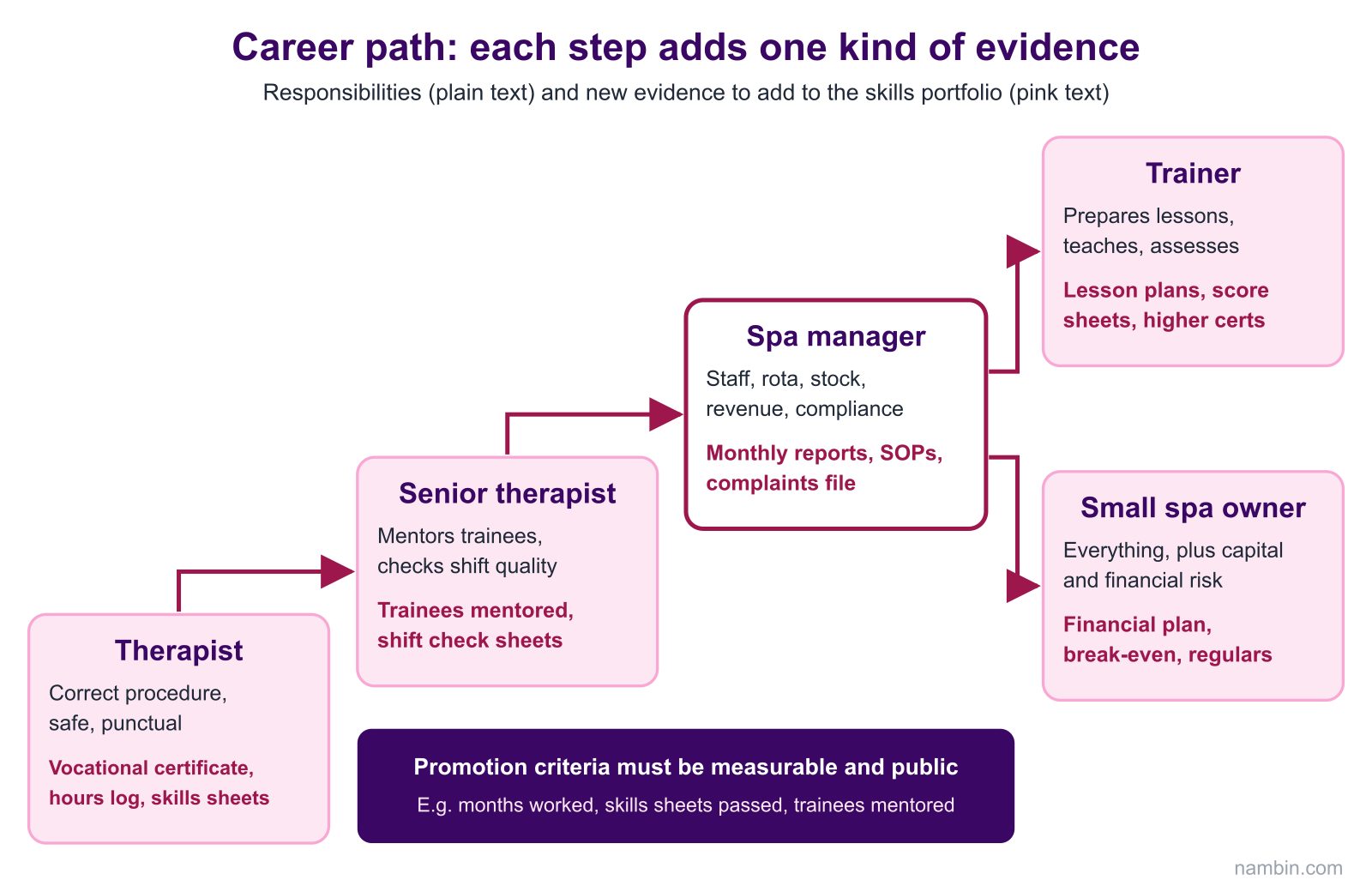
| Step | Main responsibilities | Evidence the portfolio should contain |
|---|---|---|
| Therapist | Follows procedures correctly, safely and on time for every client | Vocational certificate; practice-hours log; passed skills assessment sheets |
| Head therapist | Mentors trainees, checks shift quality, handles difficult cases | Plus: a list of trainees mentored and their results; quality check sheets completed |
| Spa manager | Staff, scheduling, stock, revenue, regulatory compliance, complaints | Plus: monthly reports prepared; procedures written; complaint files handled; inspection results |
| Trainer | Prepares lessons, teaches, assesses learners | Plus: lesson plans and assessment sheets used; usually needs a higher-level qualification and teaching skills |
| Small spa owner | Everything, plus capital and financial risk | Plus: a financial plan and break-even point (next lesson); a base of regular clients; an understanding of the legal procedures |
Promotion criteria, written so they can be measured
Avoid vague wording such as "good skills, good attitude". Example of criteria for promotion to head therapist: at least 18 months working independently; passed skills assessments for every main service; mentored at least 2 trainees to standard; no serious hygiene breaches in the last 6 months. Each spa decides its own numbers, but they must be public and the same for everyone.
The two final branches: training or opening a spa
The training branch suits people who are patient, enjoy explaining and keep good records; the financial risk is low. The spa owner branch suits people who can tolerate irregular income and are good with numbers. Whichever branch you choose, work as a manager for a while first to find out which role suits you.
A 6-step procedure to build your own portfolio
- Take stock of every document you have and sort it into the four types in the table at the start of the lesson.
- Verify your own documents. If a document cannot be verified, say so clearly; do not embellish.
- Start a practice-hours log from today; fill in the last 3 months retrospectively if you have work schedules to check against.
- Ask for assessments: ask your manager to complete a skills assessment sheet for each main service.
- Choose your next step and write down the three pieces of evidence still missing; if you need another certificate, check the provider using the 6 steps before paying.
- Review every quarter: total your hours, update assessments, adjust the plan.
Common mistakes
| Mistake | Why it is wrong or dangerous | The right way |
|---|---|---|
| Trusting a nicely printed "international standard" paper | An international standard is not an international qualification; the paper may only be the centre's own certificate | Identify who issued it; check the accredited list on the official website |
| Clicking the "diploma lookup" link sent by the centre | The lookup page may have been set up by the centre itself | Type the organisation's official web address yourself |
| Assigning staff who "have a diploma" to do microneedling or injections | Beyond scope, breaches the Law on Medical Examination and Treatment No. 15/2023/QH15, harms clients | Non-invasive services only; refer medical procedures to doctors |
| Recruiting on certificates alone | A certificate does not guarantee current skill level | Always include a trial with a marking sheet |
| Putting client photos in the portfolio without permission | Invades privacy, damages reputation | Written consent stating the purpose; prefer photos that do not show faces |
| Estimating practice hours at the end of the year | The figures are unreliable and unconfirmed | Record daily, total and get a signature every month |
Pass criteria for this lesson
You pass this lesson when you can do the following in front of your instructor:
- Correctly classify all 4/4 types of document (elementary vocational certificate, short-course certificate, international qualification, medical practising licence) across 5 sample papers given by the instructor, within 10 minutes.
- Explain within 3 minutes what CIDESCO, ITEC and VTCT are: standard-setting and awarding bodies, study at accredited providers, theory and practical exams, verification on the official website.
- Go through all 6/6 checking steps for a sample certificate and identify at least 4 irregularities planted by the instructor.
- Correctly name at least 4 procedures within the scope of medical examination and treatment that a spa certificate does not permit, and say the standard phrase for referring a client to a doctor.
- Submit a first-draft skills portfolio with all 5 parts, including a practice-hours log of at least 4 weeks with a confirming signature, containing no client personal information.
- Write the promotion criteria for head therapist at your spa with at least 4 criteria that include numbers.
Frequently asked questions
Is an international qualification worth more than a Vietnamese certificate?
They cannot be compared directly. International qualifications are recognised in international settings; elementary vocational certificates are tied to the regulatory system in Vietnam. Choose according to where you plan to work.
A centre says it is "affiliated" with CIDESCO, ITEC or VTCT. Can it be trusted?
"Affiliated" does not mean "accredited". Trust it only when the provider's name is on the list on the organisation's official website, or the organisation confirms it by email.
What if an applicant has a certificate but the issuing institution has closed?
Ask the local vocational education authority about the archived records, and at the same time give a trial with a marking sheet. Note clearly "issuer could not be verified" in the staff file.
After an international qualification, can I do laser or microneedling at the spa?
No. In Vietnam, procedures involving medical intervention fall within the scope of licensed medical facilities and licensed practitioners. A spa certificate cannot replace that licence.
Further reading
Review the overview of certificate types and income by career step in the lesson Spa vocational certificates and career path: from therapist to opening a small spa, and use the lesson Spa safety and service skills test: 20 self-check questions, a practical exam and a marking scheme as a model marking sheet for the recruitment trial.