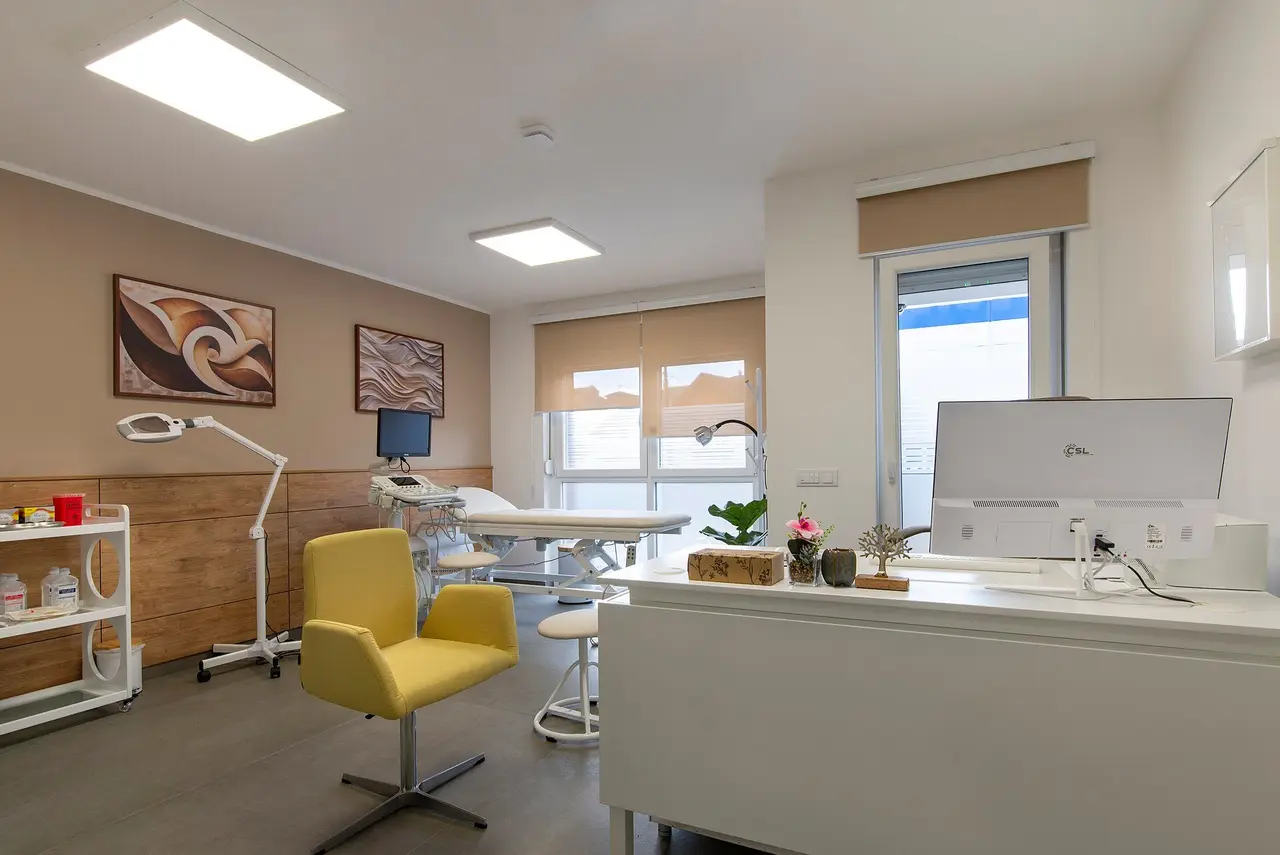
Walk round the spas in Vietnam and you will see machines in every room: a facial steamer beside the treatment bed, a "7-in-1 multifunction" unit on a trolley, an RF head, an ultrasound head, galvanic electrodes. Many machines are bought online, labelled in a foreign language, with the instruction manual long lost. New therapists are told "press this button, turn it up to 5 and you're done". Then one day a client with a pacemaker lies down for RF, or the steamer spits hot water onto a client's cheek. The machine was not at fault; the fault lay with a user who did not understand the machine.
This opening lesson of the Equipment module teaches four common groups of machines at the level of understanding the principle well enough to use them safely, not at engineer level. Most important of all are electrical safety, contraindication screening and the habit of checking machines and keeping an equipment log.
By the end of this lesson, you will be able to:
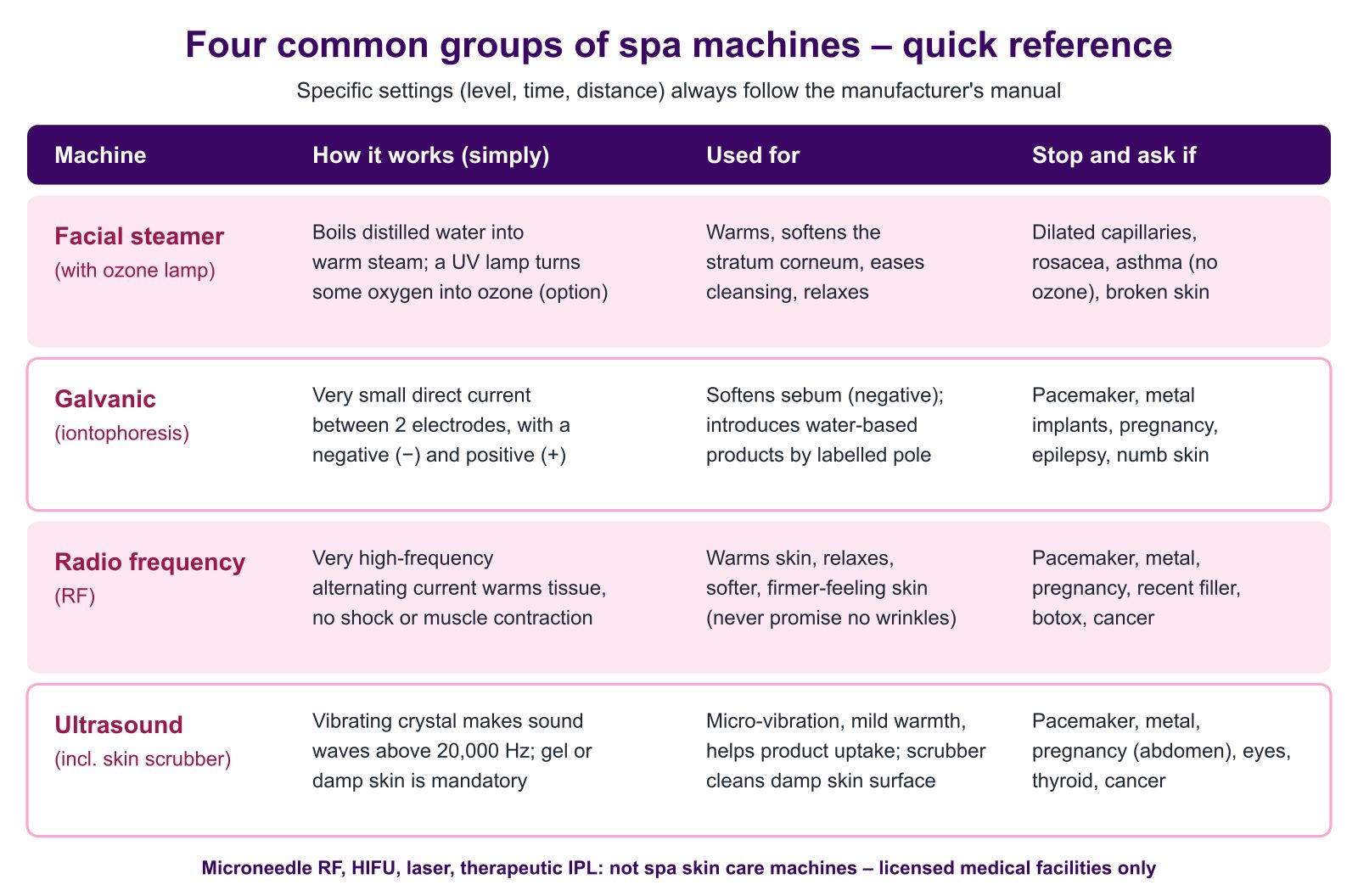
- Explain in simple words how the facial steamer (with ozone), the galvanic machine (galvanic current, ion), the radio frequency (RF) machine and the ultrasound machine work, and what they are used for in skin care.
- Carry out an electrical safety check before each shift: earthed sockets, residual current protection, power cables, and the position of water near the machine.
- Screen correctly for the contraindications specific to machines that use electricity, heat and waves: pacemakers, metal implants, pregnancy, broken skin, loss of sensation…
- Follow the 7-step machine procedure, from preparation to switching off and cleaning the contact heads.
- Keep the equipment log, recognise a machine that is not fit for use and report a fault correctly.
General principle: a machine is a tool, not magic
These four principles apply to every piece of equipment in the spa:
- The machine must have a clear origin: manufacturer's name, model, serial number, voltage label, purchase documents and instructions for use in Vietnamese. With an untraceable machine you do not know its real power, and nobody provides a warranty.
- The settings belong to the manufacturer. Intensity, time, temperature and distance are taken from the manual for that exact machine. This lesson only gives reference ranges; where they differ from the machine manual, follow the manual.
- Only use machines you have been trained on and have been signed off for by the person in charge.
- Do not promise treatment results. Spa machines support cleansing and relaxation and help the skin feel softer and more hydrated. Do not say "erases wrinkles", "reduces fat", "lifts muscles" or "treats melasma"; advertising like that can easily breach the Advertising Law 2012.
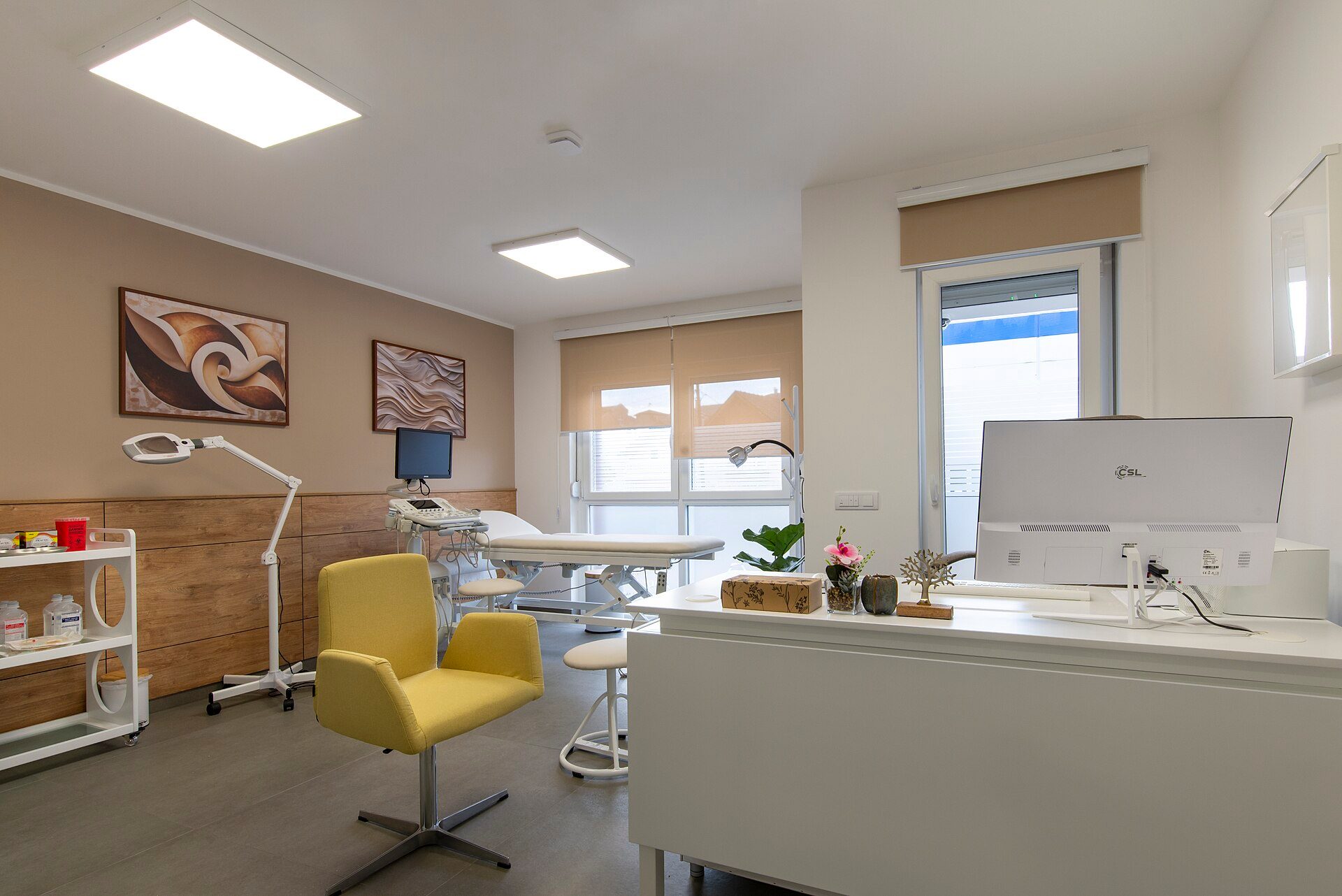
Photo: Shixart1985 / Wikimedia Commons, CC BY 2.0

The boundary with medical devices
Some machines look like spa machines but act deep in the tissue: RF with needles (RF microneedling), HIFU (high-intensity focused ultrasound), lasers, treatment IPL, fat-removal machines. Invasive techniques of this kind fall within the scope of licensed medical examination and treatment establishments under the Law on Medical Examination and Treatment No. 15/2023/QH15. If the manufacturer states that the machine is a medical device, or the manual requires the user to be a healthcare professional, the spa does not operate it. Light-based equipment (LED, IPL, laser) is covered separately in the next lesson.
Four common groups of machines and their principles in plain terms
1. Facial steamer with ozone
Principle: inside there is a water tank and a heating element. The water boils to produce steam, which passes through the nozzle as a warm, moist vapour. Many machines also have an ozone lamp: an ultraviolet bulb placed in the steam path that converts part of the oxygen in the air into ozone (O3). Ozone is a strong oxidiser, so it is often advertised as "antibacterial", but it also irritates the eyes and the airways. That is why ozone is only an option, switched on briefly, in a well-ventilated room.
Used to: warm the skin, soften the stratum corneum, make cleansing easier and relax the client (the role of the steaming step you learned at Levels 1–2).
Specific safety points:
- Use distilled water, fill to the correct line and never above the maximum line. Tap water is high in minerals and leaves scale, which makes the machine spit hot droplets and cause burns.
- Switch the machine on and wait until the steam flows evenly before turning the nozzle towards the client.
- The distance from the nozzle to the face is usually 30–40 cm and the time usually 5–10 minutes, according to the machine manual. Sensitive skin or dilated capillaries: further away, shorter, or no steam at all. Cover the eyes with damp cotton pads.
- Do not switch on ozone for clients with asthma, lung disease, a current cough, or who are pregnant. Do not leave ozone on for the whole session.
- Never let the machine run dry, even if it has an automatic cut-out relay.
2. Galvanic machine (galvanic current, ion)
Principle: the machine produces a very low-intensity direct current (galvanic current) flowing between two electrodes. One electrode is the head the therapist glides over the client's skin; the other is a metal bar the client holds or a pad placed under the shoulder; the current passes through the client's body to complete the circuit. Direct current has a clear negative and positive pole, so it is used in two ways:
- Desincrustation (softening sebum): negative pole with a specialist solution. The electrochemical reaction makes the skin surface slightly alkaline, so sebum softens and is easier to clean away. Suitable for oily skin with many closed comedones.
- Iontophoresis (introducing active ingredients): a water-based product with charged ingredients; the electrode of the same polarity "pushes" the ions into the stratum corneum. Which pole to use is shown on the product label, usually marked clearly (+) or (−).
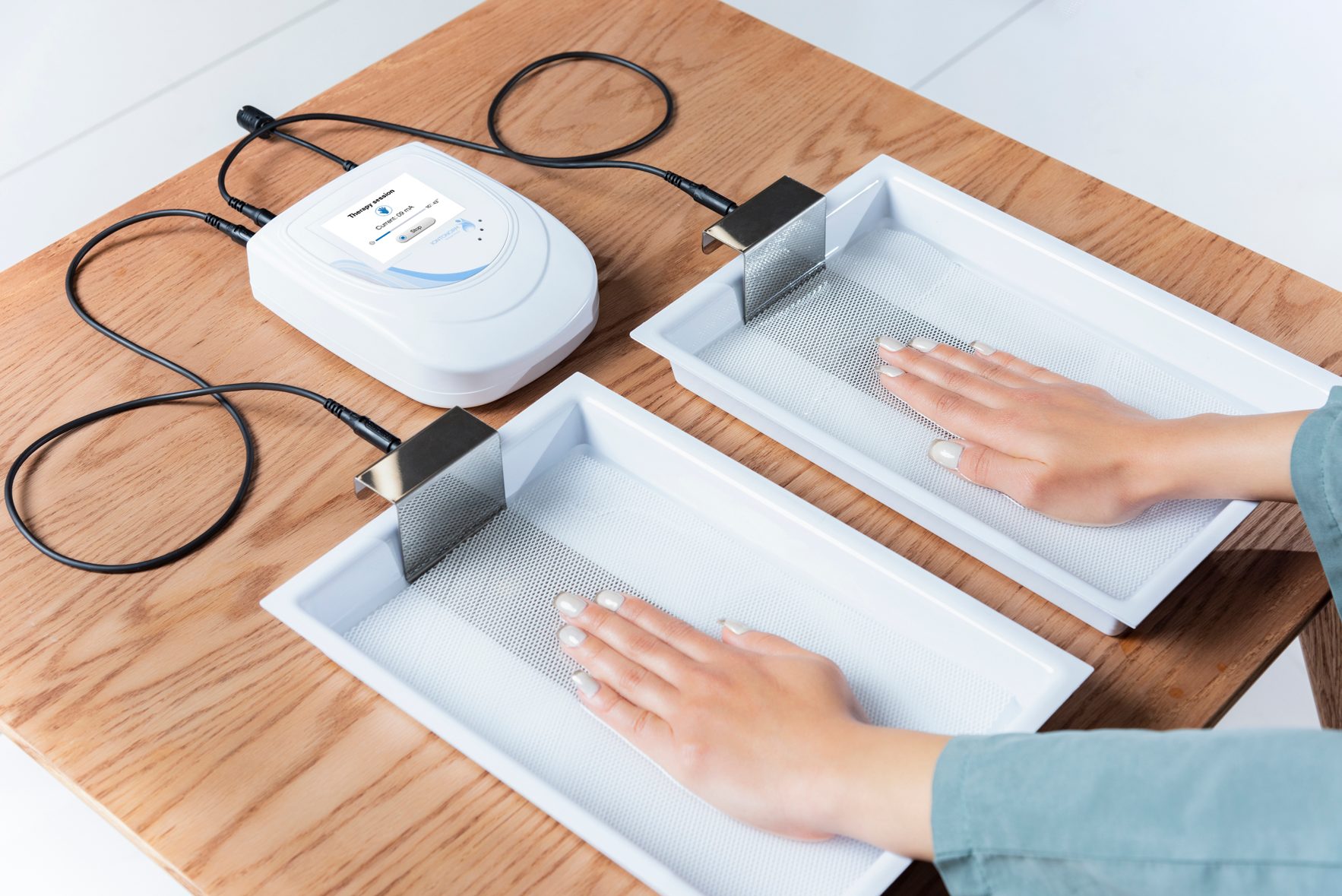
Photo: Mindfulpersian / Wikimedia Commons, CC BY-SA 4.0

Specific safety points:
- The client removes all metal jewellery. Metal concentrates the current and causes point burns.
- Place the electrode on the skin first, then increase the intensity slowly from 0; at the end of the time, reduce to 0 before lifting off. Lifting the electrode while the current is running gives a jolting, stinging sensation.
- Keep the electrode moist with even contact. A dry spot is a spot that burns easily.
- A metallic taste in the mouth is a common reaction; but if the client feels increasing stinging or burning, reduce the current immediately.
- Keep the time short, usually a few minutes per area, according to the machine manual.
3. Radio frequency (RF) machine
Principle: the machine generates a very high-frequency alternating current (usually hundreds of kHz to a few MHz) through the electrode head. The current changes direction so quickly that it causes no shock or muscle contraction, but as it passes through tissue it warms it, just as a resistance wire warms up when current flows. A monopolar head needs an electrode pad under the client's back and the heat goes deeper; bipolar and multipolar heads have the electrodes on the handpiece itself, act superficially and are the type usually found on spa machines.
Used to: warm the skin, relax the client, and leave the skin softer and feeling firmer after the session. Do not promise "erases wrinkles", "lifts muscles" or "reduces fat". RF with needles that pierce the skin is an invasive procedure; the spa does not do it.
Specific safety points:
- Apply a layer of conductive gel thick enough for the manufacturer's requirements. Dry skin under an RF head burns easily.
- The handpiece keeps moving evenly, never stays in one spot, and is never pressed hard over bone close to the surface (jawbone, cheekbones, forehead).
- Ask about heat on a 0–10 scale: pleasantly warm is enough; if it feels burning hot, lower the level or stop. Surface temperature limits are set by the machine manual.
- Do not work over areas with metal (braces, plates and screws, joint replacements) or areas recently treated with filler, botox or thread lifts; the waiting period is set by the doctor who did the procedure.
4. Ultrasound machine
Principle: ultrasound is sound waves with a frequency above 20,000 Hz, which the human ear cannot hear. The machine head contains a vibrating crystal that converts electricity into oscillation. Ultrasound travels very poorly through air, so gel or water between the head and the skin is mandatory. In spas there are two types: the skin-care ultrasound machine (round head, producing micro-vibration and gentle warmth, helping product penetration) and the ultrasonic skin scrubber (a flat metal spatula used on damp skin to cleanse the surface; held at an angle, glided lightly, never scraped). Frequency, power and mode follow the manufacturer.
Specific safety points: always have gel or damp skin, and keep the head moving; do not work on the eyelids, the thyroid area at the front of the neck, or the abdomen of a pregnant woman. HIFU (high-intensity focused ultrasound) acts deep, carries a risk of burns and nerve damage, and is not a skin-care machine; the spa does not operate it.
Electrical safety in a room with water
A spa room has water, steam and wet towels, and the client lies relaxed without shoes: the conditions in which electric shock happens most easily. You do not need to repair electrics, but you must be able to see the danger points and stop.
Sockets and the earth wire
Machines with a metal casing or that use water usually have a three-pin plug, one pin of which is the earth. If a fault makes the casing live, the earth wire carries the leaking current to earth instead of through a person. For this to work, the socket must have an earth contact that an electrician has genuinely connected to earth. A two-hole socket, or "snapping off the earth pin" to make the plug fit, removes this layer of protection.
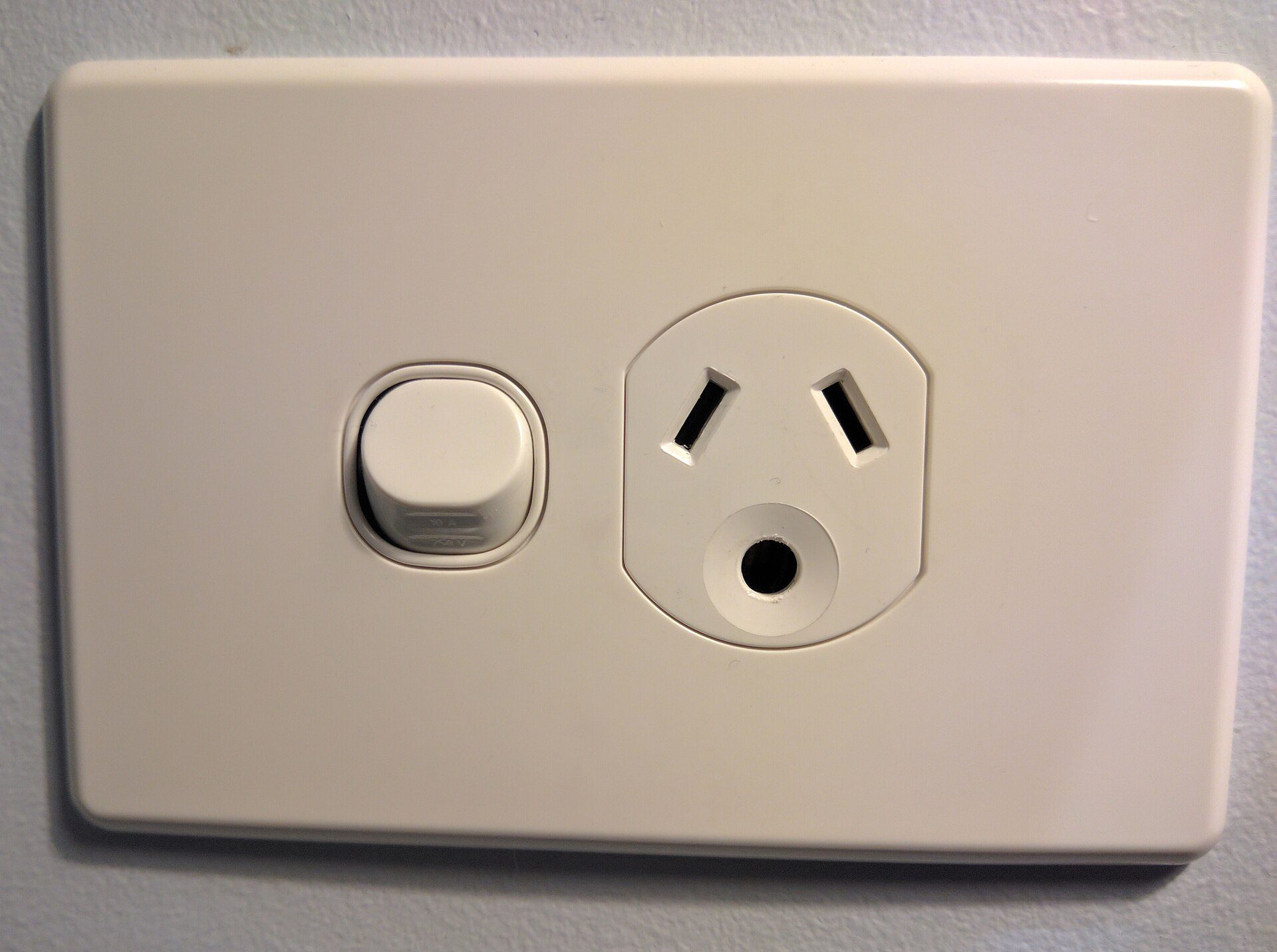
Photo: Maksym Kozlenko / Wikimedia Commons, CC BY-SA 4.0

Residual current device
The treatment room circuit should have residual current protection (commonly called an anti-shock circuit breaker, RCD/RCBO/ELCB); the 30 mA tripping threshold type is the one normally used to protect people. When there is leakage current, it cuts the power in a fraction of a second. The device is tested regularly with its "Test" button. Therapists must know where the circuit breaker for their room is, so they can cut the power immediately if something goes wrong.
Water near equipment
- Do not place water basins, cups of water, spray bottles or mask bowls on top of or right next to the machine body.
- Fill the steamer only when it is unplugged and has cooled down; wipe up any spilled water before plugging it back in.
- Have dry hands when plugging in and unplugging. Unplug by holding the plug, never by yanking the cable.
- Extension sockets (power strips) must not sit on a wet floor, must not be daisy-chained one into another, and must not carry several high-power machines (steamer, towel warmer, heat lamp) at once.
- Route power cables tidily, never across a walkway and never trapped under a leg of the treatment bed.
When someone receives an electric shock
Do not touch a person who is being electrocuted with bare hands. Switch off the circuit breaker or pull the plug (if you can do so safely), or use a dry, non-conductive object to separate them from the source. Call 115, check breathing and follow the spa's first aid procedure learned at Level 1. That machine is labelled "FAULTY – DO NOT USE" and nobody may switch it on again until a qualified technician has inspected it.
Checking machines before each shift
At the start of every shift, the therapist in charge of the room checks each machine to be used that day, which takes about 5 minutes, and ticks the daily check sheet.
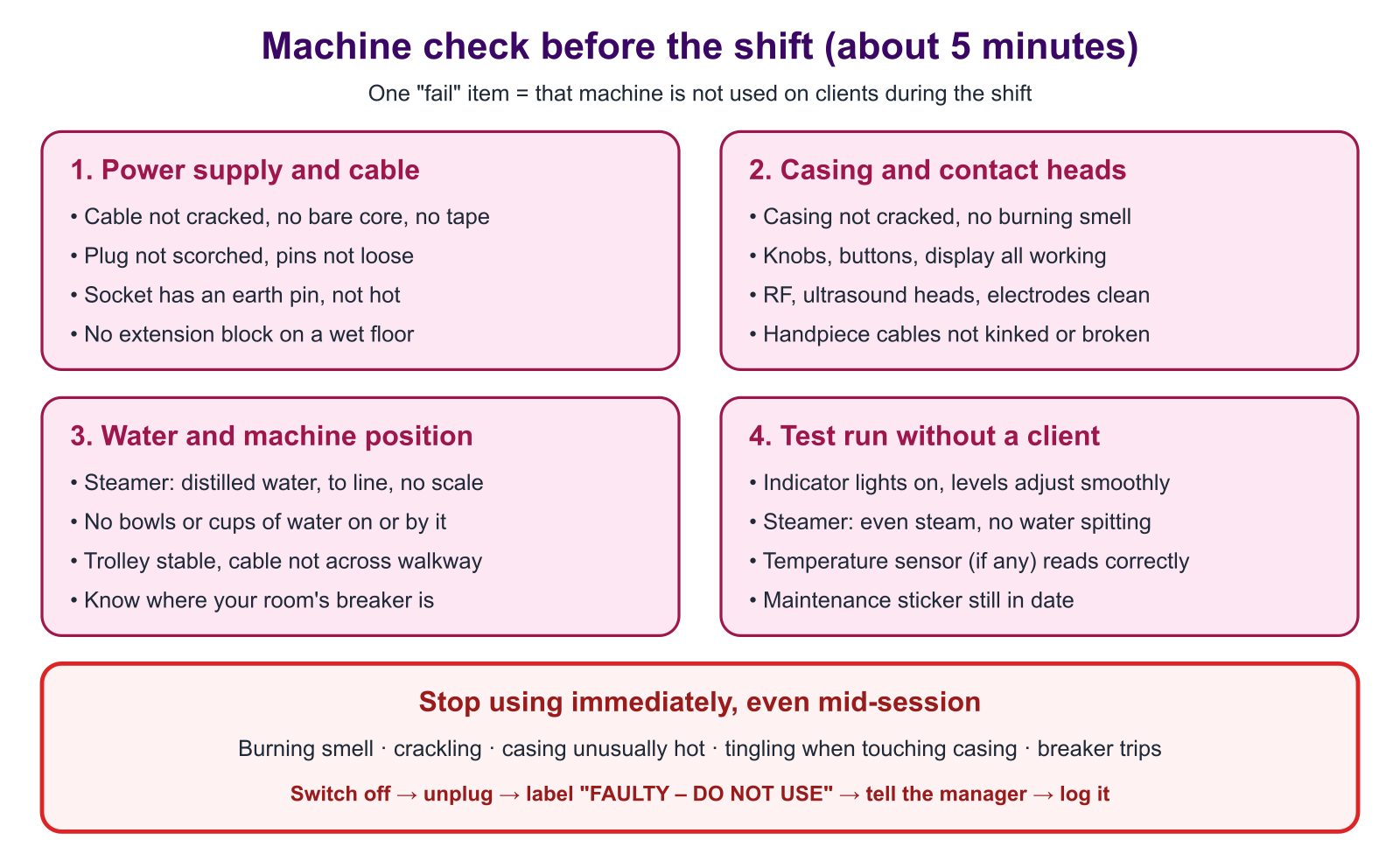
- Cable, plug, socket: no cracks, no exposed cores, no tape repairs, no scorch marks; the socket has an earth contact and is not loose or hot.
- Casing and contact heads: no cracks, no burning smell; RF and ultrasound heads and electrodes are clean with no sharp edges; handpiece cables are not kinked or broken.
- Water: the steamer has enough distilled water to the correct line, and the tank is free of scale.
- No-load test run and maintenance sticker: indicator lights and up/down buttons work smoothly; the steamer produces even steam without spitting water; the maintenance sticker is in date.
Stop using the machine immediately, even in the middle of a session, if it smells of burning, makes crackling or popping noises, the casing is abnormally hot, anyone feels tingling when touching the casing, or the circuit breaker trips: switch off, unplug, attach a faulty label, report to the manager and record it in the log.
Contraindications for electrical, heat and wave-based machines
On top of the general contraindications learned at Level 1, machines add a further layer of risk: current, heat and waves can affect devices inside the body and areas of skin that cannot feel. If in doubt, do not use the machine: switch to a manual treatment and advise the client to consult a doctor. Epilepsy and asthma (with ozone) also need careful questioning.
| Client's condition | Steaming (ozone) | Galvanic | RF | Ultrasound |
|---|---|---|---|---|
| Pacemaker, implanted defibrillator, implanted electronic device | Steam allowed; avoid ozone if there is heart or lung disease | Do not perform | Do not perform | Do not perform |
| Metal implants (plates and screws, joint replacements, metal braces) in the treatment area | Allowed | Not in that area | Not in that area | Not in that area |
| Pregnancy | Caution, no ozone, short steaming | Do not perform | Do not perform | Not on the abdomen; for the face, ask a doctor's advice – the spa chooses the safe option |
| Broken skin: open wounds, sunburn, dermatitis, eczema, active herpes, severe inflamed acne | Not on the affected area | Do not perform | Do not perform | Do not perform |
| Reduced or lost skin sensation (e.g. diabetes with nerve complications) | Caution with heat | Do not perform | Do not perform | Do not perform |
| Currently being treated for, or with a history of, cancer | Ask a doctor's advice | Do not perform | Do not perform | Do not perform |
| Dilated capillaries, rosacea, very sensitive skin | Nozzle further away, short, or no steaming | Caution | Caution, low level, or do not perform | Caution |
| Recent filler, botox or thread lift in the treatment area | Follow the advice of the doctor who did it | Not in that area | Not in that area | Not in that area |
| Fever, acute illness | Postpone | Postpone | Postpone | Postpone |
This is the minimum; if the machine manual lists more, apply the longer list. Write the question "Do you have a pacemaker, an implanted device or any metal in your body?" clearly on the health questionnaire, and ask it again verbally before every session that uses a machine.
The 7-step machine procedure
This procedure applies to all four groups of machines; the operations specific to each machine slot into step 5 according to the machine manual.
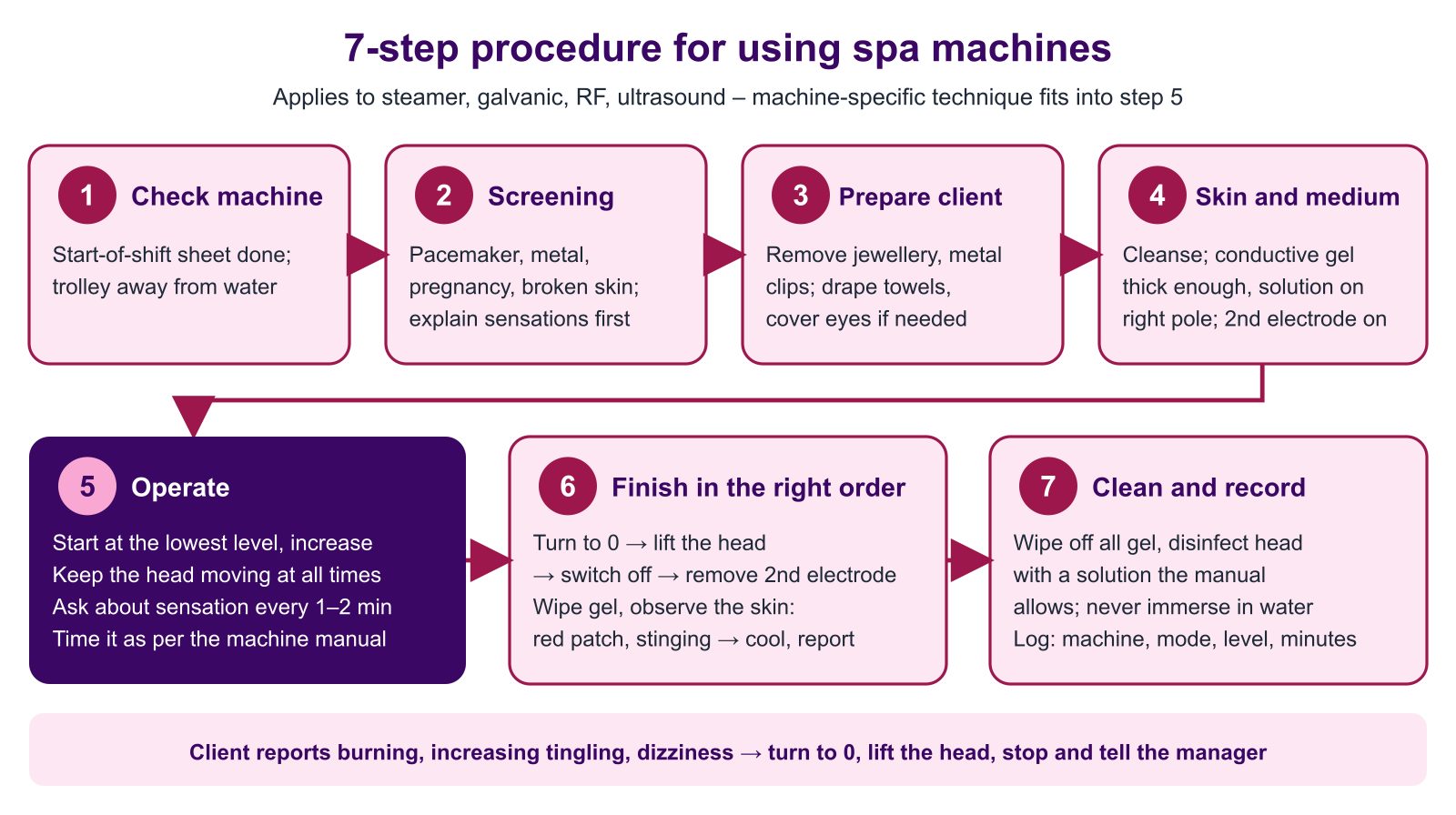
- Check the machine. The machine has passed the start-of-shift check and stands on a stable trolley, away from the water basin.
- Screen. Review the health questionnaire and ask again about pacemakers, metal implants, pregnancy and broken skin. Explain to the client the sensations they will feel (warmth, light vibration, mild tingling, a metallic taste) and say: "If you feel hot or any burning, tell me straight away."
- Prepare the client. The client removes jewellery and metal hair clips; phones are kept away from the machine head. Drape with towels and cover the eyes when needed.
- Prepare the skin and conductive medium. Cleanse the skin; apply conductive gel, galvanic solution for the correct pole, or dampen the skin; place the indifferent electrode if the machine requires it.
- Operate. Start at the lowest level and increase gradually up to the level the manual allows and the client finds comfortable. The head keeps moving at all times. Ask about sensation at least every 1–2 minutes. Use a timer, do not guess.
- Finish in the correct order. Reduce the level to 0, lift the head off, switch the machine off, and only then remove the indifferent electrode. Wipe the gel from the skin and observe the skin: an even, light pinkness is normal; patchy redness, burning or blistering is abnormal – apply a cool compress and report to the manager.
- Clean and record. Wipe the contact head with a damp cloth to remove all gel, then disinfect with a solution the manufacturer allows (many heads tolerate 70% alcohol, but some do not; check the manual). Never immerse the handpiece in water. Record on the client card: machine, mode, level, time and skin reaction.
Maintenance and the equipment log
- Daily (therapist): pre-shift check and cleaning after every client; at the end of the day empty the steamer completely, wipe it dry and coil the cables loosely.
- Weekly or per the machine manual (senior therapist): descale the steamer tank in the way the manufacturer permits, inspect the handpiece cables thoroughly, and press the "Test" button on the residual current device.
- Periodically (qualified technician or the manufacturer): electrical safety inspection, calibration, replacement of components. Therapists do not open the casing, do not solder cables themselves and do not replace a fuse with a different type.
The equipment log has one page for each machine. It shows which machines are due for maintenance and which break down often, and it proves the spa acted correctly if an incident occurs. Each page records:
- Machine name, manufacturer, model, serial number, voltage, power; purchase date, supplier, warranty expiry, and where the Vietnamese manual is kept.
- Therapists trained on the machine, training date, and who signed them off.
- Maintenance schedule: date, work done, who did it, result, next due date.
- Incidents: date and time, description, client affected (if any), action taken, and the date the machine was returned to use.
Common mistakes when using spa machines
| Mistake | Why it is dangerous/wrong | The correct way |
|---|---|---|
| Filling the steamer with tap water, or above the line | Mineral scale and boiling over make the nozzle spit hot droplets onto the client's face | Distilled water, to the correct line; switch on and wait for even steam before turning the nozzle |
| Leaving ozone on for the whole session in a closed room | Ozone irritates the eyes and airways of both client and therapist | Ozone is only an option: brief, in a ventilated room, never for people with asthma |
| Not asking about pacemakers or metal implants | Current and RF waves can affect the device; metal heats up and causes internal burns | Ask on the health questionnaire and again verbally at every session that uses a machine |
| Lifting the galvanic electrode while the current is running | The client gets a jolt or sting and loses trust | Place the electrode, then increase from 0; reduce to 0 before lifting off |
| Holding the RF head still, with too thin a layer of gel | Heat builds up at one point and burns the skin, especially over bone close to the surface | Enough gel, head always moving, ask about heat every 1–2 minutes |
| Snapping off the earth pin to fit a two-hole socket | Protection is lost if the machine leaks current to its casing | Use an earthed socket; ask the manager to have the correct socket installed |
| Advising "this machine erases wrinkles, reduces fat" | A false promise that may breach the Advertising Law 2012 | Say "supports, relaxes, helps the skin feel softer and more hydrated", and state the limits clearly |
Pass criteria for this lesson
You pass this lesson when you can do the following in front of your instructor:
- Explain in your own words the principle and purpose of 4/4 machine groups (ozone steamer, galvanic, RF, ultrasound), taking no more than 1 minute per machine.
- Complete the pre-shift check sheet for one machine in no more than 5 minutes, finding 100% of the faults the instructor has planted (cracked cable, unearthed socket, steamer filled above the line…).
- Screen a role-play client and identify 100% of the planted machine contraindications (pacemaker, metal implants, pregnancy, broken skin).
- Operate the steamer: distilled water to the correct line, wait for even steam before turning the nozzle, distance and time according to the machine manual (usually 30–40 cm, 5–10 minutes).
- Operate galvanic or RF on a model through all 7/7 steps, increasing from 0, head always moving, asking about sensation at least every 2 minutes, and finishing in the correct order.
- Correctly complete one equipment log page and one simulated incident entry with all mandatory fields.
- State correctly what to do when someone receives an electric shock, and point out where the circuit breaker for your room is.
Frequently asked questions
A client with a pacemaker only wants facial steaming – is that allowed?
Steaming with warm water vapour does not pass electric current through the body, so it is usually allowed, provided the client has no other heat-related contraindication. Do not switch on ozone if the client has heart or lung disease. Never use galvanic, RF or ultrasound. Record this clearly on the client card and choose manual techniques for the rest of the treatment.
A client asks "How many RF sessions until my wrinkles are gone?" – how should I answer?
Tell the truth: "RF in the spa helps your skin feel warm, soft and firmer after the session, but it cannot erase wrinkles. If you want to treat wrinkles, you should see a dermatologist." Clients trust a spa that tells the truth more than a spa that makes big promises.
The circuit breaker trips during a treatment – can I just switch it back on?
No. A tripped breaker is a sign of current leakage or overload. Lift the head off the client, unplug the machine, keep the client safe and report to the manager. Only reset the breaker once the cause has been found; a machine suspected of leaking current must be labelled faulty and wait for a technician to inspect it.