Any spa near a gym, a football pitch or an office district meets this kind of client: "Please use firm pressure, my shoulders are as hard as stone", "I've just run a half marathon, give my legs a really thorough going-over". Many therapists understand "deep tissue" as pressing as hard as possible – the more the client grimaces, the more "correct" the treatment. The result is clients with bruises, sore for three days and afraid to come back; some get numb arms because someone pressed into the armpit, others get their "neck cracked" in a style copied from the internet. Deep tissue massage done properly is not about causing more pain; it is about working more slowly, more purposefully and with more communication.
By the end of this lesson, you will be able to:
- Distinguish relaxation massage, deep tissue massage and sports massage in terms of purpose, rhythm, pressure and communication.
- Apply progressive pressure at the correct angle, using the palm, thumb, forearm and elbow in the right place at the right time.
- Use the 0–10 pain scale to keep pressure within the safe zone, and recognise signs that the client is tolerating too much.
- Name and avoid the endangerment sites: the front of the neck, the hollow above the collarbone, the armpit, the inner elbow, the back of the knee, the groin, the spine and the kidney area.
- Screen for the contraindications specific to deep techniques and know when to stop and when to advise the client to see a doctor or a physiotherapist.
How deep tissue and sports massage differ from relaxation massage
You learned the 5 groups of movements at Level 1 and the 60–90-minute Swedish massage at Level 2. Deep tissue and sports massage reuse those movements; the difference lies in purpose, speed and depth.
- Deep tissue massage: a technique applied slowly with progressive pressure to reach the deeper muscle layers and the fascia (the membrane wrapping around muscles), usually focusing on a few areas where the client is often tight, such as the neck and shoulders, lower back, buttocks and calves. A 60-minute session may work thoroughly on only 2–3 areas rather than covering the whole body evenly.
- Sports massage: massage for people who train, divided by timing: before activity, after activity, and maintenance between training blocks. Depending on timing, it can be light and fast (before competition) or slow and deep (maintenance sessions).
In the spa, both remain services for care, relaxation and helping the body feel more comfortable. They are not injury treatment and not physiotherapy. You can help the client feel less stiff; you do not "cure" a herniated disc, do not "realign" the spine, and do not "treat" tendinitis.
| Criterion | Relaxation massage | Deep tissue massage | Sports massage |
|---|---|---|---|
| Main purpose | Whole-body relaxation, stress reduction | Softening specific tight muscle areas | Preparation, recovery support and maintenance for people who train |
| Speed | Even, rhythmic, moderate | Very slow, with pauses holding pressure | Before training: fast, short; after training: slow, light |
| Pressure | Light to medium | Gradually increasing from medium to deep, guided by feedback | Varies with timing; never deep straight after competition |
| Scope | Whole body in sequence | 2–3 focus areas | The muscle groups used most in the sport |
| Communication | Little talking, let the client rest | Frequent pressure checks using the 0–10 scale | Ask about training schedule, competitions, old injuries |
Photo: Threeohsix / Wikimedia Commons, CC BY-SA 4.0

The three timings of sports massage
- Before activity (pre-event): 10–15 minutes, fast rhythm, light to medium pressure, quick stroking and kneading to warm the muscles. No deep work and no long press-and-hold, because the muscles may feel "loose and weak" during competition.
- After activity (post-event): wait for the client to cool down and for breathing to return to normal. Light pressure, slow strokes towards the heart. No deep tissue work on competition day, because the muscles are fatigued and may have minor damage the client has not noticed; usually wait about 48–72 hours.
- Maintenance: regular sessions between training blocks, for example once every 1–2 weeks. This is the most suitable time to use deep tissue techniques on the muscle groups the client uses most.
Deep tissue technique: slow, progressive, at the right angle
The core principle: tissue only "allows" you to go deeper once the superficial layer has softened. Pressing hard from the start makes the muscle contract to protect itself; the harder you push, the stiffer the muscle becomes and the more pain the client feels.
Progressive pressure layer by layer
- Warm up for 5–10 minutes with broad strokes and gentle kneading over the whole area, as in the opening of a Swedish massage.
- Enter the middle layer: stroke slowly with the heel of the hand at about 2–3 cm per second, feeling where it is stiff and where the client tenses up.
- Enter the deep layer: place the point of contact and press in slowly over 5–10 seconds, stopping at the level the client reports as about 4–6/10. Wait until you feel the tissue "release" under your hand before moving on or adding a little more pressure.
- Hold or glide slowly: press and hold one point for about 20–60 seconds, or glide very slowly along the muscle fibres. If after about 30 seconds the pain does not ease but increases, release the pressure, change the angle or move to another area.
- Release slowly: withdraw the pressure as slowly as you went in; never spring your hand off suddenly. Finish the area with broad strokes to soothe it.
Contact angle and body weight
Deep pressure comes from body weight, not from the arm muscles. You learned therapist posture at Level 1: one foot forward and one back, back straight, pushing from the hips. With deep tissue work this is even more important.
- An angle of about 45 degrees to the skin surface suits gliding along the muscle: the force goes both down and forwards, and the tissue is stretched along with it.
- An angle close to 90 degrees to the skin is used for press-and-hold on one point on thick muscles such as the gluteals. Only do this once the area has been warmed and the client reports pressure below 6/10.
- Lower the treatment bed more than for a relaxation session so that you can lean your weight in without standing on tiptoe or hunching; use less oil so your hands can grip the tissue, but do not let it get so dry that it drags and burns the skin.
Which part of the therapist's body to use
| Point of contact | Where to use it | Safety notes |
|---|---|---|
| Palm, heel of the hand | All areas, for warming up and the middle layer | Broad contact area, the safest, should be used most |
| Thumb, fingertips | Small muscles: around the shoulder blade, the muscles alongside the spine, the feet | Keep the finger joints straight and stack the fingers for support; do not press for long or you will damage your own finger joints |
| Forearm (the fleshy underside, near the elbow) | Long glides on the back, hamstrings, calves | Use the fleshy part, not the sharp edge of the bone; do not place it on the client's bones or joints |
| Elbow | Only very thick muscles: gluteals, outer thigh, the erector spinae a few cm away from the spine | Small contact area, very concentrated force; go in slowly, check pressure continuously; never use on the neck, armpit, back of the knee, abdomen or on the spine |
It is very hard to feel the tissue underneath with your elbow. When you use it you lose the "eyes" in your fingertips, so you must compensate by going slowly and asking the client more often.
The 0–10 pain scale and communicating with the client
A client saying "harder, please" does not mean she can tolerate any level of pressure; first-time clients are often shy about saying it hurts. The 0–10 pain scale helps both sides speak the same language.
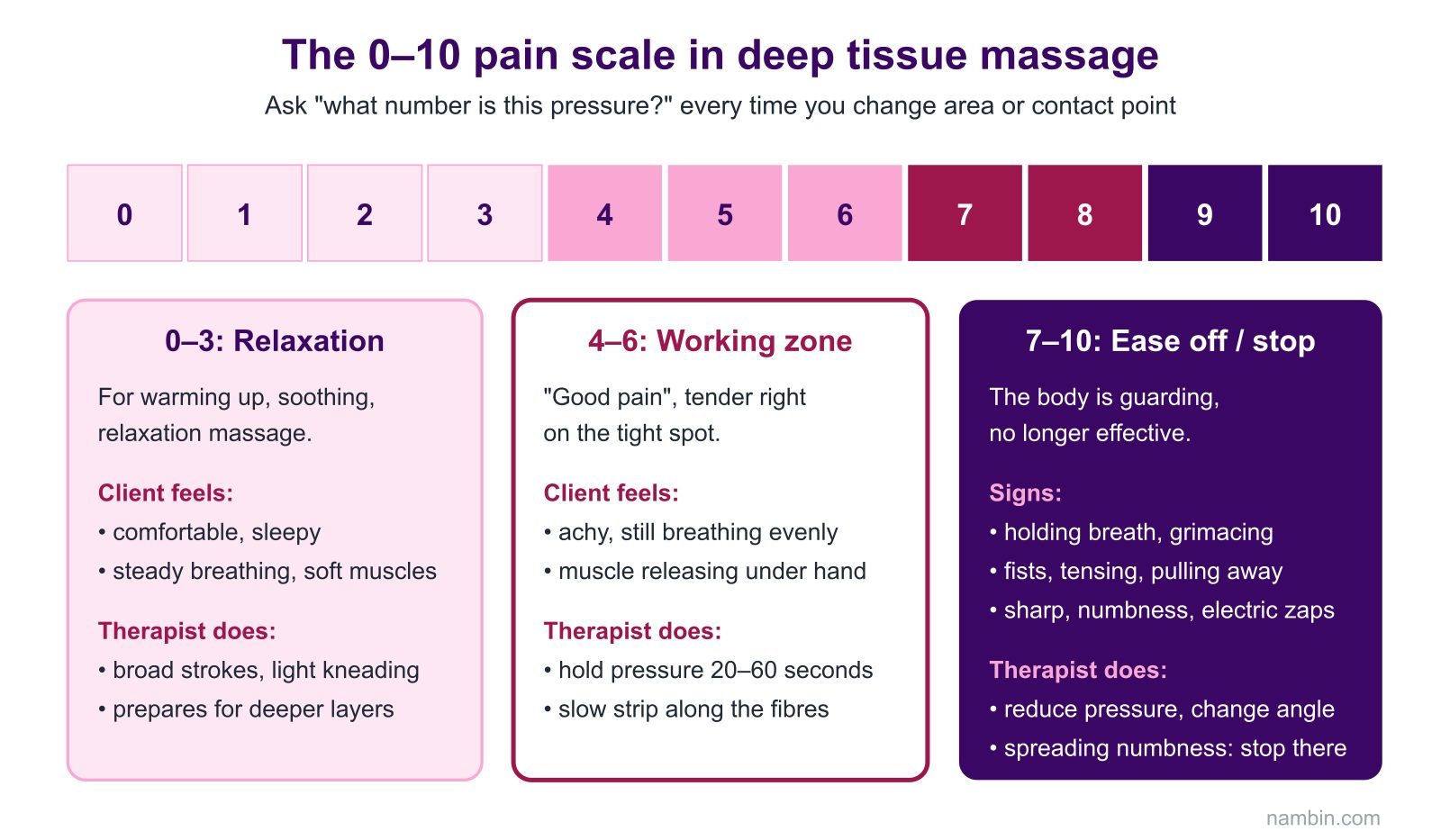
Introduce the pain scale before the session
Explain briefly while the client is still seated, before she gets on the treatment bed: "While I work, I'll ask you what level the pressure is at, from 0 to 10. Zero means you feel nothing, 10 means unbearable pain. We'll keep it around 5 or 6 – the 'hurts but feels good' kind. If it reaches 7, tell me and I'll ease off straight away."
Ask during the session
- Ask when starting a new area, when changing the point of contact (for example from hand to forearm), and when you have been holding pressure for a long time.
- When the client reports 7 or above: reduce pressure immediately; do not bargain with "bear it a bit longer so it breaks up".
Read the non-verbal signs
The client may say "5" while her body is signalling 8. Reduce pressure when you notice any of the following:
- Holding the breath, rapid breathing, quiet groaning.
- The muscle under your hand tightening instead of gradually softening.
- Clenched fists, curled toes, shoulders lifting off the bed, turning the face away.
- Unusual change in skin colour, or the client complains of numbness, sharp pain or heat spreading elsewhere. A sensation spreading down the arm or leg is a stop signal, because you may be pressing on a nerve.
A dull ache "in the right spot" can be acceptable at a moderate level. Stabbing, sharp, electric-shock pain or spreading numbness is never "good pain".
Remember: bruising after a session is not proof that you worked thoroughly. It is a sign of excessive pressure or pressure in the wrong place. Slight soreness for 24–48 hours can occur; bruising, swelling or increasing pain must be recorded in the client file and reported to the shift leader.
Endangerment sites: where deep pressure is never used
Endangerment sites are areas where large blood vessels, nerves or organs lie close to the surface with little muscle to protect them. At Level 1 you studied musculoskeletal anatomy; now connect that knowledge to each specific area. In these areas you may touch only lightly or avoid them entirely; never use deep thumb pressure, the forearm or the elbow.
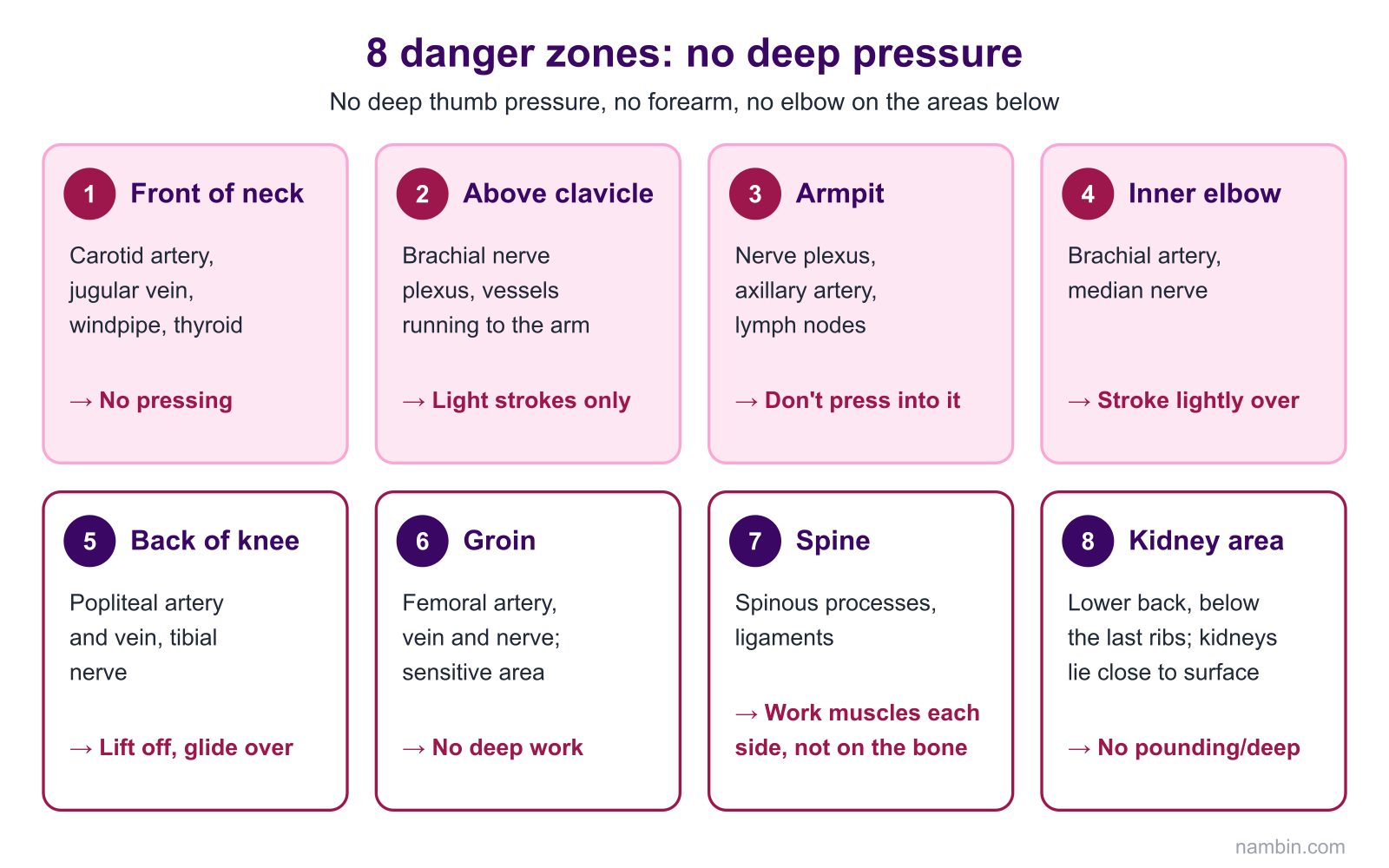
| Area | What lies beneath | What is allowed |
|---|---|---|
| Front of the neck, either side of the trachea | Carotid arteries, jugular veins, trachea, thyroid gland | No pressure. Work only on the back and sides of the neck with light pressure |
| Hollow above the collarbone | Brachial plexus (nerve network), blood vessels running down to the arm | No deep pressure; stroke lightly over it |
| Armpit, inner upper arm | Nerve plexus, axillary artery, lymph nodes | Do not press into the hollow; work the muscles around the armpit with light pressure, after asking permission |
| Front of the elbow crease | Brachial artery, median nerve | Stroke lightly over it, no press-and-hold |
| Back of the knee | Popliteal artery and vein, tibial nerve | No pressure; when gliding along the calf, lift the pressure and glide over the back of the knee |
| Groin, inner upper thigh | Femoral artery, vein and nerve; a sensitive area | No deep work. Stop at a safe distance from the groin according to spa policy, always draped |
| On the spine | Spinous processes of the vertebrae, ligaments | Do not press on the spine. Work the muscles on both sides, a few cm away from the spine |
| Kidney area (lower back, below the last rib) | The kidneys lie fairly superficially, with little bone protection | No pounding, no elbow pressure; stroke lightly |
In addition to these 8 areas, avoid deep pressure on the abdomen, the eyes, the area behind the ear below the earlobe, and anywhere you can feel a pulse. If you feel a pulse under your finger: move the point of contact immediately.
Contraindications specific to deep techniques
Level 1 taught the general contraindications. Deep techniques make the list longer, because strong pressure can rupture blood vessels, dislodge blood clots or worsen injuries.
| Condition | Why it is dangerous with deep work | What to do |
|---|---|---|
| Acute injury: a sprain, muscle strain or impact within the last few days; an area that is swollen, hot, red and painful | The tissue is inflamed; deep pressure causes internal bleeding and more swelling | Do not massage that area; work lightly elsewhere if the client wishes; advise a medical examination if there is a lot of swelling and pain |
| Suspected fracture or dislocation (after a fall, deformity, sharp pain on touch, unable to move) | Further displacement, damage to blood vessels and nerves | Do not touch the area; advise the client to go to a medical facility immediately |
| Taking anticoagulants or antiplatelet medication, or a blood clotting disorder | Bruises and haematomas form very easily even with medium pressure | No deep tissue work; only light massage, when the client's doctor allows it and it is recorded in the file |
| Marked varicose veins (twisting, bulging, blue-purple veins) | Weak vessel walls; strong pressure causes pain and vessel damage | No pressing and no deep gliding over the area; stroke very lightly around it or skip it |
| One calf swollen, hot, painful and red, especially after a long flight, surgery or childbirth | May be deep vein thrombosis; massage can make the clot move | Do not massage the legs; advise the client to see a doctor the same day |
| Osteoporosis, elderly clients, clients undergoing cancer treatment, after surgery | Brittle bones, weak tissue; a doctor's opinion is needed | No deep work; light massage with a doctor's opinion, according to spa policy |
| Pregnancy | Deep techniques and some positions are unsuitable | Do not provide deep tissue services; switch to the trained pregnancy massage routine |
| Diabetes with numbness or reduced sensation in the hands and feet | The client cannot report pain accurately and is easily injured without knowing | Light pressure; do not rely on the pain scale in numb areas; ask what the doctor has advised |
If you do not know what medication the client is taking, do not guess: write down the name of the medication, ask the shift leader, and choose light massage for now. Never advise a client to stop taking medication in order to have a treatment.
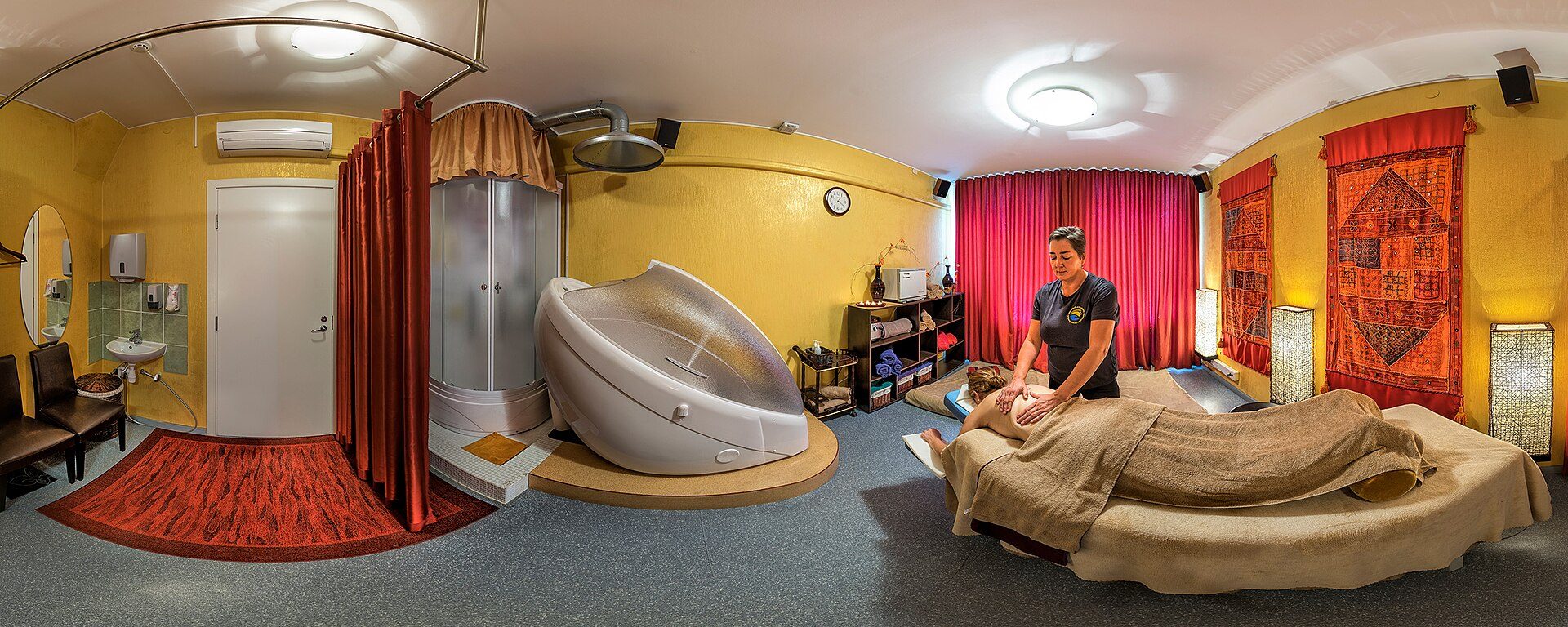
Photo: Lauri Veerde / Wikimedia Commons, CC BY-SA 4.0

The therapist's limits: no diagnosis, no manipulation
Clients often ask questions that tempt the therapist to "overstep": "Can you check whether I've got a slipped disc?", "Crack my neck for me so it clicks". The answer always stays within the scope of non-invasive care.
What the therapist does not do
- No diagnosis: do not say "you have a herniated disc", "you have tendinitis", "this muscle is torn". Describe only what you can feel: "Your right shoulder area is stiffer than the left."
- No manipulation or joint cracking: no jerking twists of the neck, no pressing the back to make "the joints click", no pulling to realign the spine. These are procedures belonging to medicine and rehabilitation, performed only by licensed practitioners at medical examination and treatment facilities under the Law on Medical Examination and Treatment No. 15/2023/QH15.
- No treatment promises: do not use phrases such as "cures slipped discs", "back pain gone for good", "treats sciatica".
- No over-stretching: passive stretching (where the therapist lifts the client's leg or arm) only within the range the client finds comfortable, slowly, with no bouncing. If the client has an old joint injury, leave out the stretch for that joint.
When to stop and advise the client to see a doctor
You do not diagnose, but you must recognise "red flags", the signs that the problem is no longer ordinary muscle tension.
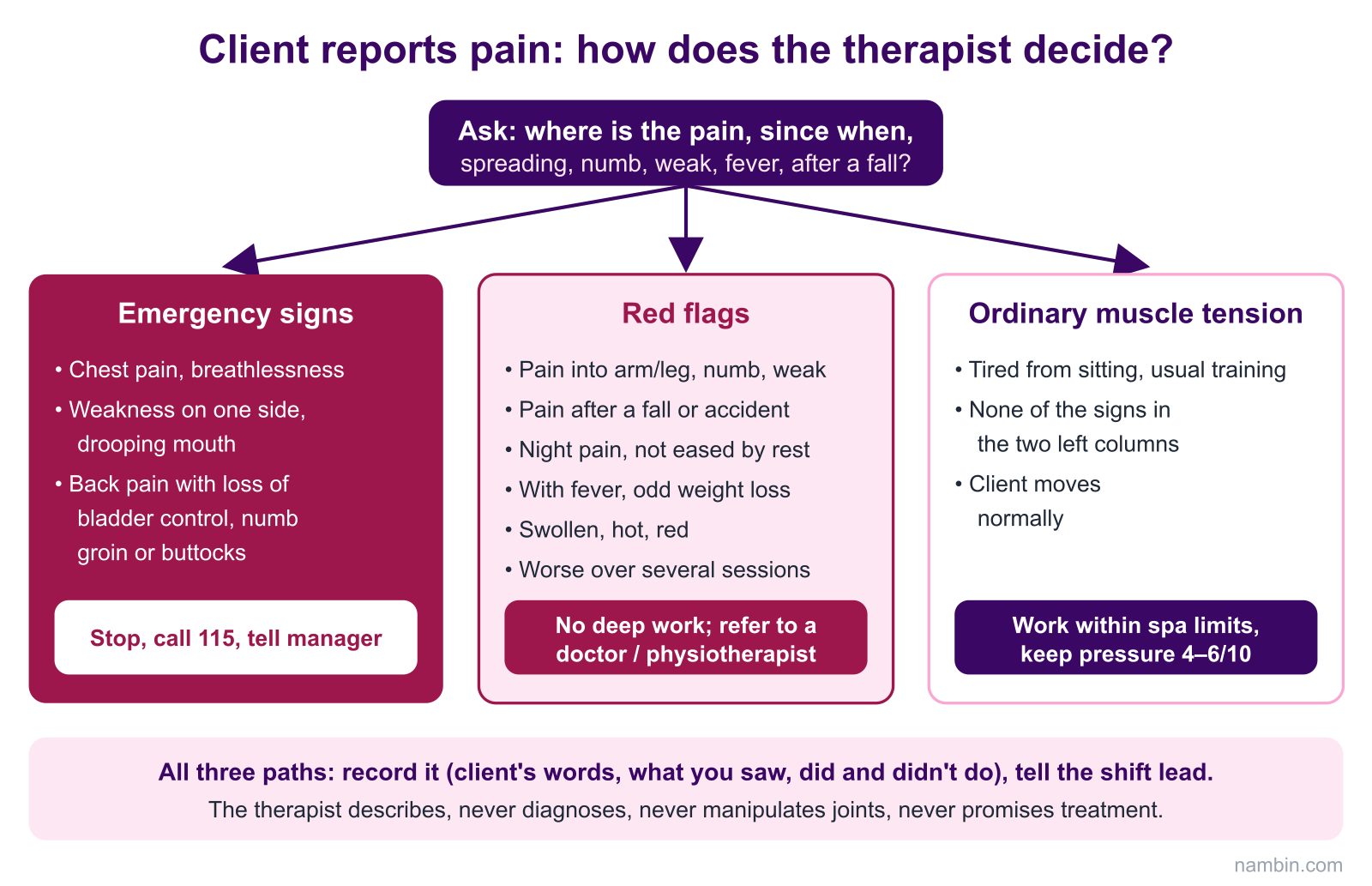
- Call emergency services on 115 immediately: chest pain, shortness of breath, weakness or paralysis on one side of the body, a drooping mouth, back pain with loss of bladder control or numbness in the groin or buttocks.
- Stop deep techniques and advise seeing a doctor or physiotherapist: pain spreading down the arm or leg with numbness or weakness; pain after a fall or accident; night pain that does not ease with rest; pain with fever or unexplained weight loss; an area that is swollen, hot and red; pain that does not improve or gets worse despite several care sessions.
- Continue within the spa's limits: tension and fatigue after computer work or after familiar training, with none of the signs above. Record it in the file and monitor session by session.
How to say it to the client: "The numbness spreading down your leg that you just mentioned – I think you should see a specialist doctor or a physiotherapist to get it checked. Today I'll just work lightly on your shoulders and upper back so you can relax." Speak calmly, without alarming the client and without diagnosing in place of a doctor.
A 60-minute deep tissue session for the back and shoulders
- Consultation and screening (5 minutes, before massage time): ask about tight areas and training schedule; go through the contraindications in the table above, especially anticoagulants, recent injuries and spreading numbness. Introduce the 0–10 pain scale.
- Agreement and preparation: choose 2–3 focus areas, for example the right side of the neck and shoulders and the lower back; warn the client that there may be slight soreness for 1–2 days. Lower the treatment bed and drape with towels as at Level 1.
- Warm up the whole back (8–10 minutes): broad strokes, gentle kneading, pressure 2–3/10.
- Middle layer (10 minutes): slow strokes with the heel of the hand along the paraspinal muscles and the trapezius, pressure 3–4/10, searching for stiff points.
- Deep layer on the focus areas (20–25 minutes): slow forearm glides along the erector spinae a few cm away from the spine, thumb press-and-hold around the inner border of the shoulder blade, keeping 4–6/10, checking pressure each time you change point.
- Soothing (5–8 minutes): broad strokes, gentle vibration, pressure gradually reducing to 2/10.
- Closing and aftercare advice (3–5 minutes): invite the client to sit up slowly and drink warm water. Advise: slight soreness for 1–2 days can occur; if there is bruising, swelling, increasing pain or spreading numbness, contact the spa. Record in the file: areas worked, points of contact, the highest pressure level the client reported, reactions.
For sports clients, replace step 5 with the muscle groups the client uses most (hamstrings and calves for runners; shoulders and forearms for badminton players) and ask about the competition schedule: if the event is less than 2 days away, no deep work.
Common mistakes in deep tissue work
| Mistake | Why it is dangerous or wrong | The correct way |
|---|---|---|
| Pressing hard from the first minute | The muscle contracts defensively, the client is in pain and bruises easily | Warm up for 5–10 minutes and increase pressure layer by layer |
| Believing "the more it hurts, the better it works" | Causes tissue damage; the client is afraid to come back | Keep to 4–6/10 and reduce immediately when it reaches 7 |
| Using the elbow on the neck, armpit, back of the knee or on the spine | Compresses blood vessels, nerves and bone | Use the elbow only on very thick muscles such as the gluteals and outer thigh |
| Cracking the neck or pressing the back to make "the joints click" because the client asks | Can cause serious injury; outside the scope of the spa | Decline politely and explain that this is the work of a medical facility |
| Deep work on the calf of a client just off a long flight, with one leg swollen | Risk of deep vein thrombosis | Do not massage the legs; advise a medical examination immediately |
| Saying "you've got a slipped disc, a few sessions with me and it'll be better" | Diagnosis outside your scope, a treatment promise | Describe what you feel; advise a medical examination when there are red flags |
Pass criteria for this lesson
You pass this lesson when you can do the following in front of your instructor:
- State correctly at least 4 differences between relaxation, deep tissue and sports massage, and name the 3 timings of sports massage with the appropriate pressure for each.
- Introduce the 0–10 pain scale to a "client" in no more than 30 seconds, and during the practical session check pressure at least every time you change area or point of contact.
- Perform 20 minutes of deep layer work on the back with the instructor playing the client, keeping the pressure within 4–6/10 according to feedback, without ever touching an endangerment site.
- Point out correctly on a model all 8/8 endangerment sites and name the underlying structures of at least 6 of them.
- Handle 3 role-play situations correctly: a client on anticoagulants, a client with one swollen calf after a long flight, and a client who demands a "neck crack"; with a sample script and a file record for each situation.
- List all the emergency signs that require calling 115 and at least 4 red-flag signs that require advising the client to see a doctor.
Frequently asked questions
The client keeps asking for "harder" – should the therapist go along with it?
You can increase pressure if the client still reports below 7 and the muscle under your hand is gradually softening. If the muscle is contracting, the client is holding her breath, or the area is an endangerment site, do not increase. Explain: "Deeper pressure right now makes the muscle tighten up – you'd feel pain without it softening any further. I'll go more slowly here so the muscle can release by itself."
The client is sore after a deep tissue session – did I do something wrong?
Slight soreness for 24–48 hours, similar to the feeling after a workout, can occur and should be mentioned in advance. Bruising, swelling, pain that keeps increasing after 2 days, or spreading numbness is not normal: record it in the file, report it to the shift leader, reduce pressure next time, and advise the client to see a doctor if it does not improve.
The client asks whether she should use a foam roller at home
You can speak in general terms: many people who train use a foam roller to soften their thigh and calf muscles themselves. Remind the client to roll slowly and avoid rolling over the knee joints, the spine and areas of sharp pain. If the client has an injury or is in rehabilitation, specific guidance should come from a doctor or physiotherapist.
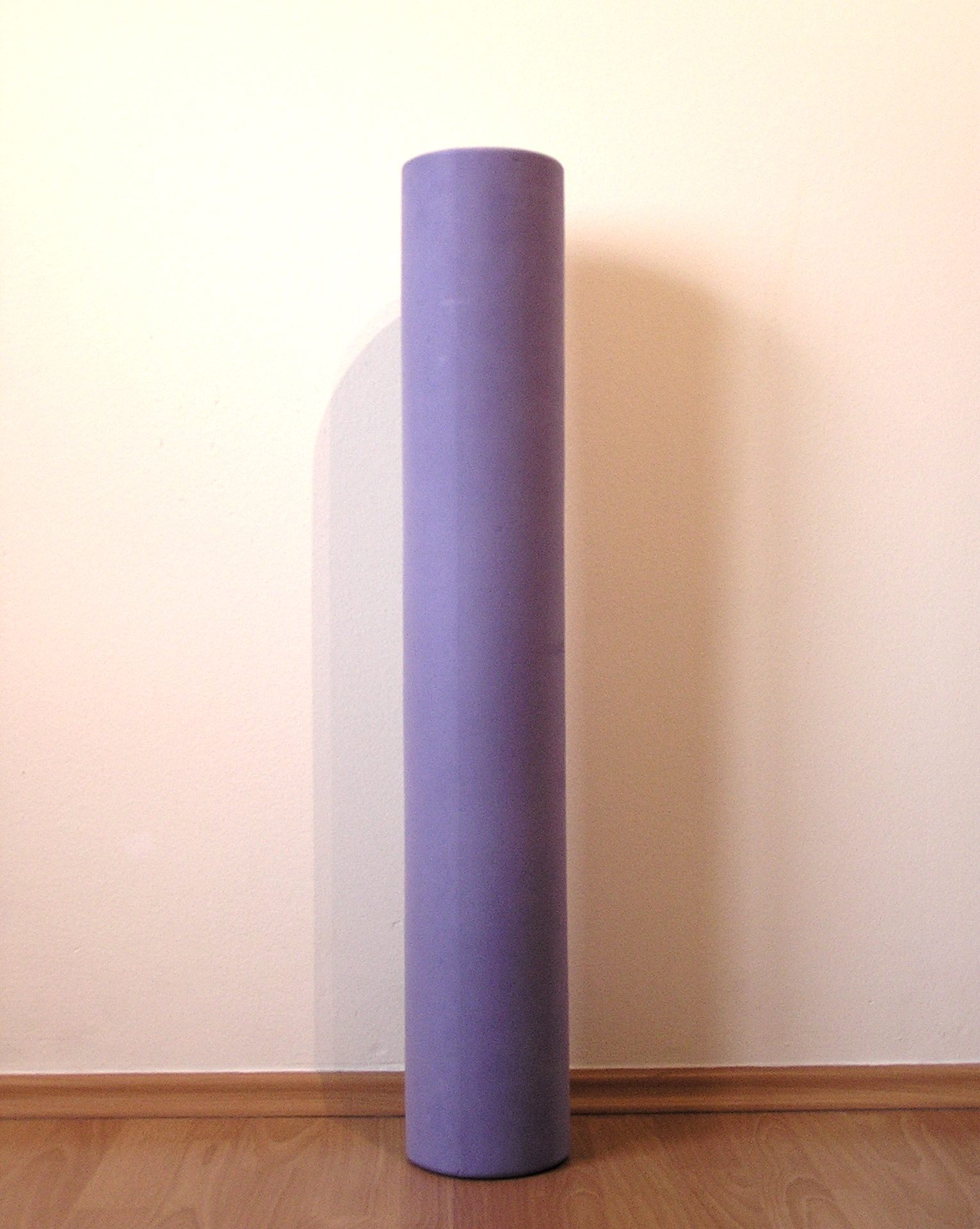
Photo: Finfit / Wikimedia Commons, CC BY-SA 3.0

Further reading
Review the rhythm and sequence of a relaxation session in the lesson 60-minute relaxing body massage: posture, hand pressure and standard spa sequence, and revisit the general contraindications in the lesson Skin structure and the contraindications every spa therapist must know by heart.