
In Vietnamese spas, the question clients ask most often when they sit down for a consultation is probably: "Could you look at this melasma for me – how do I get rid of it?" Close behind come the clients whose skin is red and stinging with every cream, whose cheeks are so thin the blood vessels show through, and who explain that "I used to use a cream from someone I know, it whitened really fast, and now when I stop, my skin breaks out and burns". Year-round tropical sun, the habit of buying unregulated mixed creams ("kem tron") online, and the wish to "whiten fast" mean these three groups of clients turn up every day: melasma, post-inflammatory darkening, and sensitive, irritated skin.
With these clients it is very easy for a therapist to make the skin worse: hot steam darkens melasma, grainy scrubs cause patchy darkening, strong peels create new dark marks, and selling a jar of "special treatment" cream of unknown origin pushes the client into corticosteroid dependence. A therapist who knows how to hold back, and knows when to say "you should see a dermatologist", keeps clients for the long term.
This lesson builds on what you learned at Levels 1 and 2 (skin structure, patch testing, skin analysis and Fitzpatrick typing, reading ingredient lists, superficial peels). With "difficult" skin, the principle of minimal intervention matters more than any technique.
By the end of this lesson, you will be able to:
- Describe, at the level of observation, the signs suggestive of melasma, post-inflammatory hyperpigmentation and sensitive skin, and record them on the client card in a therapist's words, without diagnosing in place of a doctor.
- List all six factors that make melasma, dark marks and irritation worse, and replace each one with a safe technique in the treatment room.
- Carry out the gentle-care procedure for melasma-prone and sensitive skin in about 60 minutes, without steaming and without rubbing.
- Teach clients to apply sunscreen in the right amount, in the right way, and to reapply at the right time.
- Recognise the signs of suspected corticosteroid-damaged skin from mixed creams, talk to the client appropriately and refer to a dermatologist at the right moment.
Three common conditions: melasma, post-inflammatory hyperpigmentation, sensitive skin
First, a professional principle: therapists do not diagnose skin diseases. Melasma, pigmentation disorders and dermatitis are medical diagnoses, within the doctor's scope under the Law on Medical Examination and Treatment No. 15/2023/QH15. Your job is to observe, ask, record, and use phrases such as "area of darker pigmentation on both cheekbones, suggestive of melasma; client advised to see a dermatologist". When speaking to the client, avoid "you have deep melasma"; say instead "I can see darker pigmentation here, even on both sides – to be sure, you should have a dermatologist look at it".
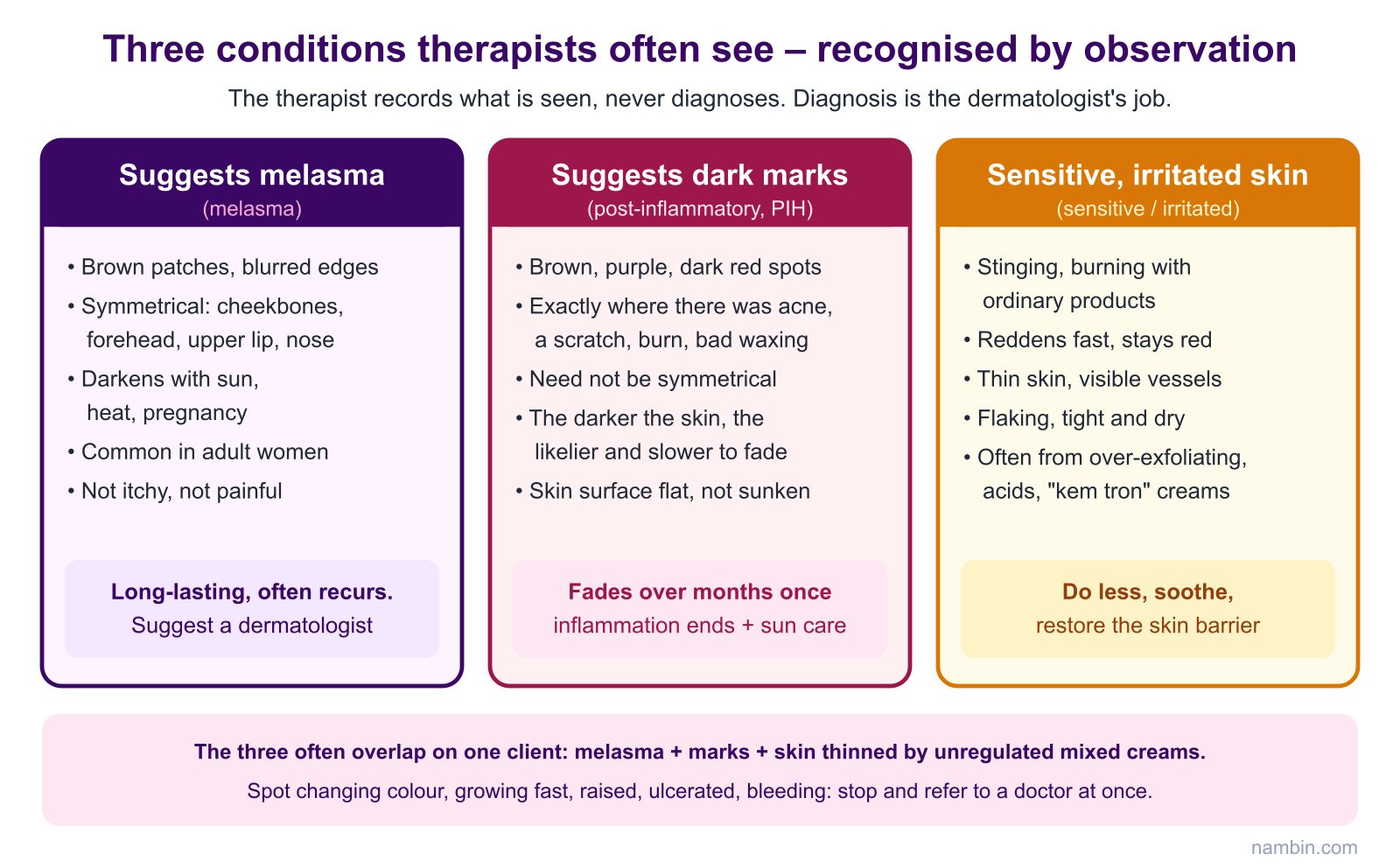
Suggestive of melasma
Melasma usually appears as patches of light to dark brown with indistinct borders, located symmetrically on both sides of the face: cheekbones, forehead, bridge of the nose, upper lip, and sometimes the chin. Melasma is common in adult women with medium-dark skin, and tends to darken in the sunny season, during pregnancy, when taking oral contraceptives, or with frequent heat exposure (working at a stove or near an oven). Melasma does not itch, hurt or flake. The most important feature for the therapist: melasma is a long-lasting condition that recurs easily. It can be lightened and controlled, but no spa product or treatment programme "cures it for good".
Suggestive of post-inflammatory hyperpigmentation (PIH)
PIH (post-inflammatory hyperpigmentation) means brown, purple or dark red spots appearing exactly where the skin was previously inflamed: a spot, a scratch, a minor burn, a badly done wax, an over-strong peel. Inflammation stimulates the pigment cells to produce more melanin, and the darker the skin (Fitzpatrick III–V, like most Vietnamese people), the more prone it is and the longer the marks take to fade. Unlike melasma, PIH does not have to be symmetrical, and the skin surface remains flat (if it is depressed, it is a scar, not a dark mark). Once the inflammation has gone and with good sun protection, the marks usually fade over months; each new episode of rubbing or irritation creates new marks.
Sensitive, irritated skin
"Sensitive skin" is not a disease; it describes skin that overreacts to ordinary things: stinging when moisturiser is applied, reddening quickly when touched, redness that takes a long time to fade, tightness, dryness and flaking. Many clients cause this themselves through overuse: exfoliating every day, layering several acids and retinoids, using mixed creams. The skin barrier (the stratum corneum and the lipid layer, learned at Level 1) is broken, water escapes and irritants get in easily. Some clients have a genuine skin disease such as rosacea or atopic dermatitis, which needs a doctor's diagnosis.
What to ask during the consultation
- How long has the pigmented area been there, and when does it get darker (sunny season, after childbirth, after starting oral contraceptives)?
- What products are you using, morning and evening? Any creams bought without a label, "mixed creams", "face creams", or creams mixed by someone you know?
- Are you using any topical or oral medicine prescribed by a doctor? Have you recently had laser, microneedling or a peel elsewhere?
- Does your skin sting, burn or itch when you apply ordinary products? Does it go red when you drink alcohol, eat spicy food or are somewhere hot?
- Habits: riding a motorbike at midday, working outdoors, working at a stove; do you use sun protection every day?
Record the answers on the consultation form. Progress photographs (same angle, same light source, bare face) are recommended when the client agrees by signature; the photos are only for monitoring in the client file.
Six factors that make melasma, dark marks and irritation worse
Melanin is the "shield" the skin produces when it is under attack. Whatever attacks, inflames or heats the skin also stimulates pigment. With melasma and dark marks, you must treat every action in the treatment room as a potentially harmful stimulus, and only do it when the benefit is clear.
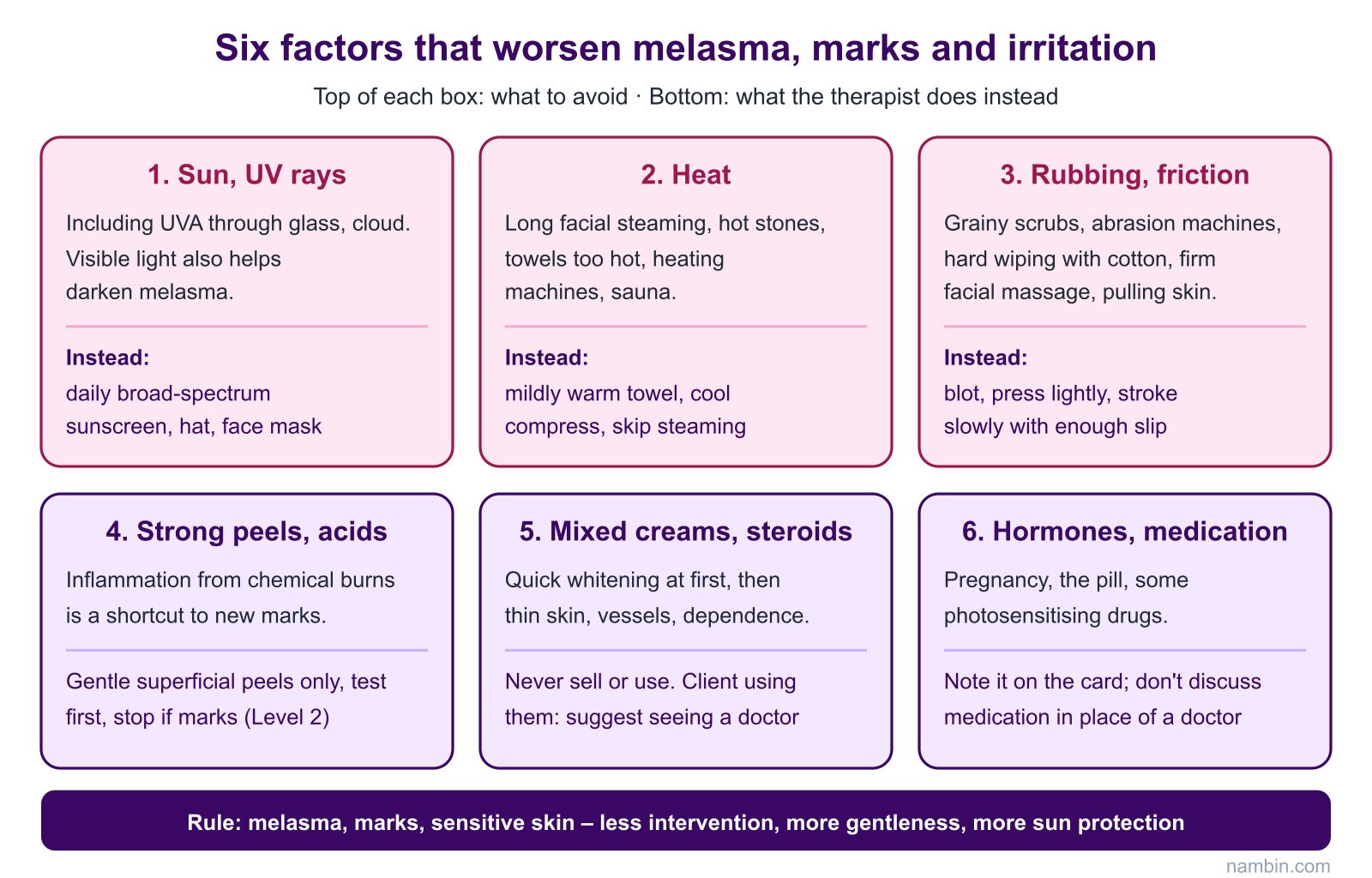
- Sun and UV rays. UVB causes sunburn; UVA passes through clouds and window glass, penetrates deeper and stimulates pigment. Visible light also contributes to darkening melasma in darker skin, so a client who sits by a glass window all day can still see her melasma darken.
- Heat. Heat dilates blood vessels and stimulates pigment cells. For melasma-prone skin, skip facial steaming, do not leave hot towels on for long, and do not use hot stones or heating machines on the face. Use instead a moderately warm towel (tested on the inner wrist, it should feel comfortable, not hot), cool compresses and cooling gel masks.
- Rubbing and friction. Grainy exfoliants, microdermabrasion machines, rubbing hard with cotton pads, firm massage and stretching the skin all create micro-injuries and mild inflammation. Replace them with blotting, light pressure and slow strokes with enough slip product.
- Peels and strong acids. At Level 2 you learned that peels can cause post-inflammatory hyperpigmentation, especially in darker skin. For melasma or dark marks, only consider a slow-penetrating superficial peel (mandelic, lactic) when the skin is stable, has been patch tested, following the manufacturer's instructions, and stop immediately if the previous session left dark marks. Do not peel irritated skin.
- Mixed creams and creams containing corticosteroids. This is the leading cause of skin damage that therapists see. It is covered in detail later in this lesson.
- Hormones and medicines. Pregnancy, oral contraceptives, and some medicines that make the skin sensitive to sunlight. The therapist records these on the client card and does not advise the client to stop or change medicines; medicines are the doctor's business.
Sun protection: the most important part of every treatment programme
If a melasma client hears only one piece of advice from you, let it be sun protection. Every brightening or soothing treatment programme loses its effect if the client goes out without protecting her skin. Vietnam lies in the tropics, and the UV index is usually high to very high in the middle of the day, even on overcast days.
Photo: US Government material. Figure obtained from the National Oceanic and Atmospheric Administration. / Wikimedia Commons, Public domain

Choosing a sunscreen
- Broad spectrum: protects against both UVB and UVA. SPF measures protection against UVB; UVA protection is usually shown as PA (PA+++ or higher) or as "UVA" in a circle, depending on the country of manufacture.
- SPF 30 or higher for daily use; SPF 50 for long periods outdoors.
- For melasma-prone skin, a tinted sunscreen (containing iron oxides) blocks part of the visible light as well, and is often recommended by dermatologists.
- For sensitive skin, prefer fragrance-free products; mineral filters (zinc oxide, titanium dioxide) are usually gentler, but a patch test is still required.
- Products sold or used in the spa must be clearly labelled and have a cosmetic product notification under Circular 06/2011/TT-BYT on cosmetics management.
Apply enough, reapply at the right time
Most clients apply too little – only a third to a half of the amount needed – so the real SPF is much lower than on the label. The easiest method to teach is the two-finger rule: squeeze the sunscreen into two long lines along the index and middle fingers, which is enough for the face and neck.
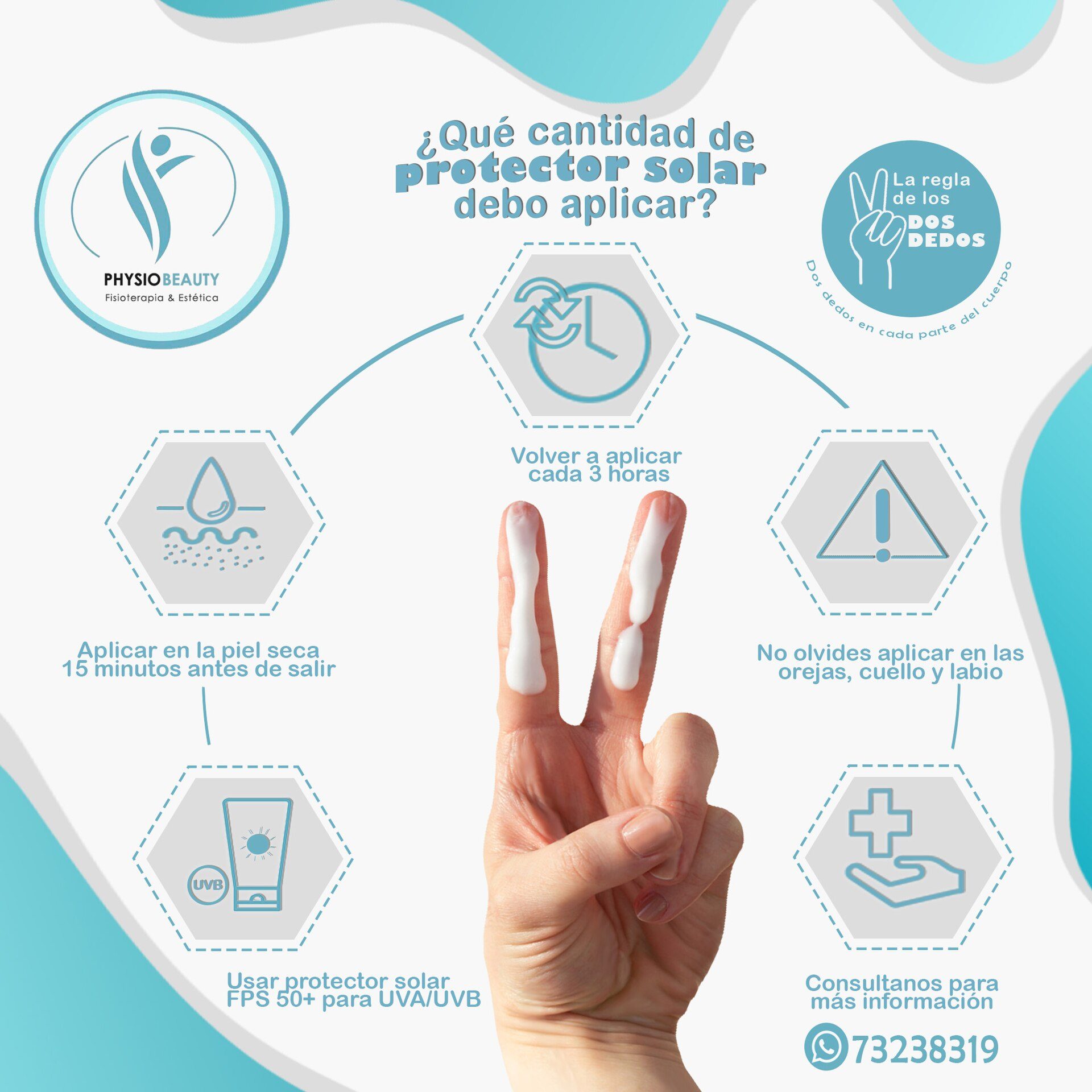
Photo: Gabriela Isabel Sánchez Luque / Wikimedia Commons, CC BY-SA 4.0

- Apply after moisturiser and before make-up, about 15 minutes before going out.
- Dot it evenly on five points (forehead, both cheeks, nose, chin), then spread by patting gently, not rubbing hard.
- Do not forget the easily missed areas: the hairline, eyelids (using a product gentle enough for the eyes), ears, neck and the back of the neck.
- Reapply about every 2 hours when outdoors, after heavy sweating, and after wiping the face.
- Combine with physical protection: a wide-brimmed hat, face mask, sun-protective clothing, sunglasses, and avoid going out between about 10 a.m. and 4 p.m. when possible. Riding a motorbike at midday is one of the biggest sources of sun exposure for Vietnamese clients.
Mixed creams and corticosteroids: a warning every therapist must know
"Kem tron" – unregulated mixed creams – is the name for home-mixed creams, unlabelled creams or creams with vague labels, sold with claims such as "express whitening in 7 days" or "special melasma face cream". Many have been found to contain corticosteroids (steroid anti-inflammatory medicines), and some contain high-concentration hydroquinone or mercury. Corticosteroids are medicinal active ingredients and must not be present in cosmetics; topical corticosteroid medicines are only used when prescribed by a doctor, for the right duration and on the right area.
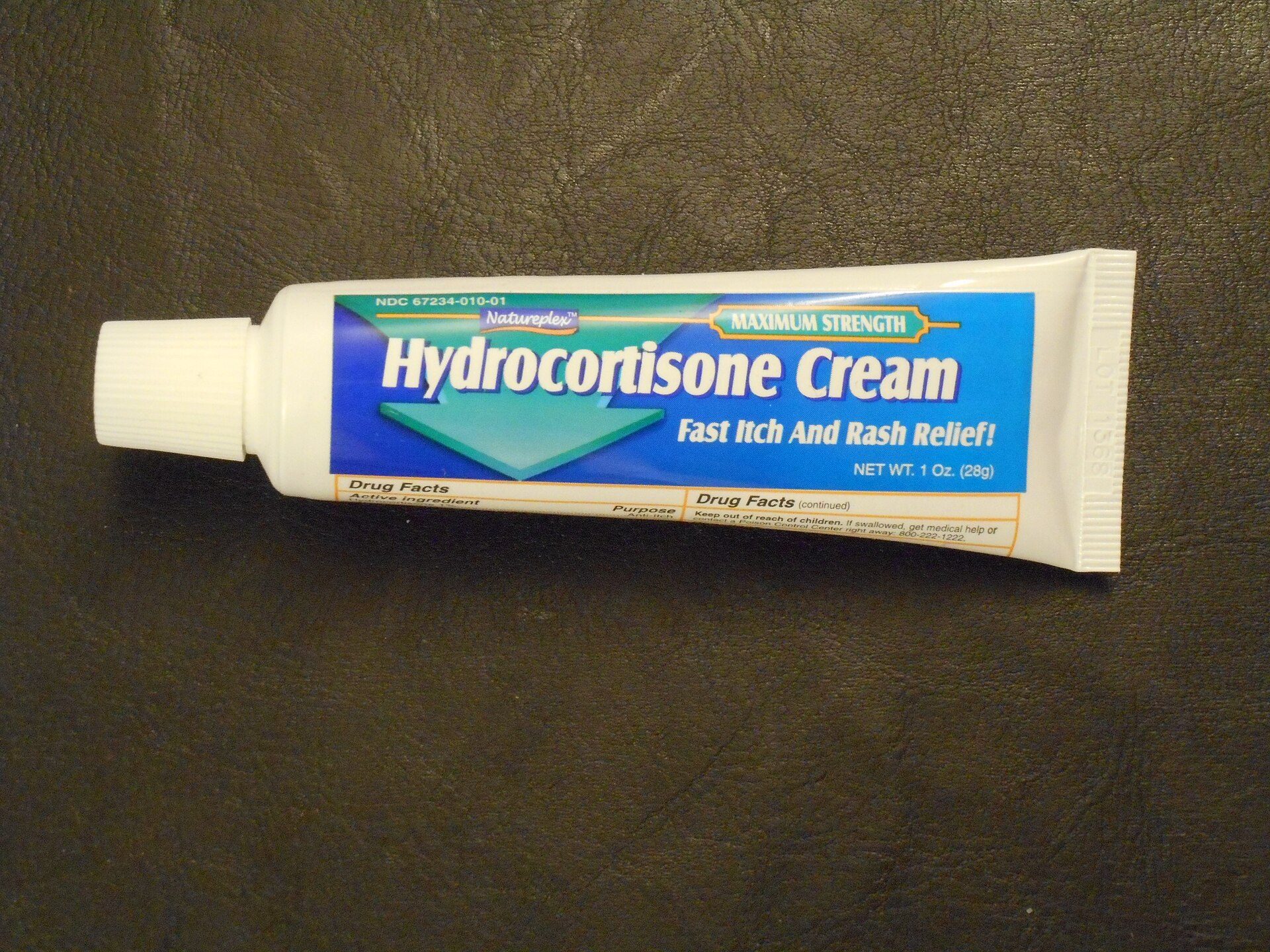
Photo: Father Goose / Wikimedia Commons, CC BY-SA 4.0

Why creams containing corticosteroids are dangerous
Corticosteroids constrict blood vessels and reduce inflammation, so at first the skin looks white, smooth and no longer red. With prolonged use on the face, the skin gradually thins, dilated blood vessels show through, and pustules, fungal infections and fine facial hair appear easily. When the cream is stopped, the skin flares red, burning and itchy; the client is frightened and starts applying it again: that is the cycle of dependence.
Signs of suspected corticosteroid-damaged skin
- The client says she has used fast-whitening creams, unlabelled creams or creams mixed by someone she knows, continuously for many months.
- Thin, shiny, red skin with small blood vessels clearly visible on the cheeks and nose.
- Many small, uniform spots and pustules in the area where the cream was applied.
- Burning, itching and flaring redness a few days after stopping the cream.
What the therapist does and does not do
- Do not peel, exfoliate, perform extraction, massage firmly or steam skin suspected of corticosteroid damage.
- Do not sell "corticosteroid detox", "lead removal" or "toxin peeling" treatments. They have no basis, and skin that is already damaged will get worse.
- Do not advise the client to stop or reduce the cream on her own according to word-of-mouth advice, and do not give her any other medicine. This needs to be supervised by a dermatologist.
- Do tell the truth gently: "Your skin is showing signs of damage from long-term use of that cream. At this point you should see a dermatologist, who can guide you on stopping the cream safely. Once the doctor agrees, we can support you with gentle care."
- Do record on the client card: product name (if the client remembers), how long it was used, the signs observed, the advice given, and the date and time.
- The spa must never mix or sell mixed creams, and must never sell products without a cosmetic product notification. Advertising "cures melasma for good" or "white in 7 days" is untrue and may breach the Advertising Law 2012.
Gentle-care procedure for melasma-prone, darkened and sensitive skin (about 60 minutes)
The procedure below applies when the client has no signs requiring immediate referral to a doctor, or has been given the doctor's agreement for supportive care. Aim: cleanse, soothe, hydrate, strengthen the skin barrier, protect from the sun. No step "blasts away" melasma. Products used must be gentle, without strong fragrance or drying alcohol, labelled and notified; new products must be patch tested first, as learned at Level 1.
- Re-screen and sign the form (5 minutes). Ask the questions above, even for regular clients: any new products, new medicines, recent heavy sun exposure, recent procedures anywhere. If there are "stop and refer immediately" signs, stop at this step.
- Progress photographs (2 minutes), if the client agrees: same angle and same lighting as last time, bare face.
- Gentle make-up removal (5 minutes). Use a gentle cleansing oil or milk, let the product dissolve the make-up, then remove with damp cotton by blotting and stroking lightly in one direction. Do not rub back and forth.
- Cleanse (5 minutes). A gentle cleanser with a pH close to that of the skin, cool or lukewarm water, never hot. Pat dry with a soft towel.
- Quick skin analysis (3 minutes). Observe under the magnifying lamp: pigmented areas, red areas, flaking areas. Record on the client card and compare with last time. Skip the steaming step.
- Soothing toner (2 minutes). Press on with the hands or cotton; no drying alcohol.
- Light-pressure facial massage (10 minutes). Enough slip product, slow strokes, light pressure, no vigorous circular rubbing. Shorten or skip if the skin is red. The detailed technique is covered in a later lesson.
- Soothing mask (15 minutes). A gel or sheet mask that hydrates and soothes, following the manufacturer's instructions; ask the client whether it stings.
- Serum and repair cream (5 minutes). Prefer barrier-strengthening ingredients such as ceramides, panthenol and glycerin. Melasma-prone skin that is not irritated can take a cosmetic serum that supports an even tone (niacinamide, gentle vitamin C, tranexamic acid…) as learned at Level 2.
- Sun protection and aftercare advice (5 minutes). Apply sunscreen in the correct amount. Advise the client to use sun protection, not to rub, not to pick or squeeze, and to report back if there is redness or stinging. Record on the client card: products, batch numbers, reaction, photographs taken, next appointment.
The steps total about 57 minutes. For skin that is currently irritated, the first session may consist only of cleansing, a soothing mask and sun protection.
Setting the client's expectations
Say clearly from the start: "Our treatment programme helps your skin feel calm and hydrated, and supports a more even tone as long as you use sun protection consistently. Melasma recurs easily; for in-depth treatment you need a dermatologist." Do not promise "melasma gone" or "skin several shades whiter after 5 sessions".
What the spa does, and when to work with or refer to a doctor
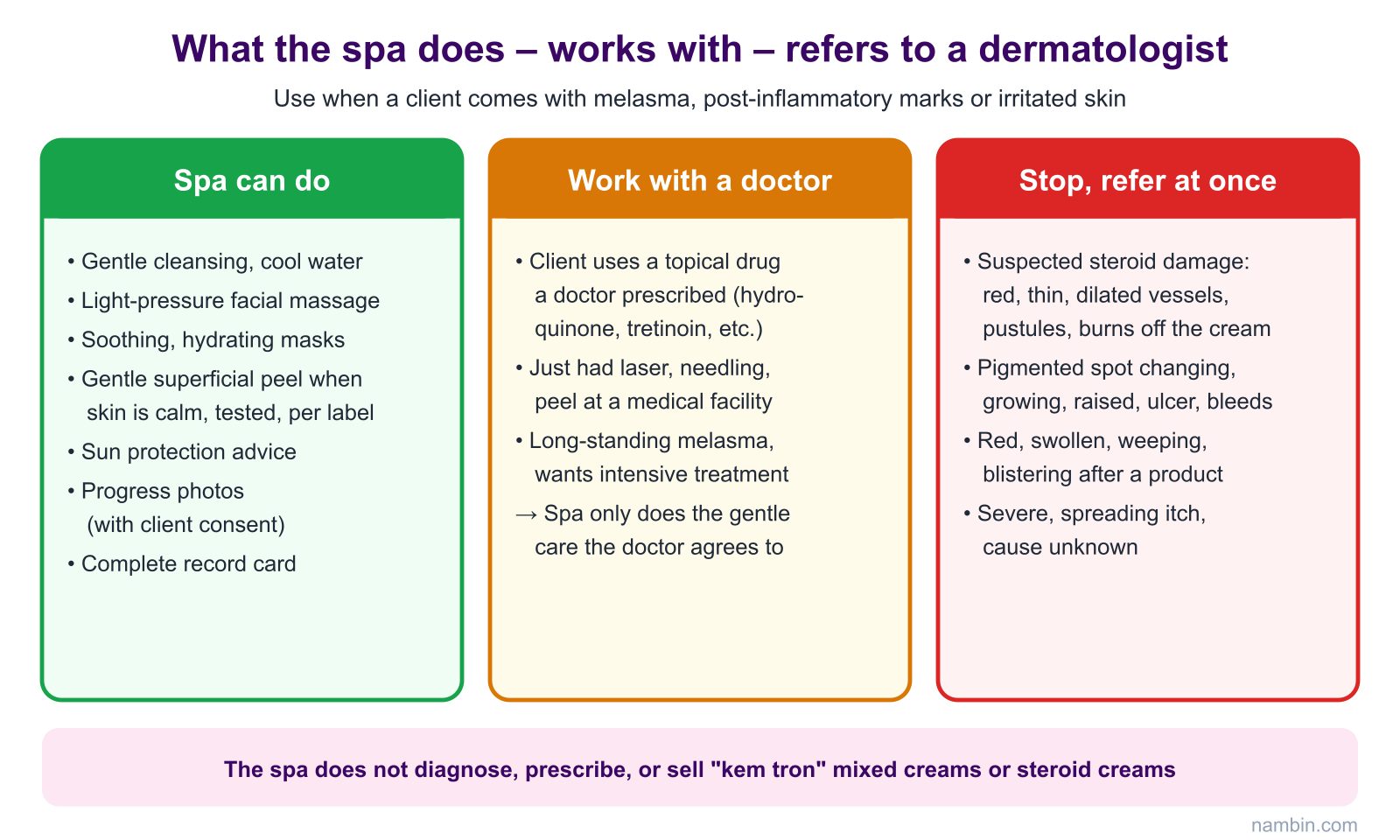
Laser and IPL treatment for melasma, medium and deep peels, deep microneedling, mesotherapy injections for melasma, prescribing topical hydroquinone or tretinoin, and oral medicines for melasma all fall within the scope of licensed medical examination and treatment establishments. The spa does not perform them, does not "try them out" and does not present them as spa services.
Working with the doctor
Clients currently under a doctor's treatment (using prescribed topical medicines, recently treated with laser, or recently peeled at a medical establishment) can still come to the spa, but the spa only provides the gentle care the doctor has agreed to, without adding strong active ingredients on top.
Stop the service and refer immediately
- Suspected corticosteroid-damaged skin as described above.
- A pigmented spot that changes colour, grows quickly, has a ragged border, becomes raised, ulcerates or bleeds, or a new spot that looks quite different from the others. Apply nothing to it, do not perform extraction, and invite the client to see a dermatologist soon.
- Redness, swelling, weeping or blistering after using a product, whether at the spa or at home.
- Severe itching, widespread red rash or thick flaking with no clear cause.
When you refer a client, do not sell an alternative service at that moment. Record it on the client card and phone to check on the client a few days later; that kind of reputation lasts longer than any treatment package.
Common mistakes when caring for melasma-prone and sensitive skin
| Mistake | Why it is dangerous/wrong | The correct way |
|---|---|---|
| Hot steaming or hot towels for a melasma client | Heat stimulates pigment and darkens melasma; sensitive skin becomes red and stinging | Skip steaming; use moderately warm towels, cool compresses, gel masks |
| Grainy scrubs or abrasion to "peel off the melasma layer" | Friction causes inflammation, creates new dark marks and breaks the skin barrier | Gentle cleansing, no rubbing; only consider a slow-penetrating superficial peel when the skin is stable |
| Saying "you have deep melasma", "you have dermatitis" | A diagnosis beyond the therapist's scope, and possibly wrong | Describe what you see and suggest a dermatology examination |
| Promising "cures melasma for good", "white in 7 days" | Untrue, disappoints the client, and may breach the Advertising Law 2012 | Say "supports, soothes, gradually evens the tone with good sun protection" |
| Selling or using unlabelled creams or mixed creams | May contain corticosteroids or mercury; causes dependence and skin damage | Only use labelled products with a cosmetic product notification |
| Peeling or performing extraction on skin suspected of corticosteroid damage | The skin is thin; damage worsens and infection is likely | Stop the service and invite the client to see a dermatologist |
| Skipping sunscreen at the end of the session and giving no advice | The sun wipes out all the care work | Apply sunscreen at every session and teach the two-finger rule |
| Layering the spa's active ingredients on top of prescribed medicines | Irritation, dark marks, interference with the treatment | Only provide gentle care the doctor has agreed to; ask clearly about restriction periods |
Pass criteria for this lesson
You pass this lesson when you can do the following in front of your instructor:
- Look at 5 photographs or 5 described scenarios and correctly place at least 4/5 into the groups suggestive of melasma, post-inflammatory hyperpigmentation or sensitive skin, recording them on the client card in descriptive language, without diagnostic terms.
- List all 6/6 aggravating factors (sun, heat, rubbing, strong peels, corticosteroid mixed creams, hormones and medicines) and state the alternative technique for each, in no more than 3 minutes.
- Carry out all 10/10 steps of the gentle-care procedure on a model, in the correct order, within 55–65 minutes, without steaming and without rubbing.
- Teach a role-play client to use sunscreen: the correct amount by the two-finger rule, reapplication about every 2 hours outdoors, and at least 3 methods of physical protection.
- List at least 4 signs of suspected corticosteroid-damaged skin and deliver an appropriate referral statement, without diagnosing and without selling an alternative service.
- Correctly sort 3/3 scenarios given by the instructor into the three columns: the spa can do it, work with a doctor, stop and refer immediately.
Frequently asked questions
A client asks "how many sessions until my melasma is gone?" – what do I say?
Answer truthfully: melasma is a long-lasting condition that recurs easily, and no number of sessions can guarantee it will be "gone". Spa treatment helps the skin feel calm and hydrated and gradually supports a more even tone if the client uses sun protection consistently and avoids aggravating factors. If the client wants treatment, recommend a dermatology examination. The client can continue gentle care at the spa alongside it when the doctor agrees.
Can melasma-prone skin have a facial massage?
Yes, if the skin is not currently irritated. Use light pressure and enough slip product, no vigorous circular rubbing, no scrubbing, and do not heat the skin. If the skin is red and stinging or suspected of corticosteroid damage, do not massage: only cleanse gently and apply a soothing mask, or postpone entirely and refer to a doctor.
A client is using a topical medicine prescribed by a doctor – can she have spa services?
Possibly, but only gentle care: cleansing, hydration, soothing masks, sun protection. Ask the client for the name of the medicine and the doctor's instructions, and record them on the client card. No peels, and no additional acids or retinoids from the spa. If unsure, suggest the client asks the doctor before booking.