A Zalo message at nine in the evening: "Do you do lip filler? The other place only charges 1.5 million." The next morning the spa owner shows you a newly bought lip-tattooing machine, with the promise that "three days of training and you'll be able to do it". That same afternoon a regular client who has just had nose filler at a friend's "clinic" feels some pain and asks you to "massage it gently to bring the swelling down". In all three situations the right answer begins with "no"; the hard part is how to say "no" and what to do next.
By the end of this lesson, you will be able to:
- Explain in your own words what an invasive procedure is, and correctly place the services clients often ask about (filler, botox, mesotherapy, deep microneedling, cosmetic tattooing, thread lifts) in the group the spa does not do.
- State, at the level of principle, why the Law on Medical Examination and Treatment No. 15/2023/QH15 places these procedures within the scope of licensed medical establishments.
- Describe the real risks accurately: infection, blood-borne disease transmission, and vascular occlusion by filler leading to skin necrosis or loss of vision.
- Recognise the signs of complications in clients who have had procedures elsewhere, sort them into three levels and respond correctly: call 115 immediately, advise a medical examination the same day, or postpone services on that area.
- Refuse politely but firmly when a client, colleague or the spa owner asks you to perform such a procedure, and record the refusal.
Note on the scope of this lesson: this lesson does not teach any technique for injecting, tattooing, microneedling or thread lifting. You are learning to recognise danger and refer the client to the right place, not to perform the procedure.
What "invasive" means: the line the spa does not cross
At Level 1 you learned that the skin has three layers: the epidermis, the dermis (containing blood vessels and nerves) and the hypodermis. The outermost stratum corneum is the body's protective barrier. Non-invasive care works on the surface of that barrier.
A procedure is invasive when it deliberately breaks through the skin barrier: using a needle, blade or cannula to pierce the skin; introducing a substance into the dermis, fat or muscle; or using energy (laser, treatment IPL) to cause deliberate tissue injury. Once inside the skin, the procedure can hit blood vessels or nerves and carry bacteria deep down. That is why it requires a person with medical expertise, a sterile room, medicines and emergency equipment.
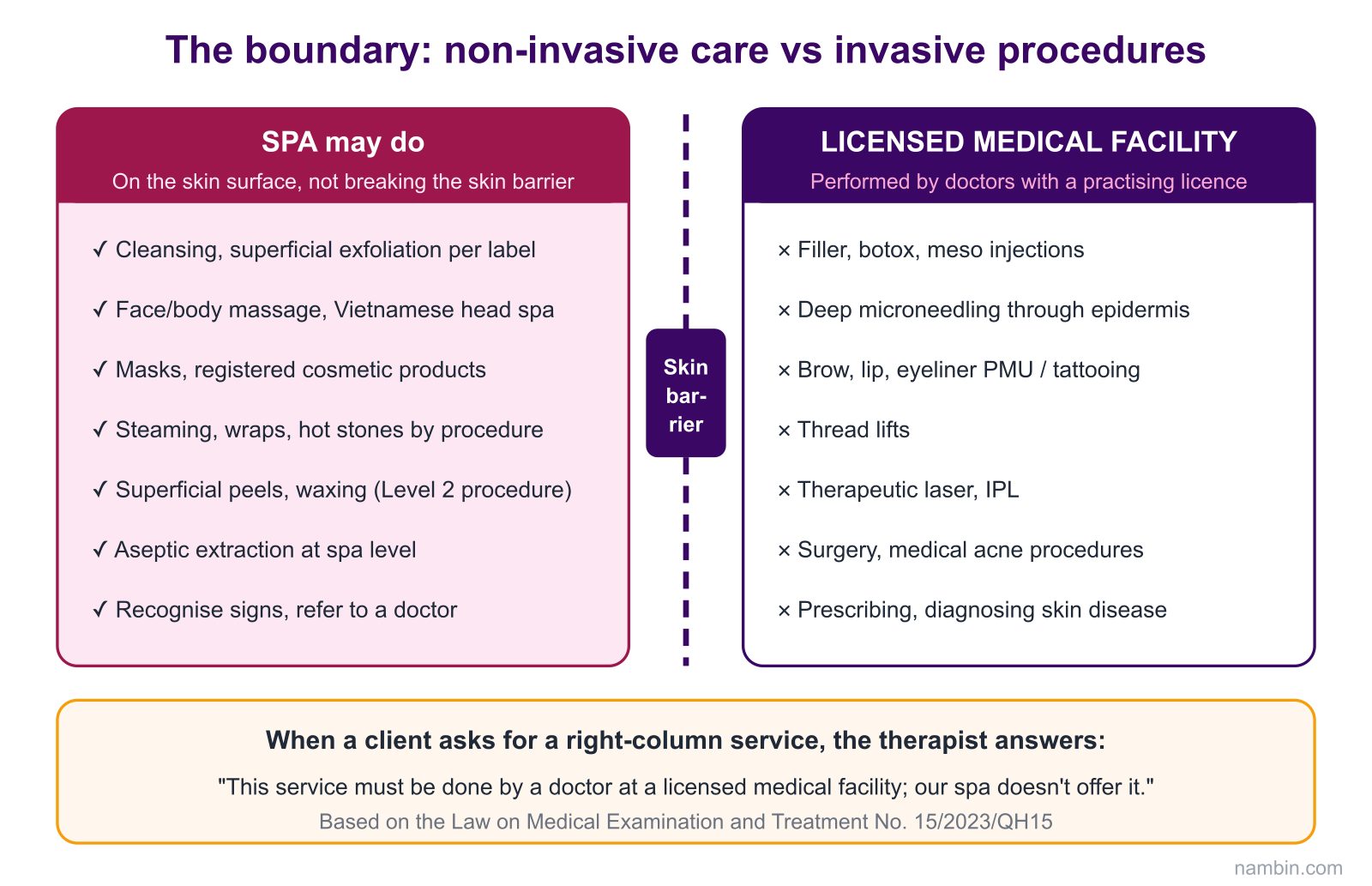
Six services spas are often asked about
| Service | What it is | Belongs to | What the spa can offer instead |
|---|---|---|---|
| Filler injection (dermal filler) | Injecting a filler, most commonly hyaluronic acid (HA) gel, into the dermis or deeper to create volume in the lips, nose, chin or folds | A doctor at a licensed medical examination and treatment establishment | Hydrating skin care, relaxing facial massage; state clearly that it cannot change facial volume or shape |
| Botox injection | Injecting botulinum toxin, which is a medicine, into muscle to reduce muscle contraction | A doctor at a licensed establishment | Topical cosmetics containing peptides; state clearly that the effect is quite different and limited |
| Mesotherapy injection | Injecting a mixture of active ingredients superficially into the skin at many points | A doctor at a licensed establishment | Applying masks and serums as directed on the cosmetic label, without introducing them through the skin |
| Deep microneedling | Using needles to puncture many holes in the skin to stimulate wound healing | A medical establishment, when it passes through the epidermis | Superficial exfoliation as directed on the label, as learned at Level 2 |
| Cosmetic tattooing, microblading (brows, lips, eyeliner) | Using needles to introduce pigment into the skin | Outside the scope of non-invasive care; when injected local anaesthetic is used, it is within the scope of a medical establishment | Make-up, brow shaping with tweezers following an aseptic procedure |
| Thread lift | Inserting threads under the skin with a needle or cannula to pull tissue | A doctor at a licensed establishment | Relaxing lifting-style massage; do not promise "a lift like threads" |
Three things to remember. First, HA filler is usually regulated as a medical device and botox is a medicine; they are not cosmetics. Under Circular 06/2011/TT-BYT on cosmetics management, a cosmetic is a product used on the surface of the body, so there is no such thing as an "injectable cosmetic". Second, an alternative service always comes with a statement of its limits, and never promises the results of a procedure. Third, this course places every technique that uses needles to pierce the skin in the group therapists do not perform; "how shallow is acceptable" is a medical question, and therapists do not judge it themselves.
Why the law places these procedures in medical establishments
The Law on Medical Examination and Treatment No. 15/2023/QH15 sets out a general principle: medical examination and treatment, including techniques that intervene in the body such as injections, surgery and procedures, may only be carried out by a person with a practising licence, at an establishment with an operating licence, within the permitted professional scope. Practising without a licence or beyond one's scope is a prohibited act. For details, the spa owner should ask the local health authority or a person with legal expertise.
Therapists can understand the spirit of the law through three simple questions:
- Who does it? Someone with medical training, who knows the anatomy of blood vessels and nerves, can recognise and manage complications, and is licensed by the state. A "3-day filler course" certificate from a training centre is not a practising licence.
- Where is it done? At an establishment that meets the requirements for a procedure room, sterility, medicines and emergency equipment. A spa room is not such a place, even when "a doctor comes to the spa to help out".
- What is used? Medicines and medical devices of clear origin, authorised for circulation. Hand-carried imports, products without Vietnamese labelling and "in-house" products add risk on top of risk.
Responsibility does not rest with the owner alone
Many therapists think "the owner told me to, so the owner takes responsibility". That is wrong. The person who directly performs a procedure without a licence can be penalised under the regulations, must pay compensation for damage, and can face criminal prosecution if serious harm results. A "client accepts full responsibility" form does not turn something that is not permitted into something that is. Advertising injection, tattooing or thread-lift services on the spa's fanpage also runs into the Advertising Law 2012.
Photo: No machine-readable author provided. Fifo assumed (based on copyright claims). / Wikimedia Commons, CC BY-SA 2.5

The real risks of invasive procedures
When a needle passes through the skin, three things can happen: bacteria travel deep with it, blood from one person is transmitted to another via instruments, and the injected substance goes to the wrong place. In a properly equipped medical establishment the risks still exist, but they are reduced by procedures and managed promptly. In a place that does not meet the requirements, the risks rise and nobody manages them.
Infection and blood-borne disease
Bacteria on the skin or on instruments are carried deep, where the protective barrier no longer exists. Signs are usually swelling, heat, redness, increasing pain, pustules, discharge and fever. Some infections after non-sterile injections or tattooing develop slowly, appearing after a few weeks as lumps or small abscesses that are hard to treat and may leave scars. Shared or incorrectly sterilised needles, microneedling heads, tattooing needle cartridges and inks can transmit hepatitis B, hepatitis C and HIV.
Vascular occlusion by filler
This is the most dangerous complication of filler injection and needs to be described accurately. Vascular occlusion happens when filler enters inside a blood vessel, or compresses a vessel from outside, so that blood cannot reach the area of skin that vessel supplies. The skin deprived of blood becomes painful and changes colour and, if not treated in time, the tissue can die – this is called necrosis – leaving an ulcer and a scar.
In some areas of the face, such as between the eyebrows, the bridge of the nose, the nasolabial folds and the temples, small blood vessels connect with the vessels that supply the eye. If filler travels this route, the client can suffer sudden reduced vision or loss of vision in one eye, sometimes with weakness down one side of the body or difficulty speaking. This complication is rare but very serious, and the window for intervention is very short. That is why any change in vision after filler injection is an emergency.
Vascular occlusion usually appears during the injection or within the first hours, but it may be noticed later, when the client has already come to the spa for another service. At that moment the therapist may be the first person to see it.
Other risks by procedure
| Procedure | Main risks | Signs the therapist may see or hear the client describe |
|---|---|---|
| Filler | Vascular occlusion, necrosis, loss of vision; infection; delayed lumps, granulomas | Increasing pain, blanched white or patchy purple skin, blurred vision; hot, red swelling; hard lumps |
| Botox | Drooping eyelid, facial asymmetry; products of unknown origin can cause widespread muscle weakness | Drooping eyelid, double vision; rare but serious: difficulty swallowing, speaking or breathing |
| Mesotherapy | Infection, inflammatory lumps, allergy to the injected mixture | Many red spots, small lumps or pus at the injection points, which may appear after several weeks |
| Deep microneedling | Infection, post-inflammatory hyperpigmentation, scarring, reaction to the products applied with it | Prolonged redness and stinging, weeping, patchy darkening after a few weeks |
| Cosmetic tattooing | Infection, ink allergy, granulomas, scarring, blood-borne disease transmission | Swelling, discharge, thick crusting, itchy raised lumps in the tattooed area |
| Thread lift | Infection, exposed threads, skin dimpling, asymmetry | Painful swelling on one side, thread ends poking through the skin, dimpled areas |
Recognising complications in clients treated elsewhere
The spa does not perform procedures, but its clients do have them: filler in the morning, then a Vietnamese-style head spa (herbal hair wash with head massage) in the afternoon; microneedling yesterday, and today they want a mask "to soothe it". The Level 2 health questionnaire has a line for "recent cosmetic procedures"; at Level 3 you ask in more detail: what was done, which area, what date and time, where, and what aftercare advice was given.
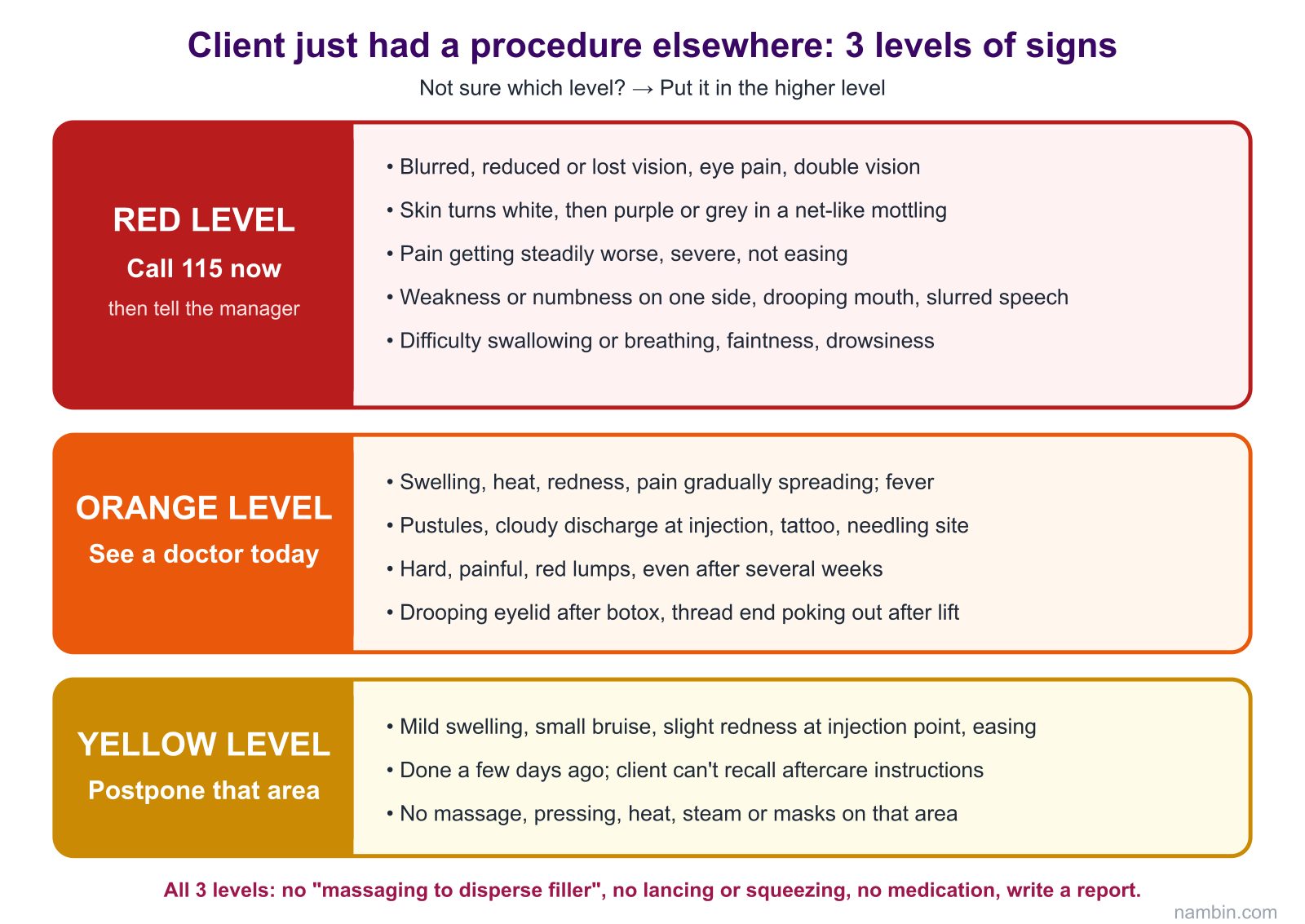
Red level: call 115 immediately
- Reduced vision, blurred vision, partial loss of the visual field, eye pain, double vision after injections in the face.
- Blanched white skin in one area, followed by patchy purple or grey mottling like a net pattern, which may feel colder than the neighbouring skin – especially on the nose, lips, nasolabial folds and forehead.
- Increasing, severe pain, unlike the mild ache after an injection, which does not ease with time.
- Weakness or numbness down one side of the body, a drooping mouth, difficulty speaking; difficulty swallowing or breathing; faintness or drowsiness.
Orange level: advise a medical examination the same day
- Swelling, heat, redness and pain that gradually spread; pustules, cloudy discharge; fever.
- A painful, red, hard lump at an injection or tattoo site, even if the procedure was a few weeks ago.
- A drooping eyelid after botox; thread ends poking through the skin after a thread lift.
Yellow level: postpone services on that area
- Mild swelling, small bruises or slight redness around injection points that are gradually settling, with no increase in the client's pain.
- The client had the procedure within the last few days, or cannot remember what aftercare restrictions they were given.
- No massage, pressure, hot compresses, steaming or masks on that area.
The restriction period depends on the procedure and is set by the doctor who performed it. If the client cannot remember, suggest they check with the place that did it; in the meantime, only perform services on other areas and record this in the client file.
Safety: At all three levels, never "massage to disperse the filler", never prick or squeeze, never apply medicines, and never apply heat to the area. Massage or firm pressure can move the filler or make the injury worse. If the client asks, refuse and explain why.
Procedure when you detect signs of a complication
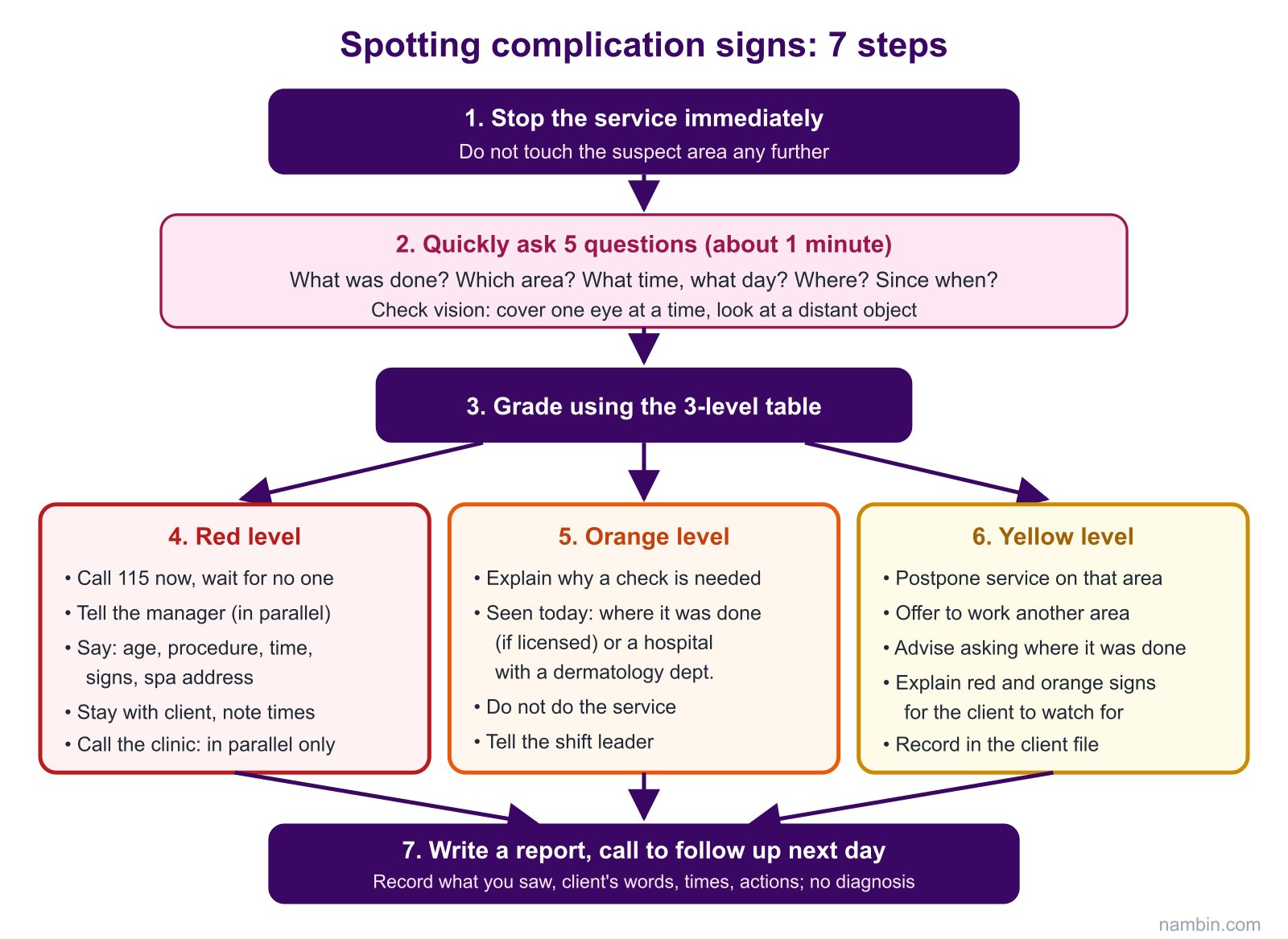
- Stop the service immediately. Wash your hands; help the client sit up slowly, or let them lie on their side with the head raised if they feel faint. Do not touch the suspicious area any further.
- Quickly ask five questions in about one minute: what procedure, which area, what time and date, where, and when the signs began. Ask whether the client can see clearly: cover each eye in turn and look at an object in the distance.
- Assign a level using Figure 3. If unsure, choose the higher level.
- Red level: call 115 immediately, and ask a colleague to inform the manager at the same time. Tell the operator: the client's age, what was injected where and at what time, the current signs, and the spa's address. Calling the place that performed the procedure is only a parallel action; it does not replace 115. Stay with the client, note the time of each sign, and have the procedure details ready to hand to the medical team.
- Orange level: explain why a medical examination is needed the same day; suggest returning to the medical establishment that did the procedure if it is licensed, or going to a hospital with a dermatology department. Do not perform the service. Inform the shift leader.
- Yellow level: postpone services on that area, offer to work on another area if the client wishes, and tell the client the red and orange signs to watch for themselves.
- Write the report and follow up: what you observed, what the client said, times, actions taken (the template is in the next lesson). The next day, make a follow-up call if the client agrees.
What to say to the client without blaming or causing panic
Do not diagnose and do not comment on the place that did the procedure ("they did a sloppy job", "it must be a blocked vessel"). Say what you see and what needs to be done: "I can see the skin on your nose is paler, and you said the pain is getting worse. This sign needs a doctor to look at it straight away. I'm going to call an ambulance for you, and I'll stay right here with you." A calm voice, short sentences, quick action.
Refusing when a client or the spa owner asks you to do it
Refusing is a skill, not an attitude: the client does not feel criticised, the owner does not feel opposed, but the procedure does not happen in the spa.
When a client asks
Use the three-sentence pattern: say clearly that you do not do it – give a short reason – offer a choice.
- "Filler injections must be done by a doctor at a licensed medical establishment, so our spa doesn't offer them."
- "That's because it's a procedure that puts a substance under the skin, so it needs a doctor and a room with emergency medicines."
- "If you do go ahead, remember to check that the establishment has an operating licence for medical examination and treatment and that the doctor has a practising licence. Here, I can give you a hydrating facial, but I'll tell you upfront that it can't create shape the way injections do."
Do not run down the procedure ("filler is really toxic"), and do not recommend "a place I know that injects cheaply". If the client insists, repeat the first sentence, still in a gentle voice. If the client asks by message, reply in writing using the pattern so there is a record.
When the spa owner or manager asks
- Clarify the request: what service, who would perform it, where, with what product. Sometimes the owner just wants a "premium hydration treatment" and has used the wrong name.
- State the boundary and the general risk plainly, without commenting on the other person's ethics: "This service counts as medical examination and treatment; it needs a practising licence and an establishment licence. If there were a complication such as vascular occlusion, our spa would have nothing to manage it with, and both the person doing it and the spa would be held responsible."
- Propose a legitimate option: keep to non-invasive services; if the spa wants to open a medical aesthetics line, it must set up or partner with a licensed medical establishment, with doctors performing procedures there, and the owner should look into this with the health authority.
- If you are still asked to do it: you have the right to refuse. Do not sign a "self-responsibility" undertaking and do not post advertising for that service. Record the time, the content of the request and your answer, and keep the messages.
| Situation | What to say | What to do next |
|---|---|---|
| A client asks for "just a light mesotherapy" | "Mesotherapy is also an injection through the skin; it has to be done by a doctor at a medical establishment, so we don't offer it." | Suggest skin care following cosmetic label directions; note the client's wish in the file |
| A colleague brings in a microneedling roller to "do extra for regular clients" | "Microneedling through the skin is an invasive procedure; we're not allowed to do it here." | Inform the shift leader; do not keep the instrument in the treatment room |
| The owner buys a lip-tattooing machine and assigns you to learn it | "I can't do this service within the scope of the spa; I'd like to stick to non-invasive services." | Record the request; propose the option of partnering with a medical establishment |
| A client who has just been injected asks for a massage "to even it out" | "I can't massage a freshly injected area; please check with the doctor who did it." | Postpone that area, check the signs against the 3 levels, record in the file |
Photo: Coastal Elite from Halifax, Canada / Wikimedia Commons, CC BY-SA 2.0

Common mistakes
| Mistake | Why it is dangerous or wrong | The correct way |
|---|---|---|
| Massaging a freshly filled area "to bring the swelling down" | Can move the filler, and mask or worsen signs of vascular occlusion | Do not touch the area, check the signs against the 3 levels, advise checking with the doctor who did it |
| Seeing blanched or patchy purple skin but waiting "to see if it gets better" | Vascular occlusion needs medical intervention within a very short time; waiting loses that chance | Classify as red level, call 115 immediately, note the time |
| Messaging the place that did the injection and waiting for their reply before calling an ambulance | Wastes time; that place may not be able to manage it | Call 115 first, contact the place that did it in parallel |
| Agreeing to do it because "the client signed to accept responsibility" | An undertaking does not legalise unlicensed work; the person who performs it is still responsible | Refuse using the three-sentence pattern, and record it |
| Advertising "herbal botox" or "cosmetic filler" on the fanpage | Misleading, and advertises a non-permitted service under the Advertising Law 2012 | Use the correct name of the care service; do not borrow procedure names |
Pass criteria for this lesson
You pass this lesson when you can do the following in front of your instructor:
- Correctly place 6/6 services (filler, botox, mesotherapy, deep microneedling, cosmetic tattooing, thread lifts) in the group the spa does not do, and explain "invasive" in one sentence that mentions the skin barrier.
- State correctly the 3 principles of the Law on Medical Examination and Treatment 15/2023/QH15 (who does it, where, with what) in no more than 2 minutes, without inventing article numbers.
- List correctly at least 4 red-level signs, including reduced vision and blanched or patchy purple skin.
- For 5 scenario cards given by the instructor, assign the correct level 5/5 and state the correct next action.
- Role-play calling 115 for a client with suspected vascular occlusion after filler, giving all 4 points (age, procedure and time, signs, address) in under 60 seconds.
- Role-play refusing a client and a spa owner using the correct pattern, without any critical remarks, and record the refusal in the log.
Frequently asked questions
If a cosmetic has "botox" or "filler" on the label, can the spa use it?
These are usually topical cosmetics containing peptides or humectants, named for marketing purposes. If the product has a cosmetic notification certificate and is applied as directed on the label, the spa can use it. When advising clients, do not say "works like botox injections"; say accurately that it is a care product with limits.
Short-needle microneedling rollers are sold for home use – can the spa use them?
In this course, every technique that uses needles to pierce the skin belongs in the group therapists do not perform. Needle depth, the skin thickness of each area and the products introduced into the skin are medical questions; therapists do not have the tools to assess them. If a client wants it, refer them to a doctor.
A client has just had filler at a licensed medical establishment – can they come for a Vietnamese-style head spa?
Usually yes, if the client shows no abnormal signs on the 3 levels. Do not massage the face, and do not let towels or the lying position press on the injected area; the restriction period follows the advice of the doctor who did the procedure. Record it in the file.
Further reading
Review how to sort clients into "proceed, adapt, postpone" in the lesson Skin structure and contraindications in the spa, and how to ask about recent procedures on the questionnaire in the lesson Spa client consultation and the health questionnaire: asking the right questions to work safely.