Many spas give therapists sales targets, and that pressure produces some very familiar lines: "Your skin is badly damaged; if you don't treat it now it'll turn into melasma", "50% off today only, gone tomorrow", "You only see results with the 30-session package – pay upfront and it's cheaper". The client is lying on the treatment bed with a mask on her face, two therapists standing on either side of her, and she signs. A few months later the client rereads the contract, realises she was pressured, and posts about it online. The spa loses one client, and then dozens more who read that post. Advanced therapists are entrusted with consulting on treatment programmes because they are trusted: to sell what the client needs, to tell the truth, and to let the client decide for herself.
By the end of this lesson, you will be able to:
- Lead a 5-step consultative selling conversation, starting from the client's needs rather than from the package currently on promotion.
- Present prices, number of sessions, validity period and service conditions transparently, including cheaper options or not buying at all.
- Recognise pressure-selling, scare-tactic and results-promising lines and replace them with honest statements.
- Explain the risks of large prepaid packages and suggest safer ways for the client to buy.
- Respect the client's right to say no and state the main principles of the Advertising Law 2012 and the Law on Protection of Consumer Rights.
What ethical selling means in a spa
There is nothing wrong with selling. A client with dry skin who is recommended the right hydrating programme and a sunscreen is a client who is better cared for. What goes wrong is the way of selling. At Level 2 you learned the 5-stage consultation and how to set realistic expectations; this lesson adds the harder part: recommendations with a price tag, when you have a personal interest (commission, targets) in the client's decision.
Three principles to check yourself against before every offer:
- Matches the need: this service addresses what the client has just told you, not what the spa wants to push.
- Honesty: state accurately what it can and cannot do, how much it costs and what the conditions are.
- The client decides: the client has enough information, time to think, and can say "no" without being treated differently.
A simple question to ask yourself: "If this were my mother or my younger sister, would I recommend exactly the same thing?" If the answer is no, do not say it.
The 5-step consultative selling process
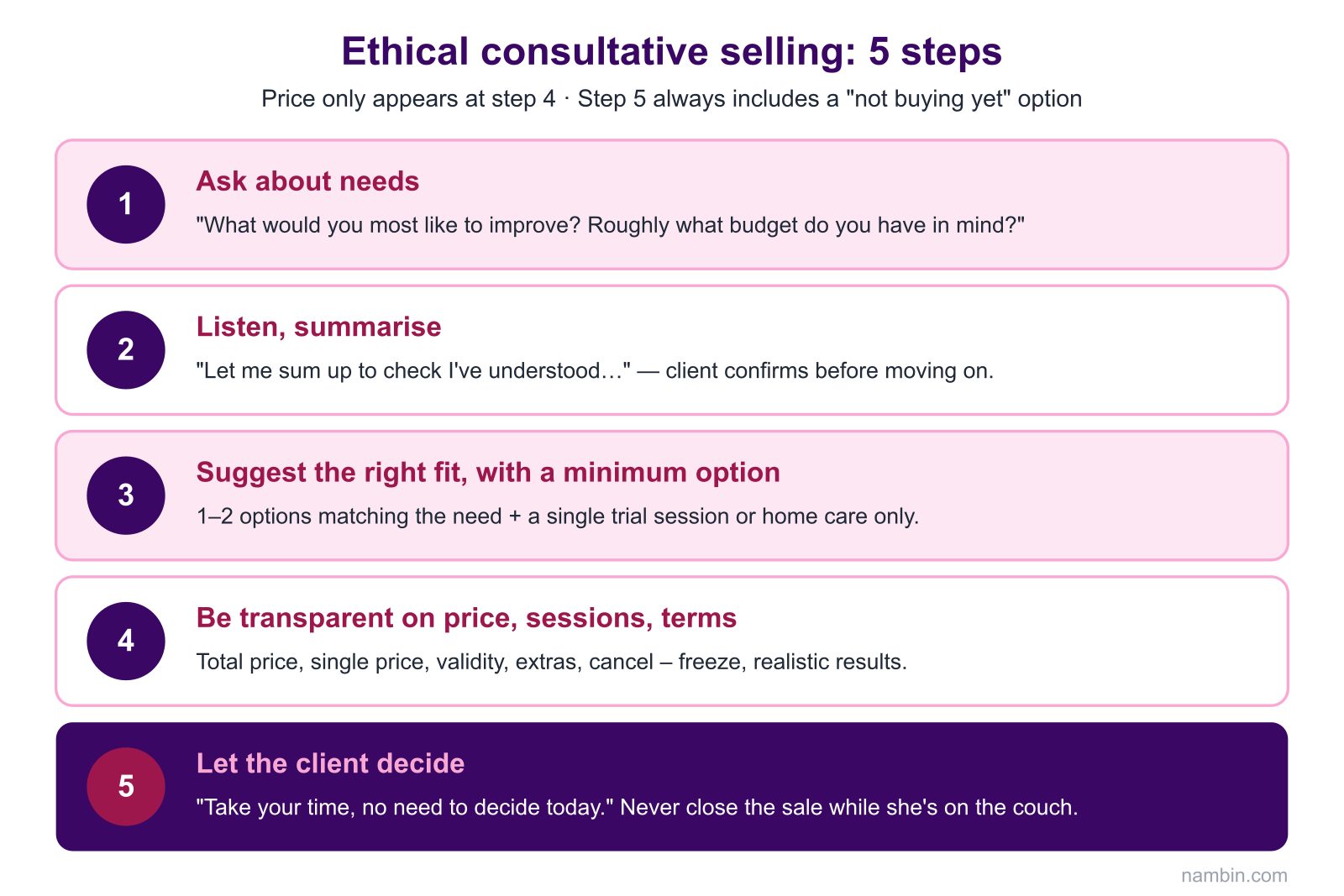
- Ask about needs. Open questions: "What would you most like to improve?", "How often would you like to come to the spa, and roughly what budget did you have in mind?" Asking about budget is not impolite; it helps you avoid recommending something the client cannot afford.
- Listen and summarise. "Let me summarise: your skin often feels tight and dry because you sit in air conditioning, you'd like to come once a week, and your budget is a few million a month – is that right?" Only move to step 3 once the client has confirmed.
- Recommend the right option, with a minimum option. Offer 1–2 suitable options, always including the lightest one: a single session as a trial, or home care only. Say why you are recommending it: "I'd suggest the 8-session hydrating programme because…, but if you'd like to try first, you can have a single session and then decide."
- Be transparent about price, sessions and conditions. State the total price, the price per session, the number of sessions, the validity period, any additional costs, and the cancellation and suspension conditions. Show the printed price list; do not say "this price is just for you".
- Let the client decide. "Take your time; you're welcome to go home and think it over. Today we'll do the single session you booked." Never close a sale while the client is lying on the treatment bed, never stand around her, and never call in extra people to persuade her.
The order matters a great deal: the price only appears at step 4, after the client has seen that the service genuinely suits her. Mention the price first and the consultation turns into haggling; never mention the price and the client feels something is being hidden.
Transparency on price, sessions and conditions
The client has the right to know everything before she pays. Before the client decides to buy a package, you must state clearly, and provide in writing, the items below.
| Information | How to say it | Avoid |
|---|---|---|
| Total price and price per session | "The 8-session package is … VND in total, which works out at about … VND per session; a single session is … VND." | Mentioning only the "discounted" price, hiding the original price or the single-session price |
| Number of sessions and frequency | "8 sessions, one a week, about 2 months." | "We'll keep going until you look great" |
| Validity period | "The package is valid for 4 months from the date of purchase." | Not mentioning the validity period, then telling the client it has expired when she comes back |
| Additional costs | "The home-care products are optional, not compulsory." | Requiring the client to buy products before she can have the treatment |
| Cancellation, suspension, transfer | Read the spa's actual policy to the client, for example suspension for health reasons | "Once bought, no refunds and no exchanges" without saying so in advance |
| Realistic results | "The programme supports hydration and makes the skin feel more comfortable; it does not treat skin disease." | "Guaranteed results", "money back if you're not beautiful" when the spa has no such policy |
Photo: BEien Sahwo TAoo MMP / Wikimedia Commons, CC0

Invoices, receipts and the package card (service name, number of sessions, sessions used, sessions remaining, validity period) must be given to the client. Each time the client uses a session, deduct it on the card and have the client sign to confirm. The client may ask how many sessions she has left at any time.
Things you must never do
No pressure selling
- False time pressure: "Today only", "only 2 places left" when that is not true.
- Positional pressure: offering a purchase while the client is lying down, wearing a mask or not yet dressed. The client is in a weak position and finds it hard to refuse.
- Group pressure: two or three staff persuading together; calling in the manager to "close".
- Emotional pressure: "If you don't buy, I'll get penalised", "After I looked after you so well".
- Financial pressure: suggesting loans, instalments or credit cards to "catch the offer in time".
No scare tactics
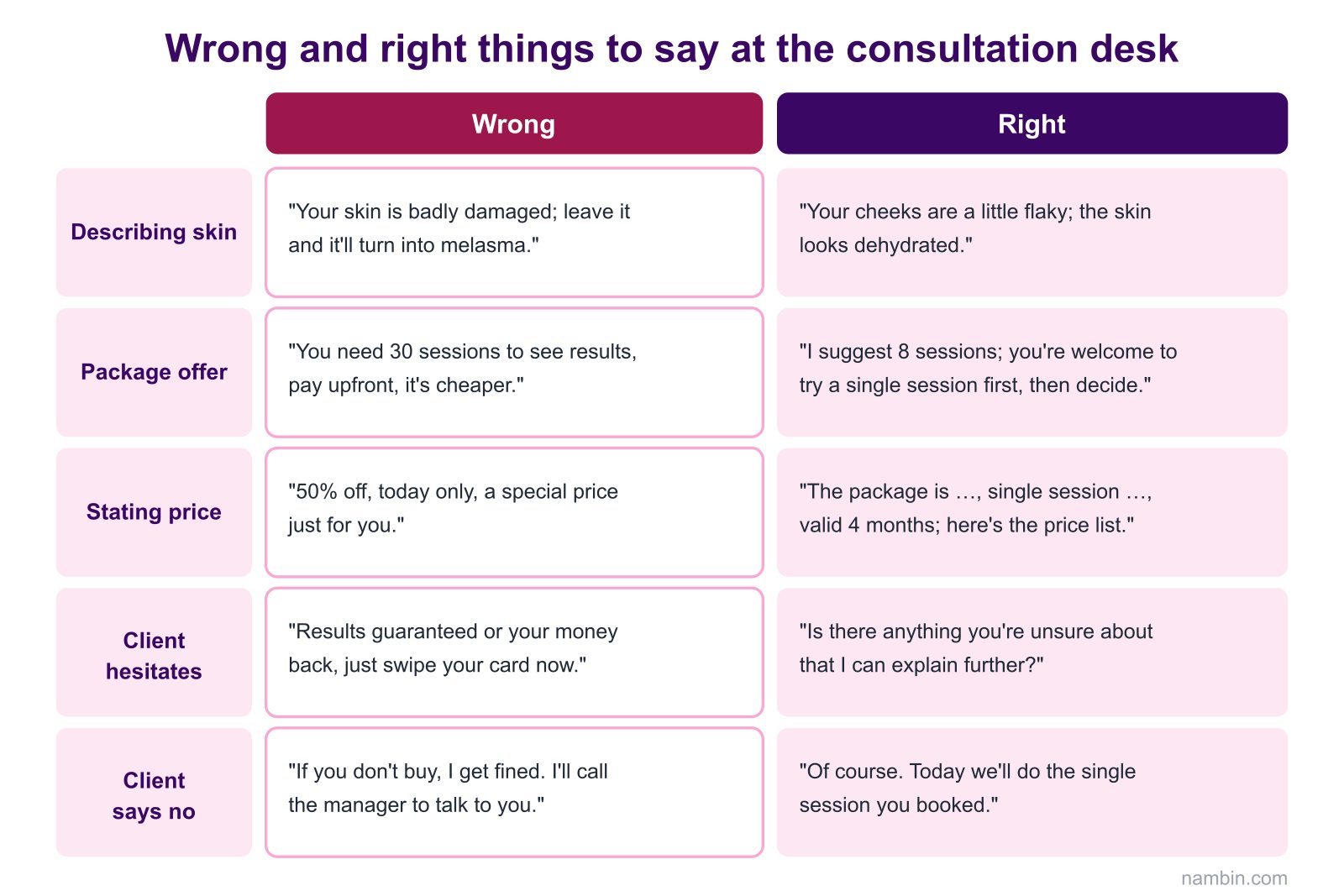
Scare tactics are the worst way to sell, because they use fear instead of information. "Your skin is badly damaged", "if you leave this acne it'll scar for life", "your pores are full of bacteria" are both untrue and hurtful to the client. Describe what you see in neutral words: "Your cheeks are a little flaky; your skin seems dehydrated." If you really see abnormal signs, the right thing to do is to advise the client to see a doctor, not to sell a package.
No promises of results
Do not use "cured for good", "permanent", "guaranteed", "several shades whiter", "ten years younger", "lose 5 kg". The spa provides non-invasive care: supportive, relaxing, helping the skin feel more comfortable. Results depend on individual constitution, home care and environment.
No selling beyond your scope
Do not agree to, or claim that "we can do it here" for, filler or Botox injections, mesotherapy, therapeutic laser or IPL, or deep microneedling. Those services belong to licensed medical examination and treatment facilities under the Law on Medical Examination and Treatment No. 15/2023/QH15. The right line: "That service needs to be done by a doctor at a medical facility; our spa doesn't offer it."
Sample scripts: wrong lines and right lines
Situation: a client with dry skin asks about a treatment programme
Ms Mai, 34, has just had a single facial and asks: "My skin is so dry – should I do a treatment programme?"
Wrong script:
"Skin as dry as yours is already premature ageing, you know – leave it and the wrinkles will set in deep and be very hard to save. We have a 30-session package at 50% off, today only. Pay 25 million upfront and I guarantee that in 3 months your skin will be as firm and glowing as a 20-year-old's. Just swipe your card now so you don't miss it – I'll call the manager in to sign."
What is wrong: scare tactics ("hard to save"), false time pressure ("today only"), a package far too big for the need, a large prepayment, promising results ("guarantee", "like a 20-year-old"), financial pressure ("swipe your card"), group pressure ("call the manager").
Right script:
"Today I noticed your cheeks are a little flaky, and you also mentioned your skin often feels tight after cleansing – that's typical of skin that's dehydrated from sitting in air conditioning a lot. There are two options for you. One is home care only: a gentle cleanser, a moisture-sealing moisturiser and sunscreen; I'll write down the ingredients to look for. The other is to add a hydrating programme at the spa, 8 sessions, one a week; the package is … VND, a single session is … VND, and the package is valid for 4 months. The programme helps your skin feel less tight and dry and more comfortable; it doesn't treat skin disease. You're also welcome to try another single session first and then decide. Take your time – there's no need to decide today."
What is right: a neutral description based on observation and the client's own words, an option that costs nothing, clear price and validity period, stated limits, time to think.
Photo: Paula zambon / Wikimedia Commons, CC BY-SA 4.0

The risks of large prepaid packages
Large prepaid packages (dozens of sessions, tens of millions of VND, a long validity period) give the spa cash flow, but put the risk on the client:
- The spa closes, changes owner or moves; the client finds it hard to get money back for unused sessions.
- The client becomes pregnant, falls ill, moves house or changes job, and cannot use all the sessions within the validity period.
- The service is no longer suitable: the skin has settled, or it turns out she needs to see a doctor.
- The therapist the client trusted leaves, and the quality changes.
Clients who feel trapped in a package often become clients who complain. How the therapist can help the client buy more safely:
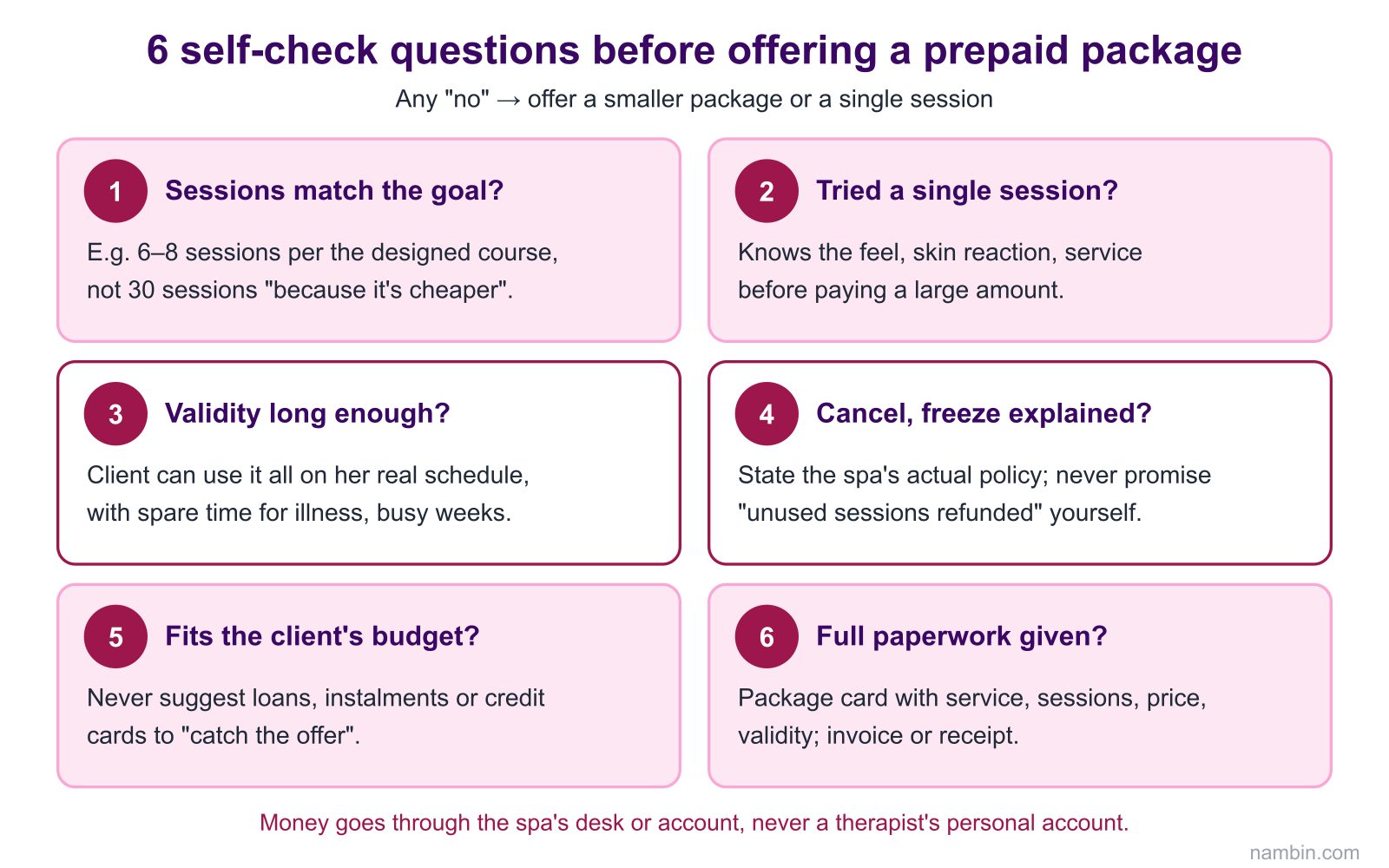
- Recommend a number of sessions that matches the treatment programme goal you designed (previous lesson), for example 6–8 sessions, not 30 sessions "because it's cheaper".
- Encourage the client to have a single session first so she knows how it feels, how her skin reacts and what the service is like.
- Explain the spa's suspension, cancellation and transfer policy clearly; if the client has health reasons, guide her through the suspension procedure.
- Make sure the client has complete paperwork: service name, number of sessions, price, validity period, conditions; with an invoice or receipt.
- Never accept bank transfers into the therapist's personal account. Money goes through the spa's account or cash desk.
Refund and suspension policies are for the spa owner to draft together with someone with legal expertise. The therapist must not personally promise "if you don't use them all I'll refund you" if the spa has no such policy.
The client's right to say no
A client saying "no", "let me think about it" or "I'll just have this session" is giving a complete answer. Rules for the therapist:
- Ask again at most once, with an open question: "Is there anything you're still unsure about that I can explain?" If the client still declines, stop.
- Do not change your attitude: serve the single session as attentively as for a client who bought a package. Do not rush it, and do not cut the time short.
- Do not write negative notes in the record such as "stingy client" or "hard to sell to".
- Do not chase: only call or message with offers when the client has agreed to receive them; if the client asks you to stop, stop. You learned at Level 2: the phone number in the record is used only for the purpose the client agreed to.
- The client changes her mind after buying: do not argue; acknowledge it and pass it to the manager to handle according to the spa's policy.
Photo: 阿道 / Wikimedia Commons, CC BY-SA 4.0

Relevant law, at the level of principles
Therapists do not need to know the articles by heart, but must know the general spirit so as not to do wrong. Drafting package contracts, refund policies and advertising content is the job of the spa owner together with someone with legal expertise.
Advertising Law 2012
- Advertising information must be truthful and accurate and must not mislead about the quality, uses or price of a service.
- Do not advertise cosmetics or care services as if they have a medical treatment effect. Under Circular 06/2011/TT-BYT on cosmetics management, a cosmetic is a product used to cleanse, perfume, protect and keep the skin in good condition; it is not a medicine.
- Advice at the consultation desk, flyers, fan page posts, promotional messages and before-and-after photos should all keep to the same standard of honesty. Before-and-after photos may only be used with the client's separate consent, as learned in the previous lesson.
Law on Protection of Consumer Rights
A spa client is a consumer of services. The general spirit of the law that therapists need to remember:
- The right to information that is accurate and complete about the service, price and conditions before the transaction.
- The right to free choice, without being forced, deceived or pressured into buying.
- The right to protection of personal information, and not to be harassed with calls or messages without consent.
- The right to complain and to have the complaint resolved when the service is not as promised.
Pressure selling, scare tactics, hiding conditions and promising non-existent results are not only a lack of professional ethics; they also run counter to these principles.
Common mistakes in consultative selling
| Mistake | Why it is dangerous or wrong | The correct way |
|---|---|---|
| Introducing the promotional package as soon as the client sits down | Selling what the spa needs before knowing what the client needs | Ask about needs, summarise, and only then recommend |
| Closing a package while the client is lying on the treatment bed with a mask on | The client is in a weak position; the decision is not voluntary | Consult once the client has sat up and dressed, in the consultation corner |
| "Your skin is badly damaged" | Scare tactics, untrue, hurtful to the client | Neutral description; for abnormal signs, advise seeing a doctor |
| Stating only the discounted price, not the validity period | Lack of transparency, leads to complaints | State the total price, single-session price, number of sessions, validity period and conditions |
| Recommending a 30-session package for an 8-session need | The client carries the risk of a large prepayment | Number of sessions matches the goal; suggest a single session as a trial |
| Accepting bank transfers into a personal account | No documentation; risk for both the client and the therapist | Collect payment through the desk or the spa's account, with an invoice or receipt |
| Giving a careless service when the client declines | Breaches professional ethics; the client is lost for good | Serve attentively, as with every client |
Pass criteria for this lesson
You pass this lesson when you can do the following in front of your instructor:
- Lead a role-play consultative selling conversation in 8–10 minutes, going through all 5/5 steps in the correct order, with a needs summary confirmed by the "client" and a minimum option.
- State all 6 transparency items (total and per-session price, number of sessions, validity period, additional costs, cancellation and suspension, realistic results) for a package given by the instructor, without using any promising words.
- Identify correctly at least 6 errors in the sample wrong script and rewrite it as a correct script within 10 minutes.
- Answer correctly all 6/6 self-check questions before recommending a prepaid package for a specific situation.
- Handle 2 situations – a client who declines and a client who hesitates: ask again no more than once, and keep the same attitude of service.
- State at least 2 principles of the Advertising Law 2012 and 4 consumer rights relevant to consultative selling.
Frequently asked questions
The spa sets sales targets – how can I reach them without pressure selling?
Clients who receive honest advice usually come back and recommend friends; sales from returning clients are more sustainable. If the targets force you to say untrue things or pressure clients, talk to your manager using concrete figures: client return rates, complaints. You do not have to do anything against professional ethics to meet a target.
The client herself wants to buy the biggest package – should I sell it?
Yes, after you have explained clearly the number of sessions that suits the goal, the validity period, the suspension policy and the risks of prepayment. If the package far exceeds the need, say so directly: "In my opinion, 8 sessions are enough for your goal." Record in the file that you gave this advice.
The client compares prices with a cheaper spa – how should I respond?
Do not criticise other spas. Talk about what you are sure of: your own spa's procedures, products, hygiene and session length. Let the client compare and choose for herself.
Further reading
Review how to ask questions and set expectations in the lesson Spa client consultation and health questionnaires: asking the right questions to work safely, and see the long-term career path in the lesson Spa vocational certificates and career path: from therapist to opening a small spa.