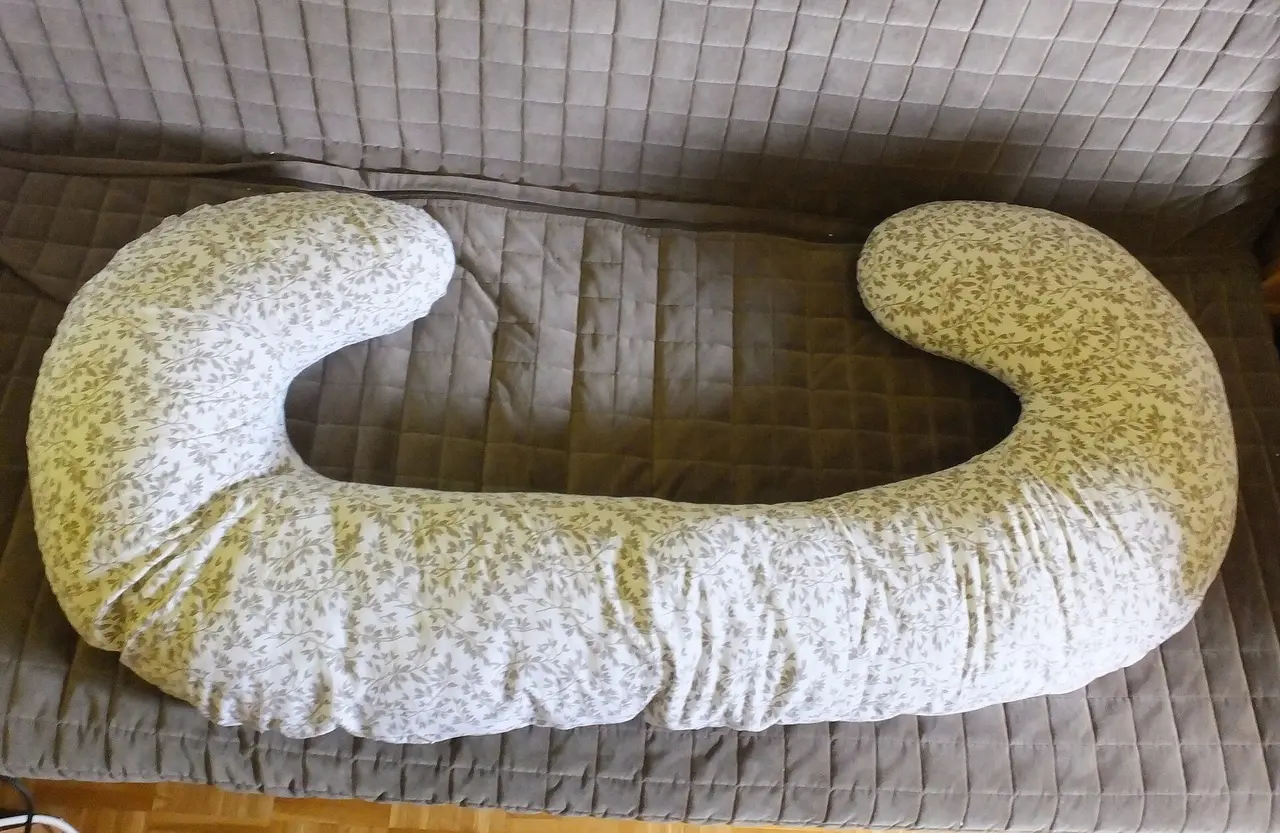
Pregnant clients come to the spa with very real discomforts: lower back pain, aching shoulders and neck, heavy legs that swell towards the evening, and poor sleep. After the birth, mothers carry their babies all day and breastfeed for hours, leaving their backs and wrists exhausted. Many spas in Vietnam now offer "pregnancy massage" and "postnatal care for mothers" packages, and these clients are very loyal if they are looked after attentively.
But this is also a client group with whom the therapist must not work out of habit. Lying flat on the back for too long can make the client faint; deep pressure on the calf of someone with a blood clot is very dangerous; a bottle of essential oil that "smells nice to relax mum" can make a client with morning sickness vomit. This lesson teaches you to perform pregnancy and postnatal massage according to one principle: doctor's approval, safe positioning, light pressure, continuous monitoring, stopping at the right moment. Massage here is relaxation care that helps relieve fatigue; it is not treatment and does not replace antenatal check-ups.
By the end of this lesson, you will be able to:
- Explain the changes in the body during pregnancy that directly affect how you massage.
- Screen pregnant and postnatal clients, identifying who needs a doctor's opinion, who must not be accepted and who must be postponed.
- Position the client correctly in a supported side-lying position, and help her on and off the treatment bed and change sides safely.
- Perform a 60-minute pregnancy massage with light pressure, avoiding the correct areas and using essential oils cautiously.
- Recognise the eight signs that require you to stop immediately and respond correctly; care for clients after vaginal and caesarean birth without touching the caesarean scar.
How pregnancy changes the body, and what that means for the therapist
You do not need to study obstetrics, but you do need to understand a few changes so that you know why the rules in this lesson exist.
- The growing uterus compresses blood vessels when lying on the back. From mid-pregnancy onwards, when the client lies flat on her back, the uterus can press on the inferior vena cava (the large vein that carries blood from the lower half of the body back to the heart). Less blood returns to the heart and the client may feel dizzy, nauseous, sweaty, and her blood pressure may drop. That is why in late pregnancy you avoid leaving the client lying flat on her back for long, and the main position is side-lying.
- Blood clots more easily. The body prepares for childbirth, so the risk of deep vein thrombosis (a blood clot in a leg vein) increases and continues into the postnatal period. Deep pressure and firm kneading of the calves and inner thighs must be avoided. A swollen, hot, red, painful calf on one side is a sign to stop and refer the client for medical examination immediately.
- Ligaments are looser. Pregnancy hormones make ligaments and joints softer and less stable, especially the pelvic joints. No strong stretching, no twisting of the spine, no forcing of joints.
- The centre of gravity shifts. The large abdomen pulls the lower back into a hollow and the shoulders round forward: this is why clients suffer lower back pain and aching shoulders and neck. It is also why clients lose their balance easily when getting on and off the treatment bed.
- Swelling (oedema). Mild swelling of the feet and ankles towards the evening is common. Sudden swelling, swelling of the face or hands, together with headache or blurred vision, may be a sign of pre-eclampsia, an obstetric emergency.
- A sensitive sense of smell, easy nausea, easily overheated. The smell of essential oils, the smell of the room and the room temperature all affect the client more than usual.
Screening and the doctor's approval
For pregnant and postnatal clients, the general health questionnaire learned at Level 2 is not enough. The spa needs an additional set of specific questions and a separate consent form, signed by the client, clearly stating that her doctor has agreed to massage.
The doctor's opinion is the first condition
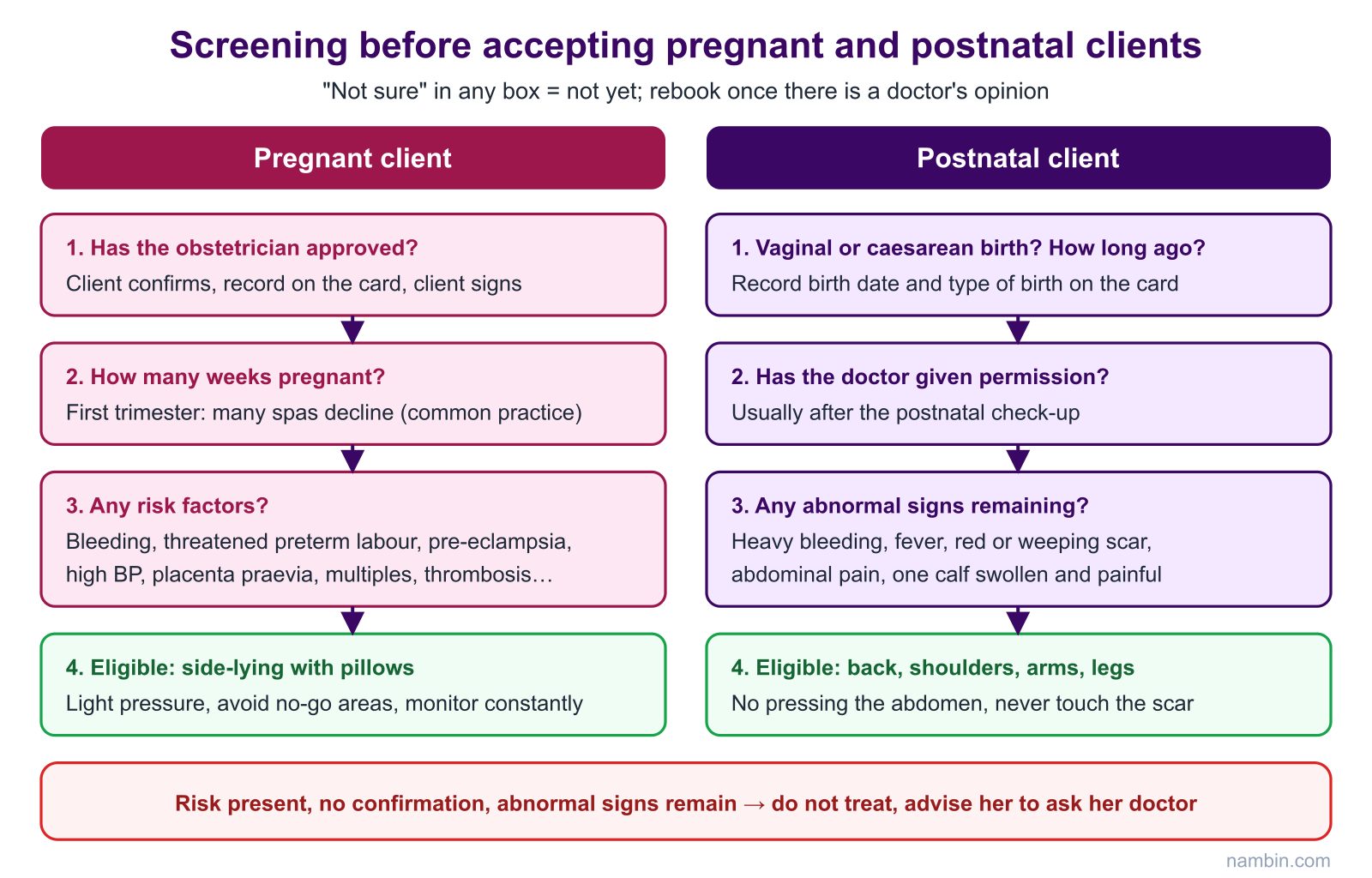
The spa cannot judge whether a pregnancy is safe; only the obstetrician following the client knows. Ask the client: "Have you asked your antenatal doctor about massage? Did the doctor give you any advice?" Record the answer. Many spas ask the client to bring her antenatal record book or a letter of approval; at a minimum, the client must confirm with her signature on the form that her doctor agrees. If the client says "I haven't asked yet", rebook after she has asked.
The first trimester: industry practice, not law
Many spas have an internal rule of not accepting body massage for clients in the first 3 months of pregnancy. This is a cautious industry practice, not a legal requirement. The reasons: at this stage the pregnancy still goes through many natural changes, clients often have morning sickness and fatigue, and if a problem happens to occur at the same time, it is very difficult for both the client and the spa. Whatever internal rule your spa follows, state it clearly in the service menu and tell the client clearly at the time of booking.
Do not accept, or accept only with a clear medical instruction
- Current bleeding, any bleeding during this pregnancy, threatened miscarriage, threatened premature labour.
- Pre-eclampsia, high blood pressure, uncontrolled gestational diabetes.
- Placenta praevia, low-lying placenta, multiple pregnancy, a pregnancy classified as high-risk by the doctor.
- A history of venous thrombosis, current severe varicose veins, a swollen and painful leg on one side.
- Abdominal pain, fever or unusual fatigue on the day.
Ask again at every session, because the state of a pregnancy changes week by week. Even regular clients who have had many massages must be asked: "At your antenatal check this week, did the doctor tell you anything new? Any bleeding, abdominal pain or a lot of swelling?"
The supported side-lying position
Positioning is the most important part of pregnancy massage. When the client lies correctly she is comfortable and safe, and your work is easier.
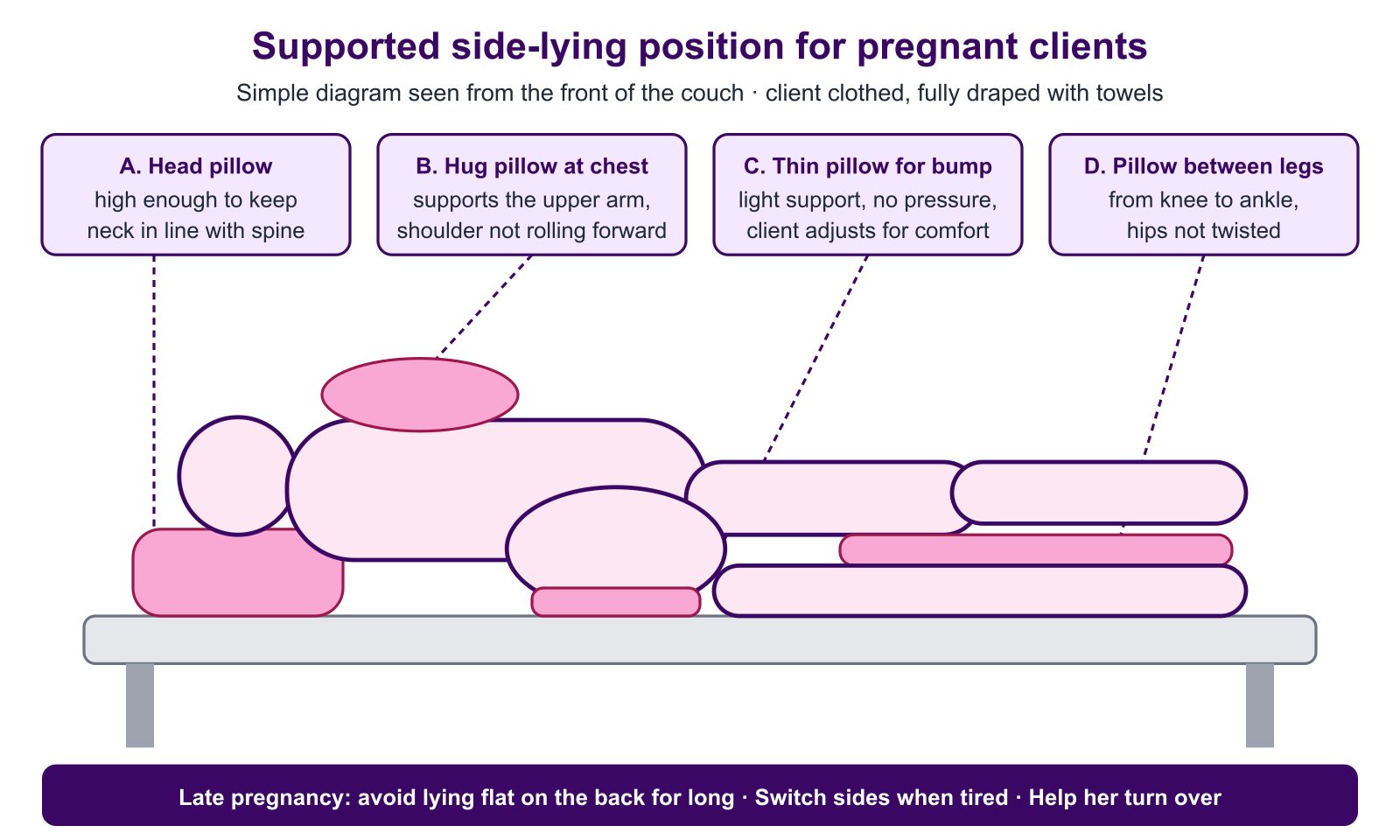
- Side-lying is the main position, especially from mid-pregnancy. Many guidelines favour lying on the left side; when the client gets tired, she turns to the right side so that you can massage the other side.
- Head pillow (A) high enough to keep the neck in line with the spine, so the head does not drop towards the bed.
- Pillow hugged in front of the chest (B) so the client can rest her upper arm on it and her shoulder does not roll forward.
- Thin pillow or folded towel under the abdomen (C) to support the weight of the bump gently; let the client adjust it for comfort, do not force it.
- Pillow between the legs (D) from the knees to the ankles, so that the hips and lower back are not twisted.
- Lying on the back: in late pregnancy, avoid lying flat on the back for long. If you need to work on the head, face or front of the shoulders, place the client in a semi-reclined position with the back and head raised and a pillow under the knees, and only for a few minutes. If the client feels dizzy or short of breath, turn her onto her left side immediately.
- Do not use the prone (face-down) position, even with beds or pillows that have a cut-out for the abdomen.
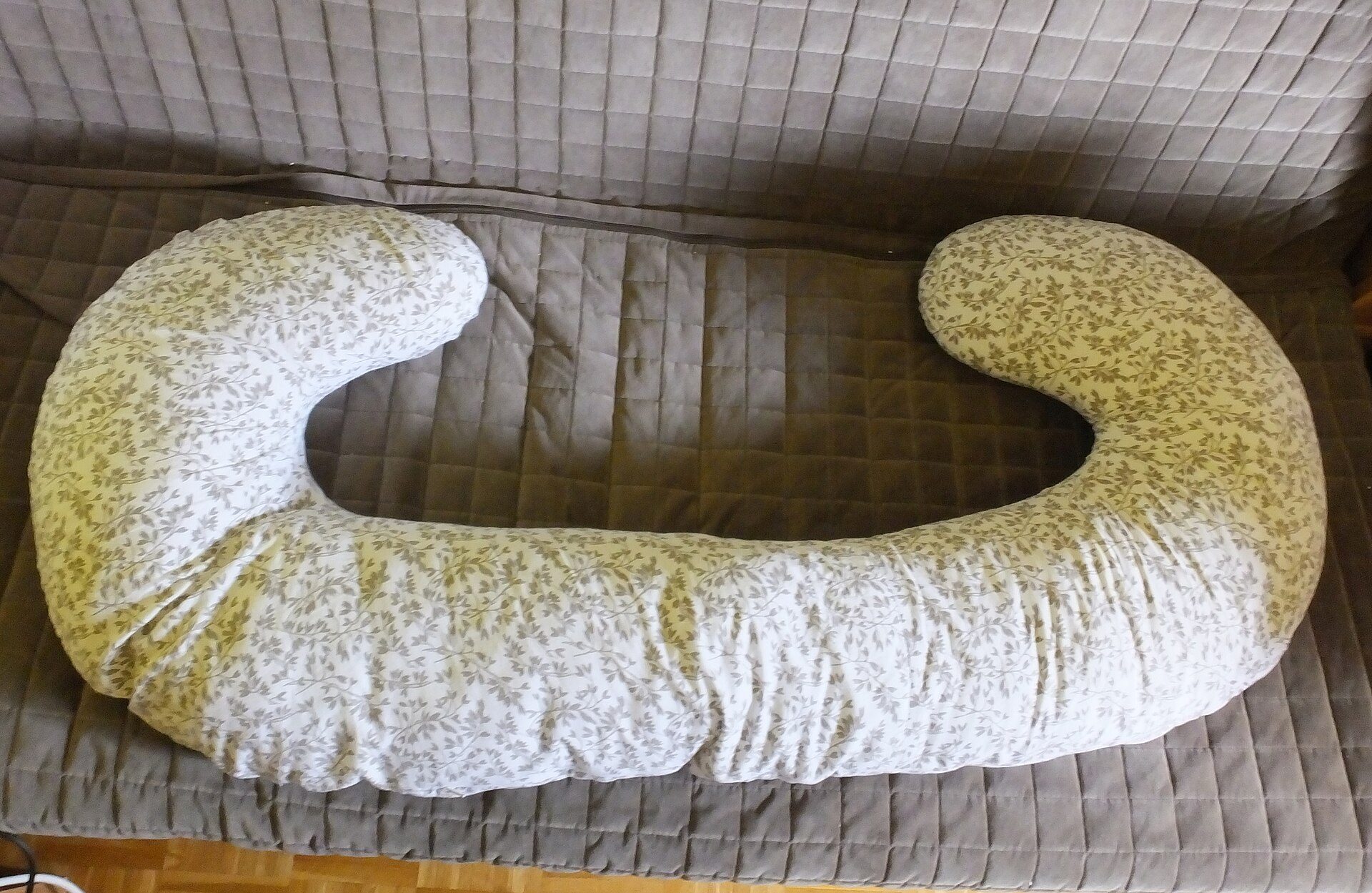
Photo: Panek / Wikimedia Commons, CC BY-SA 4.0

Getting on and off the bed, changing sides
- Lower the treatment bed if possible, or place a sturdy, non-slip step. Invite the client to use the toilet before starting.
- The client sits on the edge of the bed, leans over and lies down on one side, supporting herself with her arms. The therapist stands close, supporting the shoulders and legs, without pulling the client's arms.
- When changing sides: the client bends her knees, keeps the pillow between her legs and turns her whole body at once, as one block. The therapist holds the drape and supports the pillow, and does not let the client twist her hips.
- When sitting up: the client lies on her side, pushes herself up with her arms and sits on the edge of the bed for a while until any dizziness passes before standing.
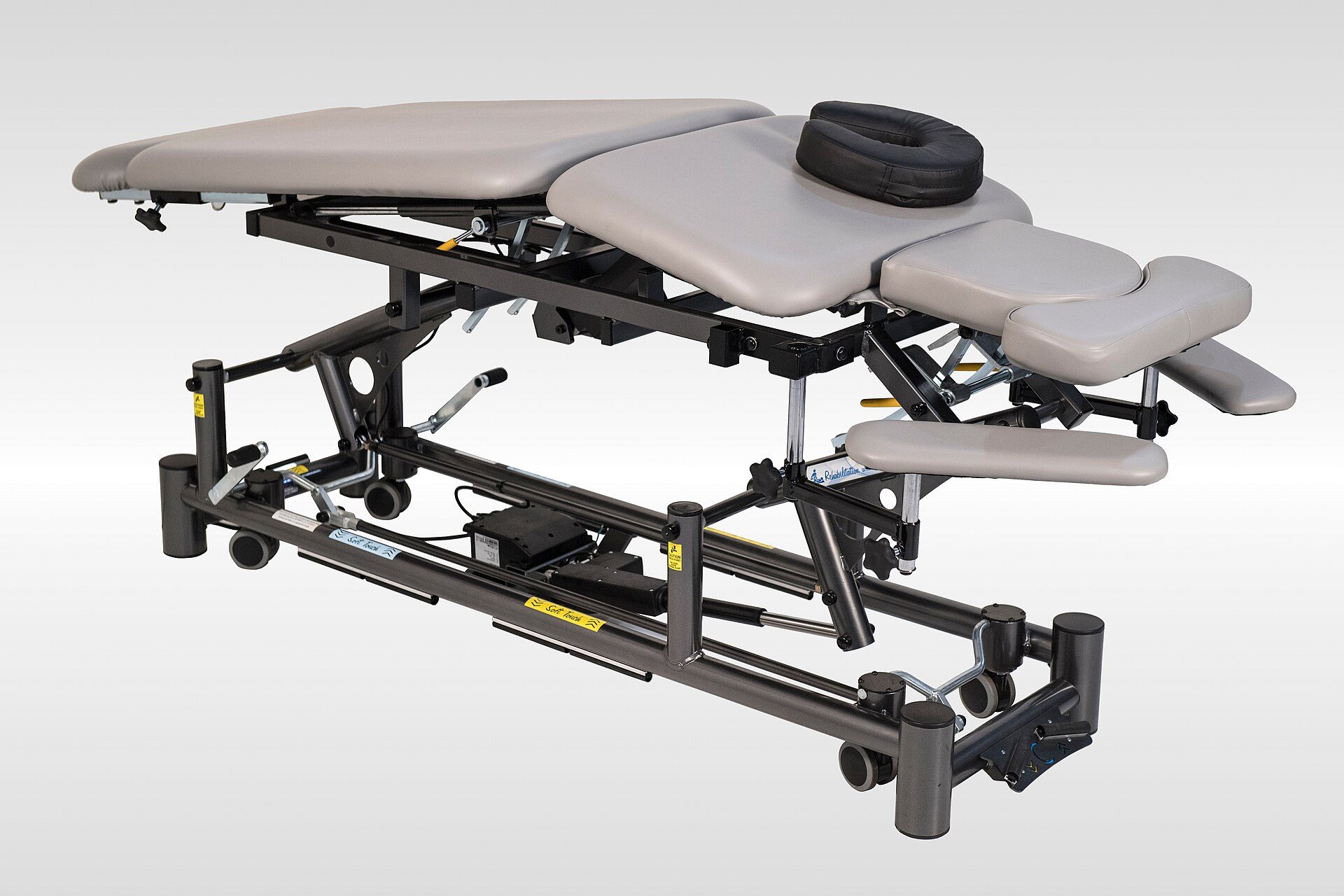
Photo: Cardonrehab / Wikimedia Commons, CC BY-SA 4.0

The room should be moderately cool and well ventilated, not too hot, with drinking water available. Do not use electric blankets, heated pads, hot stones, steam, sauna or hot tubs for pregnant clients.
Pressure, areas to avoid and essential oils
Pressure and movements
Use mainly stroking (effleurage) and gentle kneading, as learned at Level 1. Light to medium pressure, slow and even rhythm. No deep point pressure, no pounding, no hacking, no strong vibration, no joint stretching. The lower back, shoulders and neck are where clients ache most; you can spend longer there, still with moderate pressure. Check the pressure after the first few minutes, then watch the client's breathing and facial expression.
Areas to avoid
- Abdomen: the spa does not massage the pregnant abdomen. If the client wants moisturiser on her bump, she applies it herself.
- Calves, inner thighs: no deep pressure, no firm kneading. On the legs, only light strokes towards the heart. If the legs have prominent varicose veins, skip that area. If a leg is swollen, hot, red and painful on one side, do not massage and refer the client for medical examination immediately.
- No acupressure and no deep point pressure on the feet, ankles, hands or shoulders during pregnancy massage. The spa does not perform any technique advertised as "helping to induce labour" or "helping a quick birth".
- Breasts: do not massage the breasts. For breast tenderness or pain, advise the client to ask a health professional.
- The side being lain on: do not massage the hip and shoulder on the underneath side; work only on the upper side, and change sides to work on the other side.
Essential oils: use with caution
At Level 2 you learned that the usual essential oil dilution for adult body massage is 1–3%. With pregnant clients, be much more cautious:
- The safest choice is an unscented carrier oil (grapeseed oil, or sweet almond oil if the client has no nut allergy) or a fragrance-free massage cream.
- If you use essential oils, use only products that the manufacturer clearly labels as suitable for pregnant women, diluted at a low level (many aromatherapy references recommend about 1% or lower); let the client smell it first and use it only if she finds it pleasant.
- Clients with morning sickness or sensitivity to smells: no essential oils, and no essential oil diffusing in the room.
- Do not use unlabelled essential oils of unknown origin, and do not mix your own "pregnancy oil" from word-of-mouth recipes.
The 60-minute pregnancy massage routine
The routine below is for clients who have passed screening, have their doctor's approval, have no risk factors, and fall within the spa's internal rule on weeks of pregnancy. The client wears comfortable clothing or a robe and is fully draped with towels; only the area being worked on is uncovered. Ask permission before touching each new area.
- Welcome and re-screening (5 minutes). Ask the screening questions and ask where the client aches most today. Invite her to use the toilet and have a drink of water.
- Getting on the bed, positioning pillows (5 minutes). Help the client lie on her left side and place the four pillows A, B, C and D. Ask: "Are you comfortable lying like this? Is anything pressing on your bump?"
- Left side – back, shoulders, neck (12 minutes). Stroke along both sides of the spine from the lower back up to the shoulders, without pressing on the spine. Knead the upper shoulder muscles and the nape gently. Make light circles around the upper part of the shoulder blade. Stroke the lower back slowly, with medium pressure.
- Left side – hip and upper leg (6 minutes). Stroke the hip lightly over the towel. Upper leg: stroke lightly from the ankle up the outer thigh towards the heart; do not press the calf and do not work on the inner thigh.
- Left side – upper arm (4 minutes). Stroke the arm from the wrist up to the shoulder, knead the forearm gently and stroke the palm softly, without point pressure.
- Changing sides (3 minutes). Help the client turn onto her right side as described above, and readjust the pillows and towels. Ask whether she feels dizzy.
- Right side – back, shoulders (8 minutes). Repeat the movements of step 3 on the other side, for a shorter time.
- Right side – upper leg and arm (6 minutes). Repeat steps 4 and 5 on the other side.
- Semi-reclined – head, neck, light face (6 minutes). If the client wishes and is not dizzy: raise the back and head and place a pillow under the knees. Massage the scalp, stroke the sides of the neck lightly and stroke the face gently. If the client is not comfortable, work on the head and neck in the side-lying position instead.
- Closing (5 minutes). Let the client rest lying down for a minute, help her sit up slowly and sit on the edge of the bed until any dizziness passes. Offer water. Advise her to drink enough water, rest, and inform her doctor immediately if anything unusual happens during the day. Record on the card: weeks of pregnancy, areas worked, the client's reactions.
Total: 5 + 5 + 12 + 6 + 4 + 3 + 8 + 6 + 6 + 5 = 60 minutes. It can be shortened to 45 minutes by reducing the time on the back and leaving out step 9. Throughout the session, the therapist never leaves the client.
Signs that require you to stop immediately
This is the part you must know by heart and display in the treatment room used for pregnant clients.
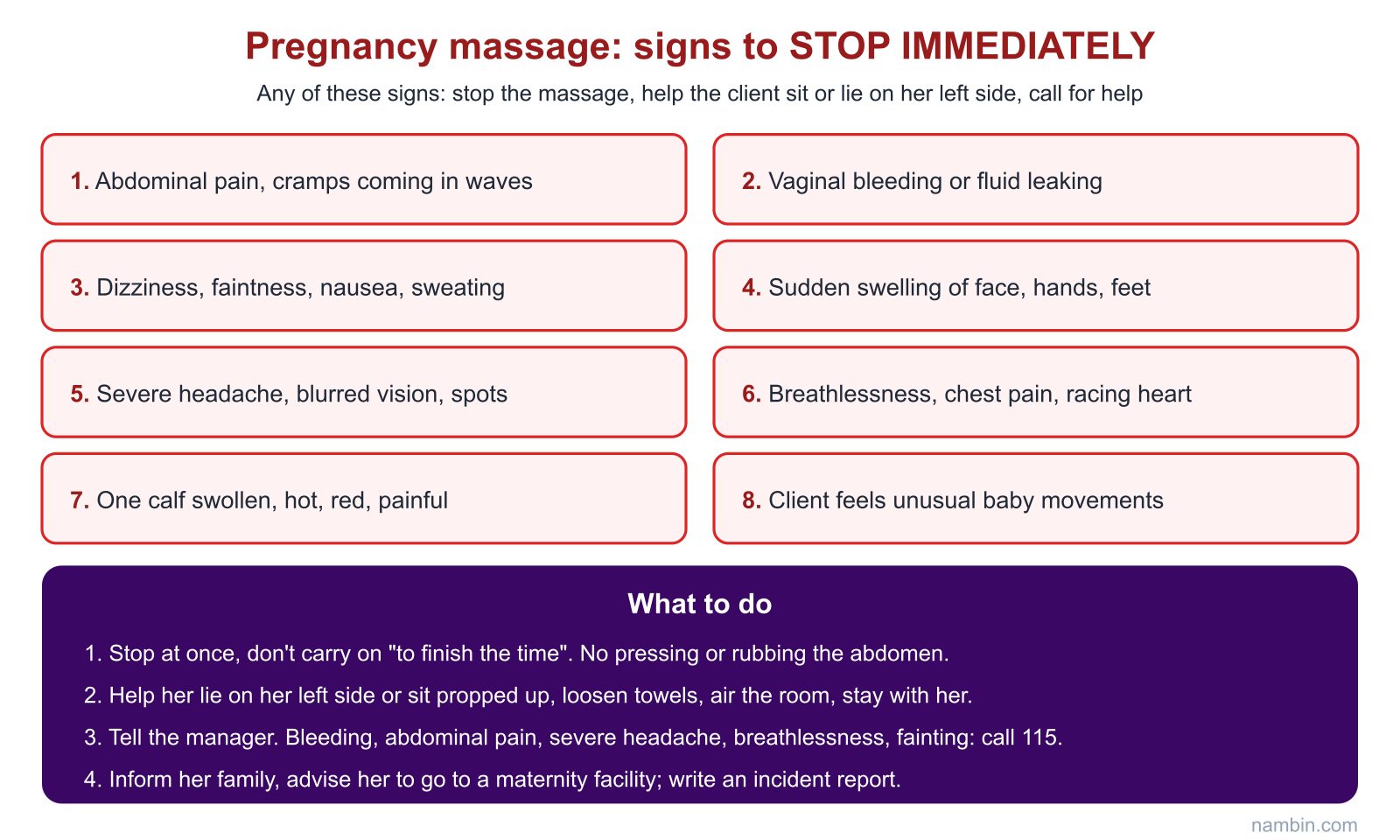
- Abdominal pain, cramping in waves, a hardening abdomen.
- Bleeding or leaking of fluid from the vagina.
- Dizziness, faintness, nausea, sweating, pallor.
- Sudden swelling of the face, hands or legs.
- Severe headache, blurred vision, seeing spots.
- Shortness of breath, chest pain, an abnormally fast heartbeat.
- A swollen, hot, red, painful calf on one side.
- The client feels the baby moving differently from usual.
Response: stop immediately; help the client lie on her left side or sit propped up, loosen the towels, ventilate the room and stay with her; inform the shift manager. For bleeding, abdominal pain, severe headache, shortness of breath or fainting, call emergency services on 115. Inform her family and advise the client to go to an obstetric facility. Write an incident report: time, signs, actions taken.
Postnatal massage: vaginal birth and caesarean section
After giving birth, the mother's body needs time to recover: the uterus contracts back, lochia (postnatal discharge) continues for several weeks, perineal stitches or the caesarean wound heal gradually, and the risk of thrombosis remains for some time. Mothers also have aching necks, shoulders, backs and wrists from carrying and breastfeeding their babies.
Wait for the doctor's permission
The spa does not set its own rule of "massage is allowed so many days after birth". Ask the client whether she had a vaginal birth or a caesarean, the date of the birth, and whether her doctor has examined her after the birth and allowed massage. Record this on the form and have the client sign. If the client has not had her postnatal check or the doctor has not yet given permission, rebook for later.
What you must not do
- Do not press on the abdomen, do not touch the caesarean scar, and do not massage the abdomen "to make the uterus contract faster" or "to flatten the tummy".
- Do not apply hot salt compresses, hot stones, hot wraps or heat to the abdomen. The skin around a caesarean scar is often numb, so the client cannot feel heat and burns very easily.
- Clients who had a caesarean should not lie face down until they are truly comfortable and the doctor allows it; use side-lying or a supported semi-reclined position.
- Do not massage the breasts and do not accept requests to "unblock milk ducts". If the breasts are tender, swollen and red, or the client has a fever, advise her to see a health professional.
- Do not promise to "reduce belly fat", "shrink the waist", "contract the uterus" or "get your figure back in 5 sessions".
What the spa can do
Once permission has been given and there are no abnormal signs: massage of the back, shoulders and neck, arms, wrists, hands and legs with light to medium pressure, in side-lying or a supported semi-reclined position; Vietnamese-style head spa (herbal hair wash with head massage) with moderately warm water. The room should be warm and free from draughts, but with no hot steam. For breastfeeding mothers, it is best to book right after a feed so that the breasts do not become engorged, and ask whether she would like a pillow under her chest when lying on her side.
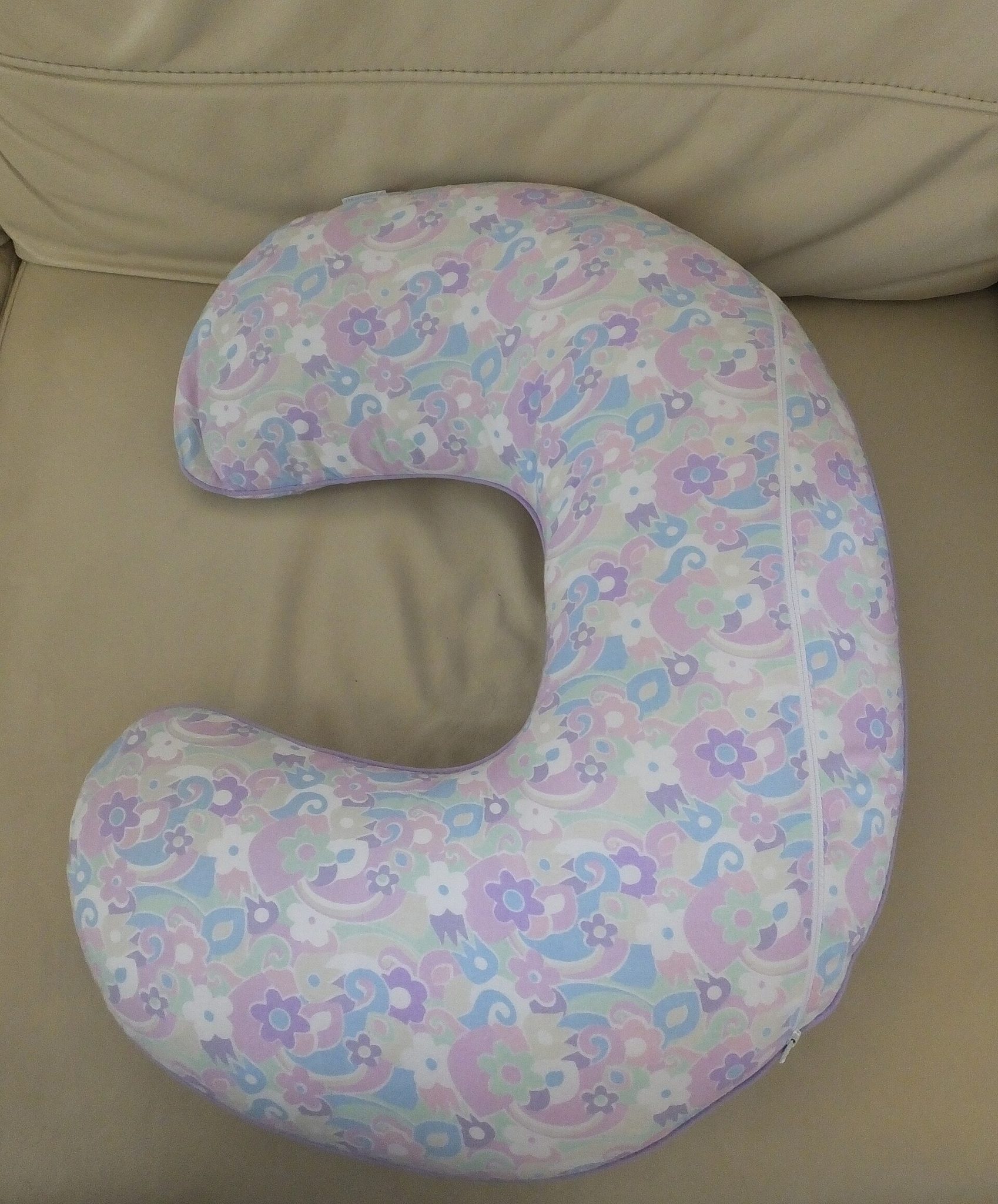
Photo: Panek / Wikimedia Commons, CC BY-SA 4.0

Abnormal signs after birth
Stop and advise the client to see a doctor if there is: fever; heavy bleeding or foul-smelling lochia; a caesarean wound that is red, swollen, oozing or increasingly painful; a swollen, painful calf on one side; shortness of breath or chest pain; severe headache. If the client is persistently sad or anxious, cries a lot, or cannot sleep even when the baby sleeps, listen to her and gently advise her to talk to a doctor or to her family: this may be postnatal depression, and she needs support.
Respect is a large part of the service: do not comment "your tummy is still big" or "you have so many stretch marks". Postnatal mothers are very sensitive to remarks like these.
Common mistakes in pregnancy and postnatal massage
| Mistake | Why it is dangerous/wrong | The correct way |
|---|---|---|
| Accepting a pregnant client without asking about her doctor's opinion | You do not know whether the pregnancy is at risk | The client confirms her doctor's approval and signs a separate form |
| Leaving a client in late pregnancy lying flat on her back for long | The uterus compresses the inferior vena cava; the client feels faint and her blood pressure drops | Side-lying with pillows; semi-reclined for only a few minutes |
| Deep pressure or firm kneading on the calves and inner thighs | Increased risk of thrombosis during pregnancy and after birth | Only light strokes towards the heart; if a leg is swollen and painful on one side, stop and refer |
| Massaging the pregnant abdomen, pressing the abdomen after birth | No proven benefit, may cause harm, the caesarean wound hurts | Do not work on the abdomen; the client applies moisturiser herself |
| Acupressure or deep point pressure on the feet and hands | Unnecessary, painful, easily misinterpreted if a problem occurs | Only light strokes on the feet and hands |
| Using strong-smelling essential oils of unknown origin | The client with morning sickness vomits, irritation, unknown safety in pregnancy | Unscented carrier oil; essential oils only if clearly labelled as suitable, very dilute |
| Hot salt compresses or hot stones on the abdomen after a caesarean | The skin around the scar is numb and burns easily | No heat on the abdomen; care only for the back, shoulders, arms and legs |
| Continuing when the client is dizzy or has abdominal pain | Missing the signs of an obstetric emergency | Stop immediately, left side-lying, inform the manager, call 115 when needed |
Pass criteria for this lesson
You pass this lesson when you can do the following in front of your instructor:
- Conduct a screening interview with a role-play pregnant client, asking fully about the doctor's opinion, weeks of pregnancy and at least 5 risk factors; correctly identify 100% of the pre-set situations that must not be accepted.
- Position the model in side-lying with all 4/4 pillow positions in no more than 3 minutes, with the neck in line with the spine and the hips not twisted.
- Help the model change sides and sit up using the correct technique, without pulling her arms or letting her twist her hips, keeping her fully draped throughout.
- Perform all 10/10 steps of the pregnancy massage routine within 55–65 minutes, without touching the abdomen, pressing deeply on the calves or using point pressure.
- List all 8/8 stop-immediately signs and state the four response steps in the correct order in no more than 2 minutes.
- State at least 4 things you must not do with a client after a caesarean and explain why heat is not used on the abdomen.
Frequently asked questions
The client says "my doctor didn't forbid it" – is that enough?
Not necessarily. "Didn't forbid it" may mean the client has not asked. Ask again: "Have you asked your doctor directly about massage? Did the doctor give you any advice?" If the client has not asked, suggest she asks at her next antenatal check. Record her answer accurately on the form and have her sign it.
Can a pregnant client with swollen feet have a foot and leg massage?
If there is mild swelling of the feet and ankles towards the evening, equal on both sides, and the client is otherwise well, you may stroke lightly towards the heart, raise the legs, and avoid deep pressure. If the swelling is sudden, affects the face or hands, is on one side with pain, or comes with headache or blurred vision, do not massage and advise the client to see a doctor immediately.
Does massaging the pregnant abdomen help prevent stretch marks?
The spa does not massage the pregnant abdomen. Stretch marks depend largely on individual constitution and the speed of weight gain, and there is no sure way to prevent them. If the client wants to moisturise her tummy, she applies a light moisturiser herself. The spa does not advertise "anti-stretch mark" or "stretch mark removal" services.
How long after a caesarean can a client have massage?
There is no single figure for everyone; it depends on how the wound heals and the mother's health. The client needs to be re-examined and given permission by her doctor. Even after permission is given, the spa still does not press on the abdomen, touch the scar or use heat on the abdomen.