A client buys a 10-session facial package. At session 6 she asks: "Is my skin any better? I can't see any difference." The therapist goes through the file: every session simply says "facial, client satisfied". There is no photo from the first session, no score to compare against, and nobody remembers how flaky her skin was when she first arrived. The client is not wrong to be doubtful, and the spa has nothing to answer her with. At Level 3, you do not just perform each individual session well; you must design the whole journey: the starting point, a realistic destination, how to measure, and when to change direction.
By the end of this lesson, you will be able to:
- Write treatment programme goals that are specific, measurable, time-bound and with stated limits, without promising results.
- Choose a sensible frequency and number of sessions for skin care and relaxation massage, taking home care into account.
- Create and use a progress tracking sheet with client self-ratings and therapist observations at review points.
- Take before-and-after photos to standard (same lighting, distance and angle), with written consent and protecting the client's identity.
- Decide whether to continue, adjust, stop or advise the client to see a doctor, based on the data in the tracking sheet.
How a treatment programme differs from a single session
A single session is one complete service: the client arrives, receives care and leaves feeling comfortable. A treatment programme is a series of sessions with one shared goal, where each session builds on the results of the previous one. To know whether a programme is on track, you need three things that a single session does not require: a recorded starting point, the same method of measurement across sessions, and review points where you stop to evaluate.
Designing a treatment programme follows a six-step cycle. The cycle does not run once and finish: at every review point, you go back to step 1 with new data.
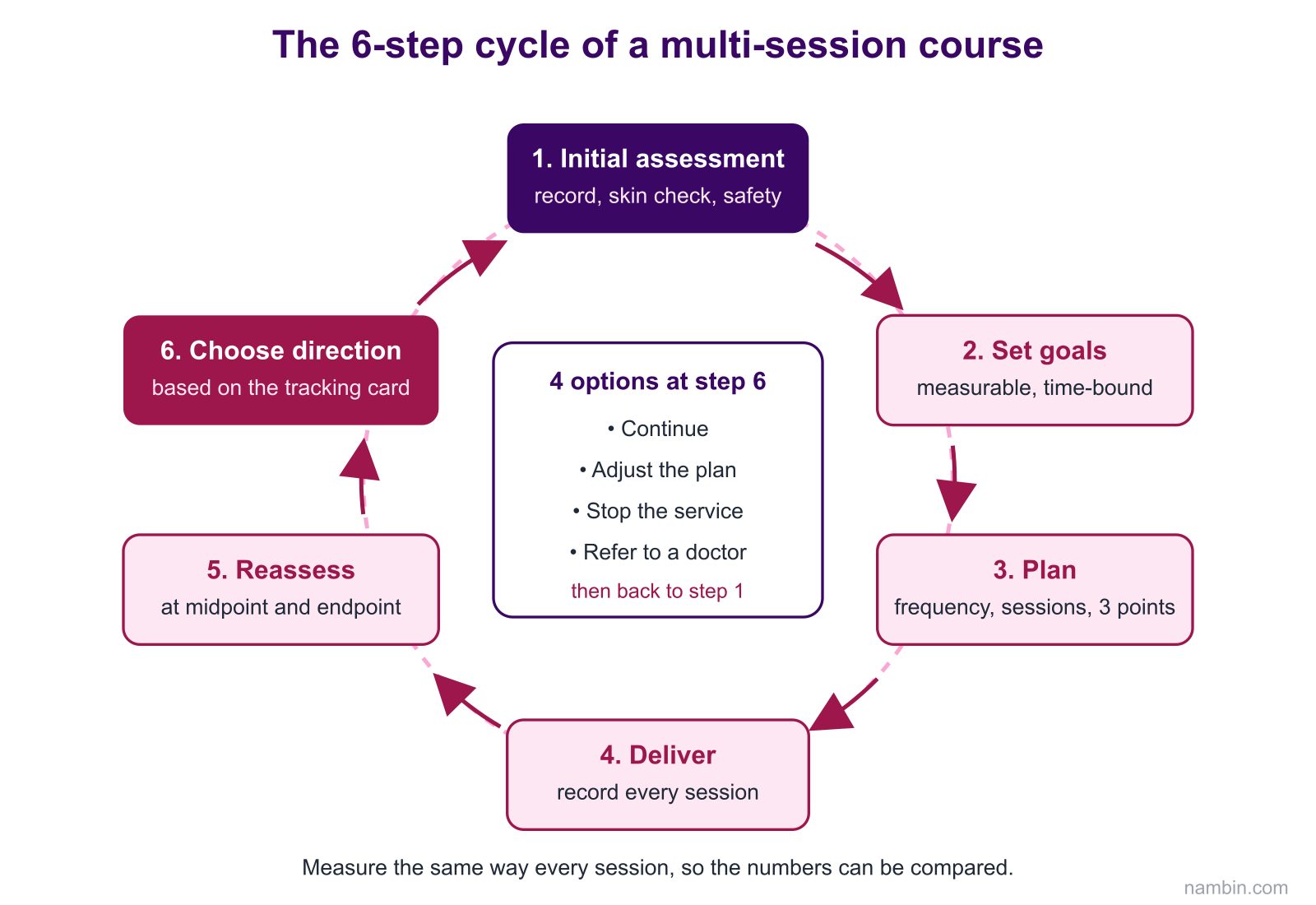
A spa treatment programme is still non-invasive care: hydrating, soothing, cleansing and relaxation massage. If the client's goal requires treatment (treating melasma, treating severe inflamed acne, treating atrophic scars, relieving pain caused by spinal disease), that is not a programme the spa can design. Such work belongs to licensed medical examination and treatment facilities under the Law on Medical Examination and Treatment No. 15/2023/QH15.
Setting realistic goals
A good goal answers four questions: what will change, how it will be measured, over what period, and what is not promised. A goal of "better skin" cannot be measured, so you never know whether it has been achieved. A goal of "glass-like glowing skin after 3 sessions" can be measured but is not realistic; it only leads to disappointment and complaints.
| Poorly written goal | Why it is wrong | Well-written goal |
|---|---|---|
| "Better skin" | Not measurable; everyone understands it differently | "Reduce the tight, dry feeling after cleansing: client self-rating from 7/10 down to about 3–4/10 after 8 weeks" |
| "Brighter, several shades lighter after 5 sessions" | Promises results, unrealistic, easily breaches advertising regulations | "Smoother skin surface, less flaking in photos taken under the same conditions at session 1 and session 8" |
| "No more neck and shoulder pain" | Promises treatment; the pain may be caused by disease | "Client self-rating of neck and shoulder tension at the end of the working day reduced from 6/10 to about 3/10 after 6 sessions" |
| "Continue until the client is happy" | No time frame, no review points | "8 sessions, reviewed at session 1, session 4 and session 8" |
How to measure
- Client self-rating from 0 to 10: degree of tightness and dryness, degree of muscle tension, quality of sleep. Ask the same question, worded the same way, at every session.
- Therapist observation: flaking, redness, smoothness to the touch, areas of stiff muscle, the range of neck rotation the client can manage comfortably. Record using a scale agreed across the spa: "none, mild, moderate, marked".
- Photos taken under the same conditions for skin programmes, only if the client gives written consent.
- Device readings (for example a skin moisture meter) if the spa has one: only compare readings from the same device, at the same location, under the same room conditions. Never use readings to "scare" the client or to "prove miracles".
Finally, state clearly what the programme cannot do on the sheet itself: "The programme supports hydration and soothing; it does not treat dermatitis, melasma or skin disease." This sentence protects both the client and you.
Frequency and number of sessions
Frequency depends on how long the body needs to "respond". The horny layer on the skin's surface renews continuously; in young people, one renewal cycle of the epidermis takes about 4 weeks, and in older people it is usually longer. So a skin programme usually needs at least 6–8 weeks before clear surface changes are visible. Muscle tension caused by working posture responds faster, but also returns quickly if habits do not change.
| Type of programme | Usual frequency | Suggested number of sessions | Notes |
|---|---|---|---|
| Care for dry, dehydrated skin | 1 session per week | 6–8 sessions | Gentle exfoliation no more than once every 1–2 weeks, according to the product label |
| Care for mild acne-prone skin (not severely inflamed) | 1 session every 1–2 weeks | 6–8 sessions | Widespread inflamed acne, cysts, scarring: advise seeing a dermatologist |
| Superficial peel in the spa | According to the manufacturer's instructions | According to the manufacturer's instructions | Learned at Level 2; do not shorten the interval to "get results faster" |
| Relaxing neck and shoulder massage | 1–2 sessions per week | 6 sessions, then maintenance once every 2–4 weeks | Combine with advice on sitting posture and breaks during computer work |
Results in the spa are only half the story. The other half is home care: a gentle cleanser, moisturiser and sunscreen for skin clients; breaks and changes of position for neck and shoulder clients. Record on the sheet whether the client follows the advice, because that is often the number one reason a programme "doesn't work".
Photo: M.Minderhoud / Wikimedia Commons, CC BY-SA 3.0

The progress tracking sheet
At Level 2 you learned about client records and consent forms. The treatment programme tracking sheet is a separate page attached to that record, with one row per session. The golden rule: measure the same way at every session; only then do the numbers mean something.
| Column on the sheet | Example entry |
|---|---|
| Session number, date, therapist | Session 4/8, 12/11, therapist Lan |
| Client self-rating (0–10) | Tight and dry after cleansing: 5 (session 1: 7) |
| Therapist observation | Flaking on both cheeks: mild (session 1: marked); redness on the sides of the nose: none |
| Work done, products | Gentle cleanse, 15-minute hydrating mask, 12-minute facial massage |
| Not done, and why | No exfoliation because it was done at session 3 |
| Reactions during and after the session | Slightly pink at the end, faded after about 30 minutes |
| Home care | Client uses moisturiser every evening; sunscreen only 3/7 days |
| Photos | Photo codes B4-01, B4-02, B4-03 (internal-use consent dated 22/10) |
| Plan for next session | Keep the same routine; remind about daily sunscreen |
Three review points
- Baseline (session 1): record the most complete starting point and take standard photos if the client consents. Without a baseline you can never prove progress.
- Mid-point (around session 3–4): compare with the baseline, tell the client the real results, and decide whether to keep or adjust the plan.
- Final review (last session): compare everything, ask the client how she feels, and propose maintenance or finishing. Finishing is also a good result if the goal has been achieved.
Before-and-after photos: technique and consent
Before-and-after photos are the strongest evidence of progress, and also the biggest privacy risk. Photos of the face and body are personal data; when linked to the condition of the skin, they are also health information, which belongs to the category of sensitive data as you learned at Level 2.
Written consent, separated by purpose
The photo consent form is a separate sheet, not combined with the service consent form. On the form there are separate boxes for the client to tick:
- Box 1, internal tracking: viewed only by the responsible therapist and the manager, to compare progress.
- Box 2, internal training: used when teaching trainees, with identifying features covered or cropped out.
- Box 3, advertising and social media: requires separate consent, stating clearly the channel of publication, whether the face is recognisable or not, and the period of use.
A client agreeing to box 1 does not mean she agrees to box 3. The client has the right to withdraw consent at any time; the spa then stops using the photos in line with its own policy. Do not take photos if the client has not signed, even if she says verbally "go ahead, take as many as you like".
Shooting to standard so that photos can be compared
Photos taken differently at each session cannot be compared: warm yellow light makes skin look dull, a flash hides flaking, a different angle makes the cheeks look bigger or smaller. Standardise with a fixed "photo corner" in the spa.
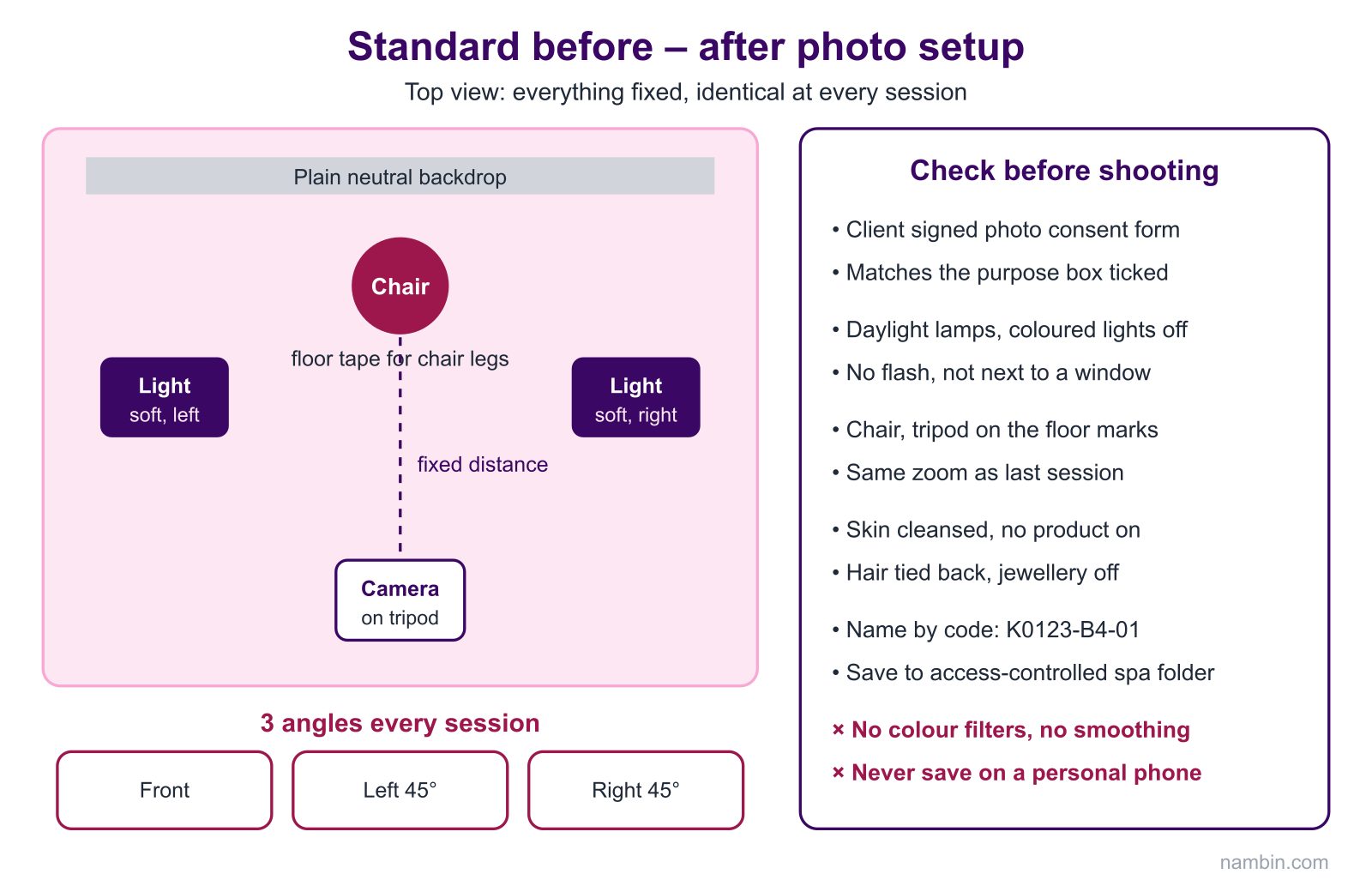
- Same lighting: fixed daylight lamps shining softly from both sides; turn off coloured lights, no direct flash, do not shoot next to a window because sunlight changes with the time of day.
- Same distance: camera on a tripod, floor markings for the chair legs and tripod legs; no different zoom between sessions.
- Same angles: three photos – straight-on, left 45 degrees, right 45 degrees; the client looks at a fixed marked point.
- Same skin condition: shoot after cleansing and before any product, at the same point in the session; hair tied back, jewellery removed.
- Same backdrop: a plain, neutral-coloured backdrop, with no logos or objects behind.
- No editing: no colour filters, no smoothing, no separate brightness adjustment for the "after" photo.
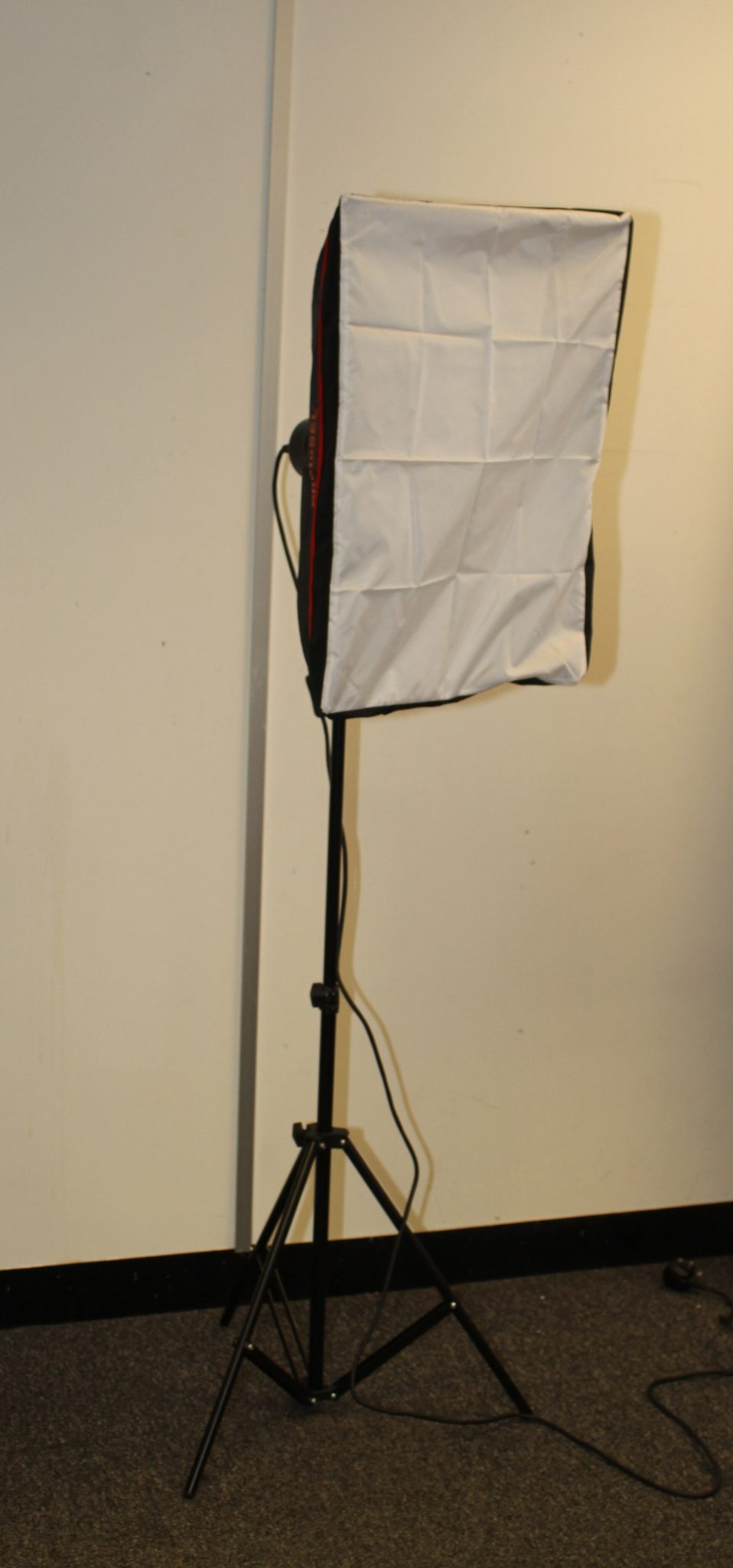
Photo: Katie Chan / Wikimedia Commons, CC BY-SA 3.0

Protecting identity in internal use
- Name photos by client code and session code (for example K0123-B4-01), not by the client's name.
- For training, use only the area of skin that needs to be seen; crop out the eyes, tattoos and easily identifiable moles.
- Store on the spa's devices and folders with access control; never on personal phones, and never send them through chat groups.
- For body programmes, photograph only the area being tracked, with the rest of the client still draped; never photograph intimate areas.
For advertising photos, in addition to separate consent you must comply with the Advertising Law 2012: information must be truthful and must not mislead about results. Edited photos, "after" photos taken with better lighting, or captions such as "cured for good" all distort the truth.
When to continue, adjust, stop or refer to a doctor
| Data in the sheet | Decision | Action needed |
|---|---|---|
| Self-ratings and observations improve steadily across review points | Continue | Keep the plan and tell the client the specific results |
| At the mid-point, almost no change from the baseline | Adjust | Review home care, products and frequency; explain honestly to the client |
| Persistent redness, stinging or itching after a session, a rash | Stop the suspected product | Follow the allergy procedure learned at Level 1, record the incident, inform the manager |
| Thick flaking, red patches with clear borders, intense itching, cracking or oozing | Stop, refer to a doctor | Advise seeing a dermatologist; the spa does not treat skin disease |
| A mole or pigmented patch changing in shape, colour or size | Refer to a doctor | Advise an early medical examination; do not perform services on that area |
| A neck and shoulder client feels numbness in the arm, spreading pain or dizziness when turning the neck | Stop, refer to a doctor | Do not massage the neck until there is a doctor's opinion |
| The client is pregnant, has started a new medication, or has just had a medical procedure | Reassess safety | Update the record, change the routine or postpone according to spa guidelines |
| The goal has been achieved | Finish or move to maintenance | Propose a less frequent maintenance schedule; do not pressure the client to buy more |
Adjusting does not mean "increasing the dose": do not increase concentrations, do not shorten peel intervals, and do not add stronger steps to get results in time. When you adjust, record the reason on the sheet.
Worked example: an 8-session programme for dry, dehydrated skin
A 34-year-old female client works in an air-conditioned office all day. Her skin feels tight and stinging after cleansing, with fine flaking on both cheeks. Her record shows no contraindications, and she uses no retinoids or topical medicines. A quick distinction: dry skin lacks oil, dehydrated skin has a horny layer that holds water poorly; this client has both. Goal: "Reduce the tight, dry feeling after cleansing from 7/10 to about 3–4/10, and flaking on both cheeks from marked to mild or none, after 8 weeks. The programme does not treat skin disease."
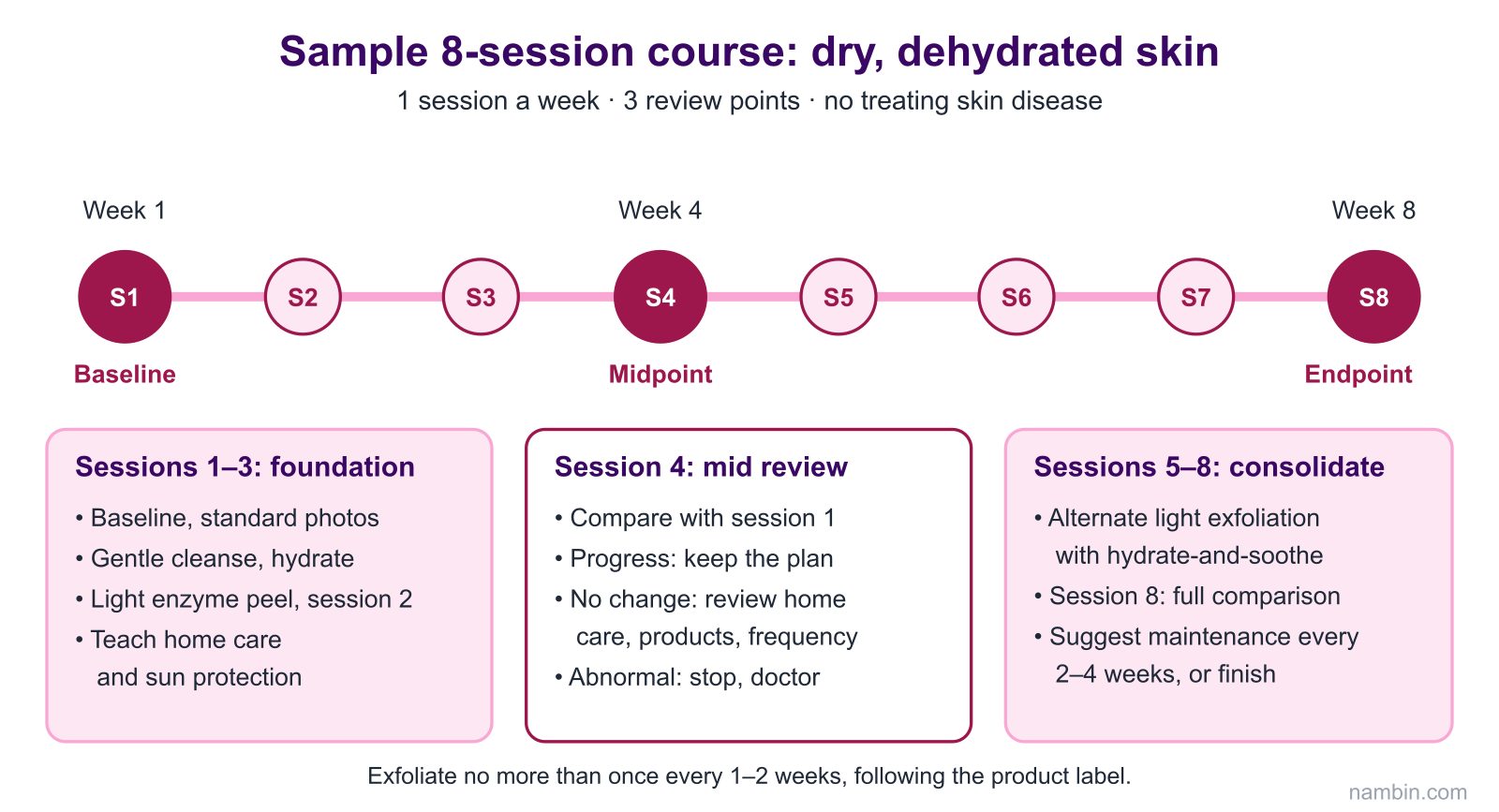
| Session | Main content | Review, notes |
|---|---|---|
| 1 | Consultation, skin analysis, gentle cleanse, hydrating mask, light facial massage; home care advice | Baseline: self-rating, observation, standard photos (if consented) |
| 2 | Cleanse, gentle enzyme exfoliation according to the label, hydrate, seal in moisture | Ask about reactions after session 1, check whether the client uses moisturiser regularly |
| 3 | Cleanse, hydrating serum (for example glycerin, hyaluronic acid), mask, massage | Record reactions |
| 4 | As session 2 | Mid-point: compare with session 1, keep or adjust |
| 5–7 | Alternate sessions with gentle exfoliation and sessions with only hydrating and soothing (for example panthenol) and sealing in moisture (for example ceramides) | Monitor sunscreen use, washing with water that is too hot, air conditioning |
| 8 | Hydrating care, summary | Final review: compare, propose maintenance once every 2–4 weeks or finish |
Home care: a gentle cleanser, no washing with very hot water; a moisturiser with moisture-sealing ingredients morning and evening; daily sunscreen. Choose products based on the ingredient-reading knowledge learned at Level 2 and the range the spa currently uses.
Short version: 6 relaxing neck and shoulder sessions
A 40-year-old male client sits at a computer 9 hours a day, with neck and shoulder tension of 6/10 at the end of the day, no numbness in the arms and no spreading pain. Plan: 2 sessions per week for 3 weeks, each session 45–60 minutes of massage on the upper back, shoulders and back of the neck, plus a Vietnamese-style head spa (herbal hair wash with head massage) if the client likes. Review at session 1, session 3 and session 6 using self-ratings and the range of neck rotation the client can manage comfortably. Advise the client to stand up and move gently after every 45–60 minutes of sitting. If numbness in the arms, spreading pain or dizziness appears, stop and advise a medical examination.
The 7-step treatment programme design process
- Initial assessment: consultation, health record, skin analysis or examination of the muscle area; rule out contraindications.
- Write the goal using the four questions: what will change, how it will be measured, over what period, what is not promised. Read it back to the client and ask whether it seems reasonable to her.
- Choose the frequency, number of sessions and review points; book the whole programme in advance.
- Obtain consent: the service consent form and, if photos will be taken, the photo consent form separated by purpose.
- Record the baseline: self-rating, observation, standard photos.
- Deliver and record each session, including what was not done and home care.
- Review at the mid-point and the final review; choose to continue, adjust, stop or refer to a doctor; tell the client the real results.
Photo: Matt @ PEK from Taipei, Taiwan / Wikimedia Commons, CC BY-SA 2.0

Common mistakes in designing treatment programmes
| Mistake | Why it is dangerous or wrong | The correct way |
|---|---|---|
| Not recording a baseline | Progress cannot be proven; disputes arise easily | At session 1, always record the self-rating, observation and photos (if consented) |
| Taking photos in a different place and lighting at each session | Photos cannot be compared and may mislead | One fixed photo corner, the same 3 angles, no editing |
| Posting internal photos on the spa's fan page | Breaches privacy, loses the client's trust | Post only with separate consent for advertising |
| Goals like "melasma gone" or "no more back pain" | Promises treatment, outside the spa's scope | Care goals that are measurable and have stated limits |
| If it isn't working, increasing concentrations and shortening intervals | Easily causes irritation, burns and damage to the skin barrier | Review home care and the plan; follow the manufacturer's label |
| Seeing signs of skin disease but carrying on to finish the package | Delays the client's medical examination and treatment | Stop, advise seeing a doctor, record in the file |
Pass criteria for this lesson
You pass this lesson when you can do the following in front of your instructor:
- Rewrite all 4/4 "wrong" goals as goals with all four elements (what will change, how it is measured, over what period, what is not promised) within 10 minutes.
- Design on paper a 6–8-session programme for a case given by the instructor, with frequency, three review points and home care advice, within 20 minutes.
- Complete all 9 columns of the tracking sheet for a role-play session; the instructor can read and understand it without needing to ask questions.
- Set up a photo corner and take 3 standard photos (straight-on, left, right) for two simulated sessions; when placed side by side, the two sets have the same lighting, distance and angles.
- Explain the photo consent form with its 3 separate purpose boxes and the right to withdraw consent in no more than 2 minutes.
- Choose the correct decision for at least 7/8 situations in the "continue, adjust, stop, refer to a doctor" table.
Frequently asked questions
The client wants to speed things up with 3 sessions a week to be ready for a wedding – should we?
For hydrating and soothing care, increasing to 2 sessions a week for a short period is usually acceptable if the skin is not irritated. For exfoliation and superficial peels, do not shorten the interval stated on the label. Tell the client honestly: skin needs time, and more frequent sessions do not mean faster results.
If the client does not agree to photos, how do we track progress?
With the client's self-ratings and the therapist's observations recorded on the agreed scale, plus device readings if the spa has a device. Respect the client's choice; do not try to persuade her, and never take photos secretly.
What if the programme ends and the goal has not been reached?
Sit down with the client, open the sheet and compare the baseline with the final review, be honest about what has and has not been achieved, and look for the reasons (home care, environment, a real need for medical treatment). If you suspect a medical problem, advise the client to see a doctor rather than selling another package.
Further reading
See how consultation, delivery and records come together in a single session in the lesson Delivering a complete 90-minute spa treatment: from welcoming the client to the record, and review how to ask health questions in the lesson Spa client consultation and health questionnaires: asking the right questions to work safely.