Friday evening, and the spa is busy. Within one hour: one client slips at the exit of the steam room; another gets back to reception and finds that the necklace she left in her locker is missing; a third complains that the hot stones have left her back red and stinging and demands a refund. The shift leader is busy, and you are the only advanced therapist with your hands free. What you say, do and write in those first minutes will decide whether the clients are safe, whether the spa keeps their trust and, if the matter goes further, whether the records are good enough to establish what happened.
At Level 1 you learned first aid for burns, eye irrigation, handling fainting, recognising anaphylaxis and writing a basic incident report. This lesson raises that to advanced-therapist level: coordinating the whole situation, writing a complete report with evidence, handling complaints within your authority, and turning incidents into lessons for the whole spa.
By the end of this lesson, you will be able to:
- Classify incidents by group and by 3 severity levels, so you know what to do immediately and whom to report to.
- Apply the general 6-step procedure for every incident: safety first, stop the hazard, inform the manager, preserve evidence, write the report, follow up.
- Handle each situation correctly: burns, allergies, slips and falls, lost property, dissatisfied clients.
- Write an incident report with all 12 fields, take photographs with consent and preserve evidence correctly.
- Handle complaints using the 4-step model: listen, apologise appropriately, offer a solution within your authority, follow up.
- Take part in a post-incident review without blaming individuals.
Classifying incidents so you handle them correctly
An incident is anything unexpected that causes, or could cause, harm to a client, a staff member or property. A complaint is when a client expresses dissatisfaction and expects the spa to resolve it. The two often go together. There are also near misses: a wet floor where nobody has fallen yet, hot stones overheated but caught in time by the therapist. These must be recorded too, because they warn of a real incident to come.
| Incident group | Examples in the spa | Who to inform immediately |
|---|---|---|
| Client health | Thermal burns from hot stones, wax or towels; allergy, irritation; dizziness or fainting after steam | Shift leader; 115 if there are serious signs |
| Accident | Slip or fall in the shower or steam room; head knocked on a shelf; hand caught in a folding couch | Shift leader; 115 if a serious injury is suspected |
| Property | Items lost from a locker, broken glasses, oil spilled on a client's bag or clothes | Manager |
| Service quality | Wrong service, wrong duration, pressure not as requested, wrong price charged | Shift leader |
| Behaviour | A client makes indecent remarks or advances towards a therapist; a drunk or disruptive client | Manager immediately; stop the service |
Three severity levels
- Level 1 – minor: handled in the spa; the client is fine on leaving (slight redness after waxing, a client complaining about pressure).
- Level 2 – needs a medical examination: the client needs to see a doctor the same day (a blistering burn, a fall with a painful wrist, a spreading allergy without difficulty breathing).
- Level 3 – emergency: call 115 immediately (signs of anaphylaxis, fainting without regaining consciousness, a fall with a head knock followed by drowsiness or vomiting, bleeding that will not stop).
The level decides the speed and who must be informed; it does not decide whether a report is written. Every level is recorded.
The general 6-step procedure for every incident
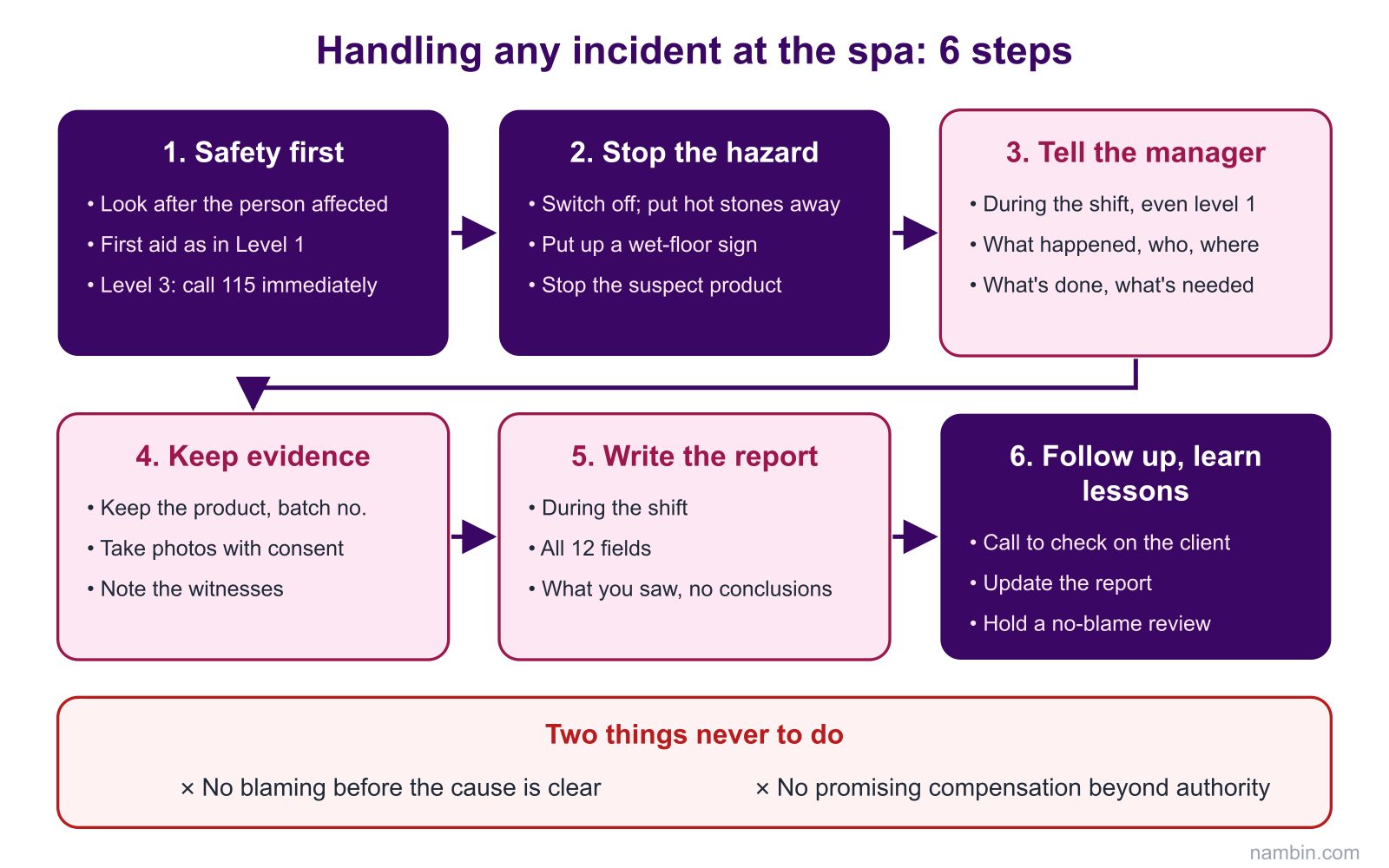
- Safety first: look after the person affected before anything else. Give first aid as in the Level 1 lesson; for Level 3, call 115 immediately.
- Stop the hazard: switch off the machine, put away the hot stones, put up a wet-floor sign, stop using the product suspected of causing a reaction, so that nobody else is affected.
- Inform the manager: tell the shift leader or manager during the shift, even for Level 1. Keep it short: what happened, who, where, what has been done, what is needed.
- Preserve evidence: keep the product, the equipment and the scene as they are if it is safe to do so; take photographs with consent; note the names of witnesses.
- Write the report: during the shift, while memories are clear, using the 12-field template below.
- Follow up and learn: phone the client to check on them, update the report, and bring the incident to the review meeting.
Two things not to do: do not blame anyone (the client, a colleague, the supplier) before the cause is clear; do not promise compensation, refunds or free services beyond your own authority. Both are hard to take back and can make the matter more complicated.
Handling each situation
Burns and allergies: a first aid reminder
You studied the first aid techniques thoroughly at Level 1; here we only recall the key points. Thermal burns: remove the heat source, run cool water over the burn for about 20 minutes, remove jewellery, cover lightly with clean gauze, and do not apply creams, toothpaste or grease; for extensive blistering, burns to the face or intimate areas, or elderly clients, advise a medical examination. Allergy or irritation: stop the product, rinse thoroughly with cool water and monitor; for difficulty breathing, swollen lips or eyes, a rapidly spreading rash, or faintness, call 115 immediately. Therapists do not give clients medicines.
What Level 3 adds is coordination: one person stays with the client, one person phones and reports, one person secures the product. Keep the product container, note its name and batch number, set it aside and do not use it on other clients until the manager decides. For burns from hot stones or wax, record the measured temperature if you have a thermometer, and leave the heater in the state it was in at the time of the incident so it can be checked.
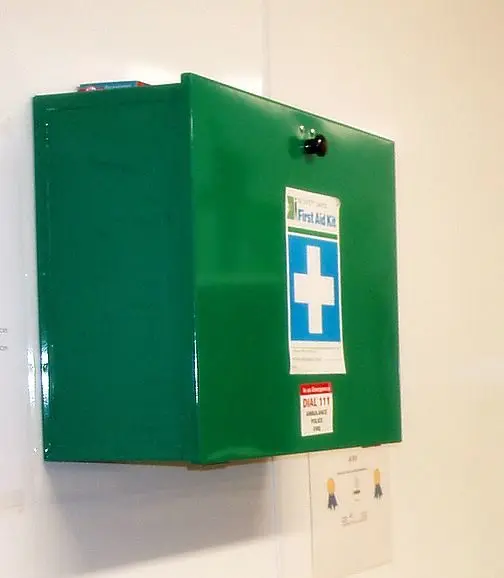
Photo: Leigh Blackall from Dunedin, New Zealand. Cropped by D6194c-1cc . / Wikimedia Commons, CC BY 2.0

Slips and falls
- Do not rush to help the client up. Ask where it hurts, whether they can move their arms and legs, and whether they hit their head. If the client has severe pain in the neck or back, cannot move a limb, or hit their head and is drowsy, vomiting or has a worsening headache: keep them lying still, keep them warm, and call 115.
- If the client can move on their own and wants to get up: help them up slowly, sit them on a chair to rest, and monitor for at least several tens of minutes. Even after a minor head knock, advise the client to have someone accompany them home and to see a doctor if any abnormal signs appear later.
- Cover the client with a towel or robe if they are lightly dressed, protect their privacy, and ask other clients to leave the area.
- Put up a warning sign, and dry the floor only after photographing the scene: where the fall happened, the wet floor, mats, slippers.
- Record the witnesses, the time, what slippers the client was wearing, and when the floor was last cleaned according to the cleaning log.
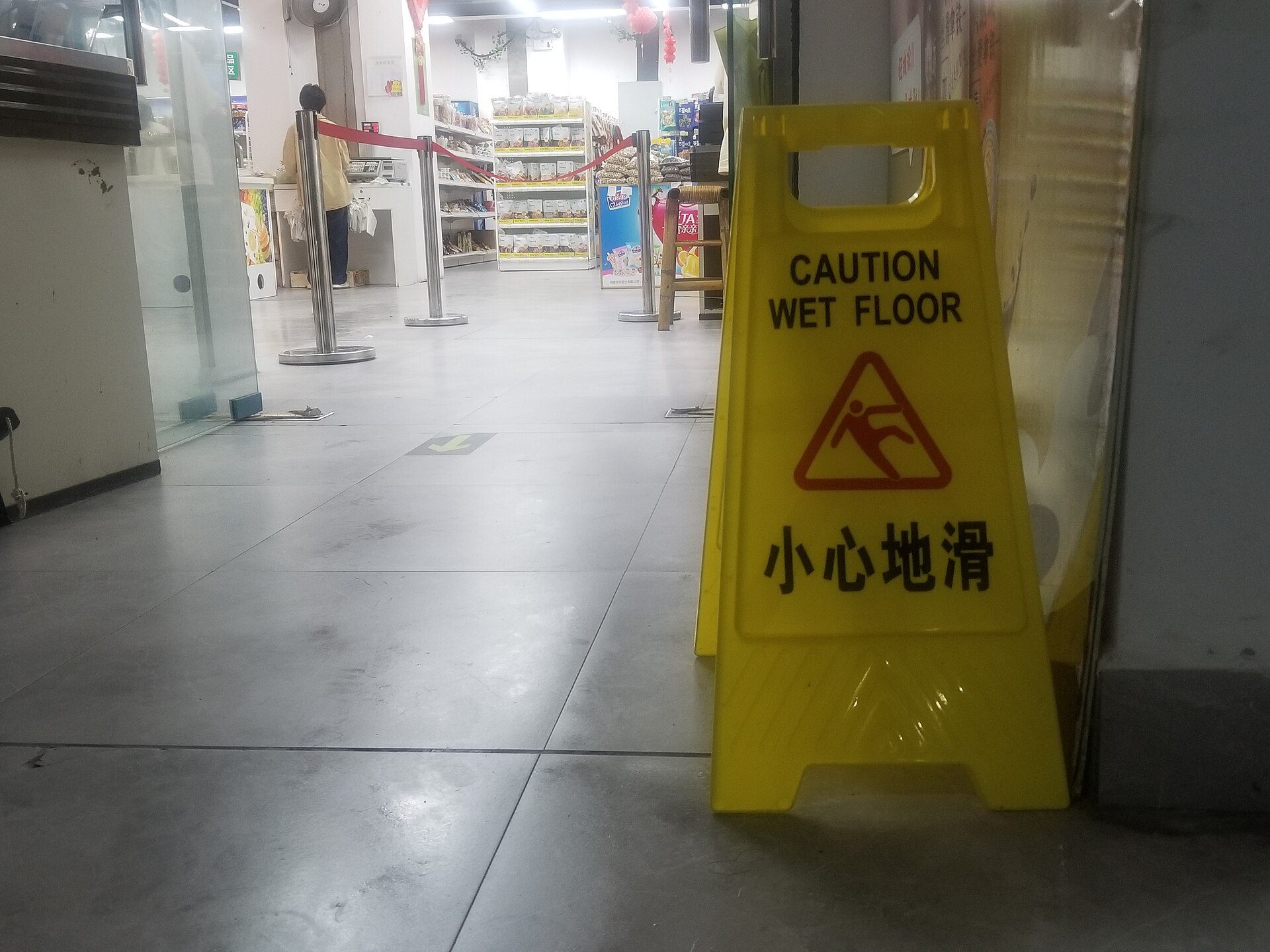
Photo: 彩色琪子 / Wikimedia Commons, CC BY-SA 3.0

Lost property
Lost property is the situation that turns tense most easily, because the client is worried and staff feel suspected. The principles: stay calm, be respectful, do not investigate on your own.
- Listen and record: what is missing, a description, where it was left, when it was last seen, the locker number, who held the key or wristband.
- Check again together with the client the places the client has been: the locker, the treatment room, the dirty towel basket, the client's handbag (the client checks her own bag).
- Inform the manager. The manager decides on viewing CCTV for the common areas and checking the locker key log.
- Do not search other clients or colleagues or their bags; do not say "you probably left it at home", and do not say "that girl must have taken it" either.
- If the client wants to report it to the police, the manager helps by providing information; therapists do not discourage this or advise "just let it go".
- Do not promise compensation. Compensation is decided by the manager or spa owner in line with regulations and the spa's rules on storing belongings.
Photo: Jorge Franganillo / Wikimedia Commons, CC BY 2.0

Clients dissatisfied with the service
The client complains about the pressure, a noisy room, a therapist skipping steps, or not seeing the "results" they expected. This is the most common type of complaint. Handle it using the 4-step model below. If the cause is mistaken expectations (the client thought one session would "clear melasma"), look back at the consultation and expectation-setting stage learned at Level 2.
A complete incident report and preserving evidence
The Level 1 report has 7 basic sections. At Level 3 you are the person who writes or checks reports for the whole shift, so you need all 12 fields. A good report answers: what happened, when, where, who was involved, what was done, what evidence exists, and who was informed.
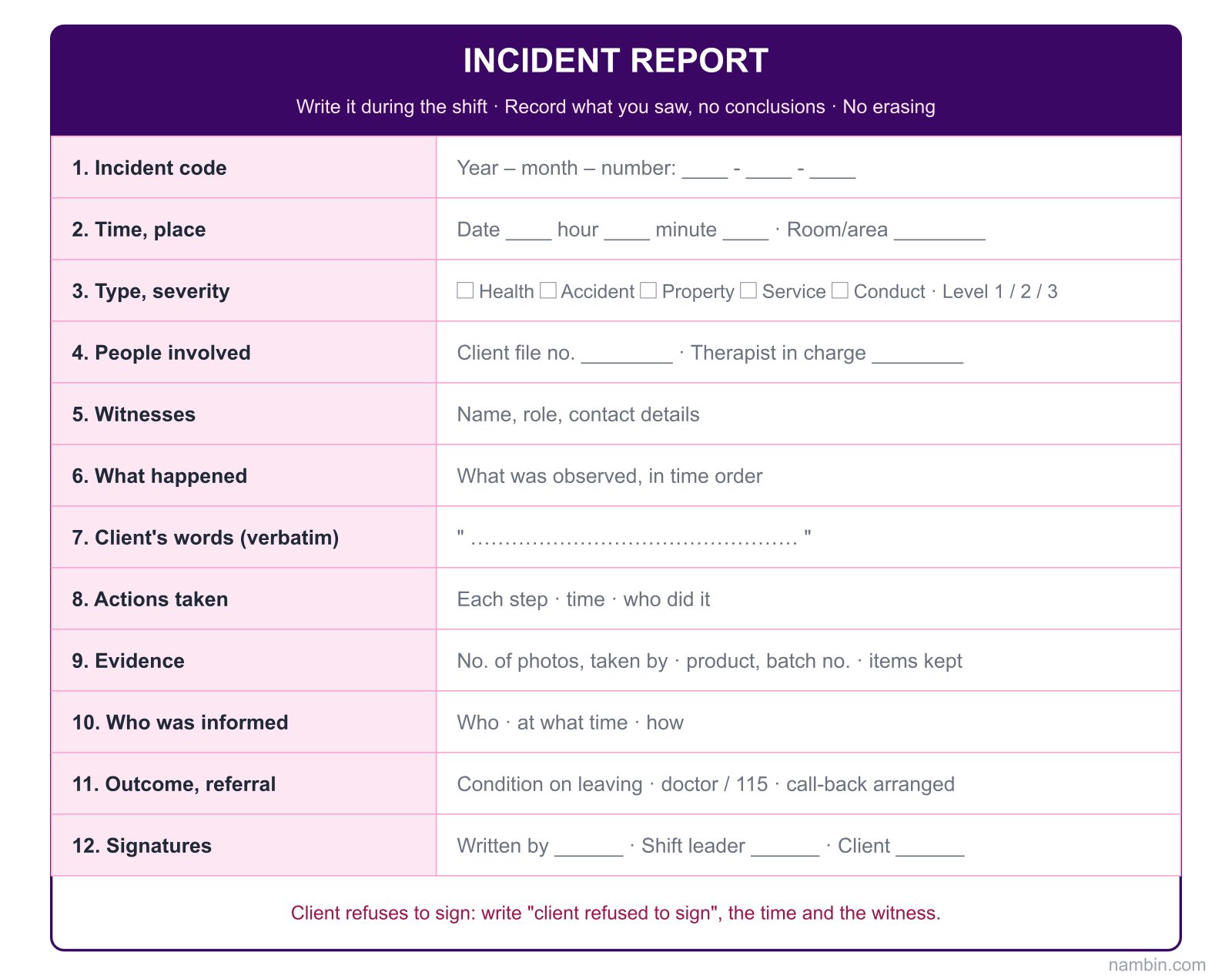
| Field | What to record | Example |
|---|---|---|
| 1. Incident code | Year-month-sequence number within the month | 2026-11-07 |
| 2. Time, place | Date, hour and minute it happened; room, area | 04/11, 19:42, steam room exit |
| 3. Group, severity | According to the classification table and the 3 levels | Accident – Level 2 |
| 4. People involved | Client file code (no need to record ID card number); therapist in charge | KH-0815; therapist Lan |
| 5. Witnesses | Name, role, contact details | Receptionist Hoa; another client who agreed to leave a number |
| 6. Sequence of events | What was observed, in chronological order | 19:42 slipped, fell onto her bottom, landed on right hand |
| 7. Client's words | Recorded verbatim in quotation marks | "The floor is so slippery, my wrist hurts" |
| 8. Actions taken | Each step, time, who did it | 19:43 asked questions, checked movement; 19:50 cold compress |
| 9. Evidence | Photos (number of photos, who took them), products, batch numbers, equipment retained | 3 photos of the scene, spa camera, taken by receptionist |
| 10. People informed | Who, at what time, by what means | Shift leader 19:44 by phone; manager 20:05 |
| 11. Outcome, onward referral | Condition on leaving the spa; advised examination or called 115; follow-up call arranged | 20:20 client walked unaided, advised a wrist X-ray |
| 12. Signatures | Person writing the report, shift leader; client if they agree | Client declined to sign; record "client declined to sign" clearly |
How to write an objective report
- Record what you saw and heard, not conclusions: "a red area about the size of a palm on the left side of the back", not "second-degree burn" or "caused by the client moving".
- Record specific times, not "sometime in the evening". If unsure, write "around 19:40, according to the receptionist".
- No erasing: if you write something wrong, strike through it with a single line, rewrite it and initial it. Information added later is written as an addition with date and time; do not alter the original.
- Do not include personal opinions about fault ("the afternoon shift's fault for not mopping the floor"). The report is about facts; finding causes is done at the review meeting.
Taking photographs and preserving evidence
- Ask for consent before photographing a person: "May I take a photo of the red area for our records, and so a doctor can see it if you go for an examination? Only the manager will see the photo. Is that all right?" If the client refuses, do not take it, and record "client did not consent to photographs".
- Photograph only the relevant area, without the face unless necessary, with the rest of the body covered by a towel. The scene, products and equipment can be photographed without asking the client, but keep other clients out of the frame.
- Use the spa's device, not a personal phone. Do not send photos to group chats; pass them to the manager through the channel the spa specifies. Client photos are sensitive data, as covered in the Level 2 lesson on client records.
- Retain physical evidence: the product container (set apart and labelled with the incident code), hot stones, the heater, slippers, mats. Do not throw away or wash out a product suspected of causing a reaction.
- CCTV: only the manager may view and extract footage of common areas; record in the report the time that needs to be viewed so it is not overwritten.
The 4-step complaint handling model
Most clients who complain just want to be heard, to be respected and to see the problem resolved. Handled well, a complaint often keeps the client; handled clumsily, a small matter can turn into an online post.
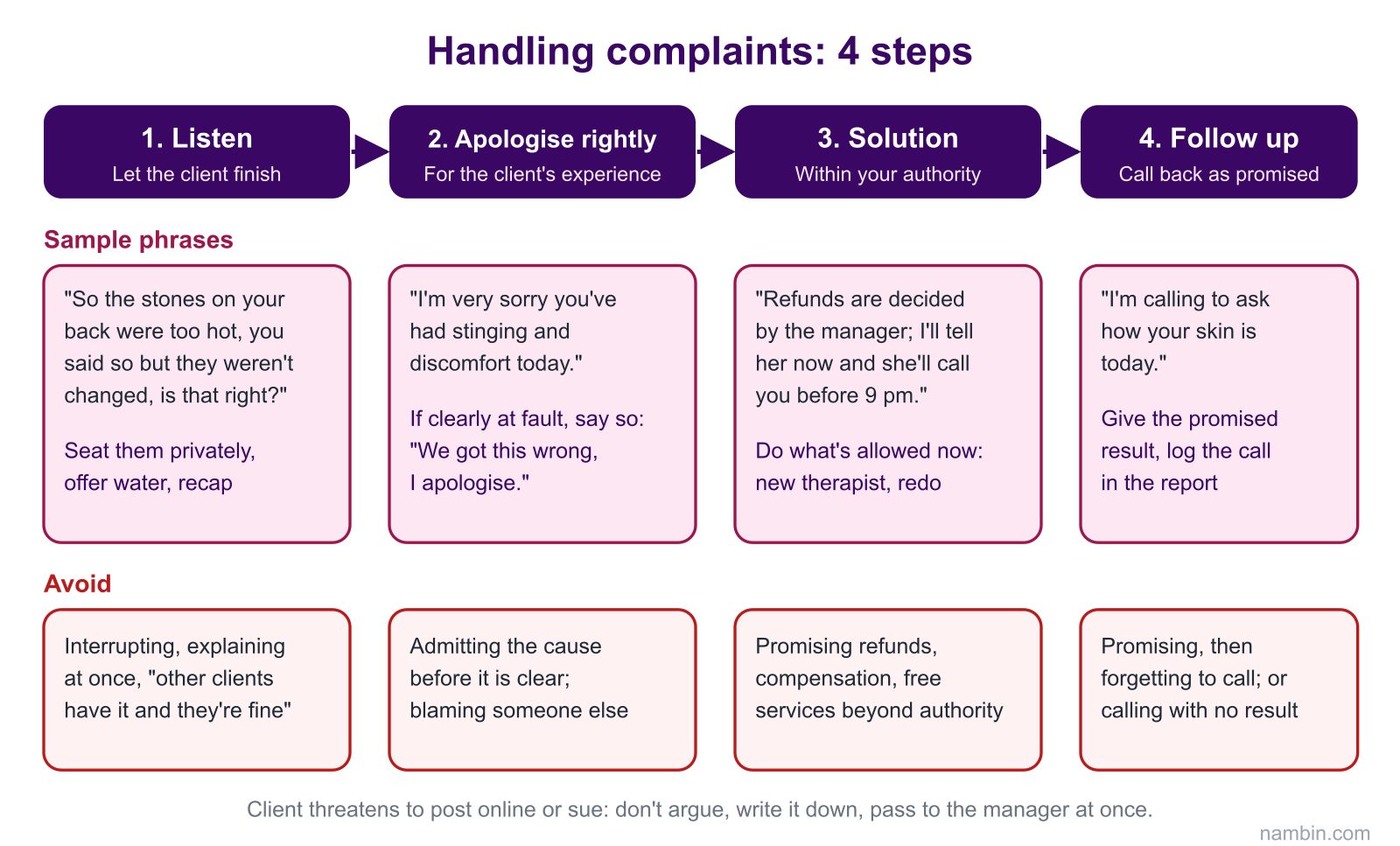
- Listen: invite the client to sit somewhere private and offer water. Let the client say everything, without interrupting and without explaining straight away. Repeat back the main points so the client sees you understand: "So, if I've understood correctly, the stones on your back were too hot, you told us, and they still weren't changed – is that right?"
- Apologise appropriately: apologise for the client's experience and feelings, without yet admitting fault for the cause while it is unclear. "I'm very sorry you felt stinging and discomfort in today's session" is appropriate. "It's my fault, I ruined it, I'll compensate you" goes too far when the facts are not yet clear. When the fault is clear (the wrong service was given compared with what the client booked), admit it clearly: "We gave you the wrong package from the one you booked, and I apologise."
- Solution within your authority: do straight away what you are permitted to do (care for the affected skin, change therapist, redo the step the client was unhappy with, offer tea and a rest). For anything beyond your authority, say clearly who decides and when: "Refunds are decided by our manager. I'll tell her right now, and she'll talk to you before 9 o'clock tonight."
- Follow up: call back at the agreed time, ask how the client is, and inform them of the outcome. Record the call in the report or the complaints log. Keeping to the agreed time matters as much as the solution itself.
Authority by position
Every spa sets its own rules; the table below shows a common division of authority. Ask your manager about your specific authority.
| Position | May decide alone | Must refer upwards |
|---|---|---|
| Therapist | First aid, stopping the service, adjusting pressure, switching to a gentler product, apologising for the experience | Anything involving money, compensation, free services, or admitting fault on behalf of the spa |
| Shift leader | Changing therapist, redoing part of a service, rescheduling, according to spa rules | Refunds, compensation, Level 2–3 incidents, complaints involving threats to post online or take legal action |
| Manager, spa owner | Refunds, compensation, client policy, dealing with the authorities | Legal advice when needed |
Phrases to use and phrases to avoid
| Phrase to avoid | Why | Phrase to use |
|---|---|---|
| "Other clients have it done and they're fine." | Denies the client's feelings | "I understand you felt uncomfortable – please tell me more about it." |
| "It's because you didn't say so earlier." | Blames the client | "Next time I'll check with you more often during the treatment." |
| "I'll compensate you right now." | A promise beyond your authority | "I'll tell the manager straight away, and she'll speak to you before … o'clock." |
| "It's the product's fault, not mine." | Jumps to a conclusion and shifts blame | "I'll keep the product container so we can have it checked." |
When a client threatens to post online or take legal action
Stay calm, do not argue, and do not threaten back. Record what was said and pass it to the manager immediately. Therapists do not reply to online comments from their personal accounts, and do not post the client's information, photos or records to "set the record straight". Any public reply is made by the manager and does not reveal the client's personal information.
Learning from incidents
An incident that is recorded but never read helps nobody. Every Level 2–3 incident, and any repeated Level 1 incidents, should be brought to a short review meeting of about 15–20 minutes within one week.
The no-blame principle
The question of the meeting is "why did the system allow this to happen", not "who is at fault". When staff are afraid of being punished, they hide near misses, and the spa loses the chance to fix things before someone is hurt. No-blame does not mean ignoring deliberate violations; those are a separate matter for the manager.
Asking "why" several times
Example: a client slipped at the exit of the steam room:
- Why did the client fall? The floor at the exit was wet.
- Why was the floor wet? The client stepped out of the steam room with water dripping from her body.
- Why was there no anti-slip mat? The old mat had gone to be washed and there was no replacement.
- Why was there no replacement? The spa only had one mat, and nobody was assigned to check.
Corrective actions drawn from this: buy a replacement mat, add "mats, warning signs" to the opening checklist, assign a person in charge, and remind clients to wear anti-slip slippers. Each action has a person responsible and a completion deadline, is recorded in the incident log and is checked again after one month. The manager reviews the log monthly: incidents of the same type repeating in the same room, service or product are a sign that the procedure needs to change.
Common mistakes
| Mistake | Why it is dangerous or wrong | The correct way |
|---|---|---|
| Immediately helping a client with neck or back pain to stand up after a fall | Can make a spinal injury worse | Keep the client lying still, ask questions, check movement; call 115 if there are serious signs |
| Mopping the floor before photographing the scene | Loses evidence of the floor's condition at the time | Put up a warning sign, take photos, then mop |
| Throwing away the product suspected of causing an allergy | Ingredients and batch number cannot be checked; the source cannot be traced | Set it apart, label it with the incident code, pass it to the manager |
| Photographing a burn on a personal phone and sending it to a group chat | Leaks sensitive data without the client's consent | Ask for consent, use the spa's device, send to the manager through the specified channel |
| Promising "I'll refund you" | Beyond your authority; if the manager disagrees, the client becomes even more upset | Say clearly who decides and when they will reply, then report immediately |
| Writing the report the next day from memory | Wrong times, missing details, lost witnesses | Write it during the shift; additions later are written with date and time |
| Not recording near misses | Loses the early warning signal; the real incident will come | Record them in the log and bring them to the review meeting |
Pass criteria for this lesson
You pass this lesson when you can do the following in front of your instructor:
- Correctly assign the group and severity level for 6/6 scenario cards given by the instructor.
- State the 6 steps of the general procedure in the correct order, and the 2 things not to do, in no more than 1 minute.
- Role-play handling a client who has slipped: not rushing to help them up, asking all 3 questions (where does it hurt, can you move, did you hit your head), putting up a warning sign and photographing the scene before mopping.
- Write an incident report with all 12/12 fields in no more than 15 minutes, with no conclusions or blame; the instructor can understand it without asking further questions.
- Role-play handling a 5-minute complaint through all 4 steps, with an appropriate apology and a referral of authority with a specific time, without promising compensation.
- Analyse a sample incident by asking "why" at least 3 times and propose at least 2 corrective actions, each with a person responsible and a completion deadline.
Frequently asked questions
What if the client refuses to sign the report?
Do not force them. Record "client declined to sign", with the time and the witnesses (shift leader, colleague). The report is still valid as a record of what happened. Give the client a copy if they want one, in line with the spa's rules.
It was a small incident and the client left happy – do I still need to record it?
Yes. Level 1 is still recorded, briefly. Repeated small incidents are an early signal of a major one; and if the client comes back the next day to complain, a report written on the day is the clearest basis there is.
The client demands compensation on the spot and the manager is not there?
Acknowledge the request and phone the manager in front of the client if possible. If you cannot reach the manager, agree a specific time when the manager will call back and take the client's phone number. Do not promise any figure yourself.
If I caused the incident myself, should I tell the truth?
Yes. Tell the truth, stick to the facts, and do it as early as possible. Hiding an incident takes away the client's chance of timely care, and when it comes out the consequences for you are far worse. The review meeting focuses on fixing the procedure, not on punishing the person who told the truth.
Further reading
Review the safety scenarios and marking scheme in the lesson Spa safety and service skills check: 20 self-test questions, a practical task and a marking scheme, and how to complete the records at the end of a session in the lesson Delivering a complete 90-minute spa treatment: from welcoming the client to the records.