Clients from around 40 upwards often say to the therapist: "My face is sagging so much lately, my cheeks are dropping on both sides – please give me a lifting massage." Online, packages for "non-surgical lifting" or "10 years younger after 5 sessions" are advertised everywhere. In reality, a correctly performed facial massage relaxes the client deeply, leaves the skin rosy and the face less tense and tired, and the client leaves feeling that her "face looks fresher". But massage cannot change bone, fat or collagen that has already been lost. A good therapist is one who performs the movements correctly, with the right pressure, and tells the truth about the results.
At Level 1 you learned musculoskeletal anatomy, the five groups of classical massage movements and foundation facial care; at Level 2 you learned body massage and skin analysis. This lesson goes deeper into the face: which muscle lies where, in which direction to stroke, how much pressure is enough, who must not be massaged, and a 25-minute routine for you to practise until your hands move smoothly.
By the end of this lesson, you will be able to:
- Explain briefly why skin ages and distinguish dynamic wrinkles from static wrinkles.
- Locate the eight main facial muscle groups correctly and state the direction of movement for each area.
- Screen for contraindications before a facial massage, especially clients who have recently had filler, Botox or aesthetic procedures.
- Perform the 25-minute facial lifting massage routine in the correct order, with the correct pressure and rhythm.
- Set realistic expectations: massage supports relaxation and makes the skin temporarily fresher; it does not "erase wrinkles" or "lift permanently".
Ageing skin: what happens beneath the surface
Skin ageing has two sources. Intrinsic ageing follows age: cells renew more slowly, the skin produces less collagen (load-bearing fibres) and elastin (elastic fibres), and the sebaceous glands become less active, so the skin gets drier. Extrinsic ageing is caused by the environment, with sun exposure being the biggest cause (known as photoageing), plus smoking, pollution and lack of sleep. Photoaged skin shows deep wrinkles, dullness, brown spots and a coarse texture.
A "sagging" face is not caused by the skin alone. With age, the fat pads under the skin shrink and slide downwards, the jawbone and the bone around the eye sockets gradually resorb, and the ligaments that hold the tissues loosen. That is why massage, however skilful, cannot bring a face back to how it looked ten years ago.
Dynamic and static wrinkles
- Dynamic wrinkles appear only when muscles contract: forehead lines when raising the eyebrows, crow's feet when smiling, the line between the brows when frowning. They are caused by expression muscles pulling on the skin over and over.
- Static wrinkles remain even when the face is relaxed, because the skin has lost collagen and elasticity, combined with many years of muscle contraction.
Massage can help tight muscles (the jaw muscles of people who grind their teeth, the forehead muscles of people who frown a lot) relax for a while, so the face looks more "relaxed" after the session. Massage does not fill static wrinkles. For ageing skin, the anti-ageing care with the best evidence is still daily sun protection, as discussed in the lesson on melasma.
How ageing skin should be touched
Older skin is thinner and drier, small blood vessels break more easily, and scratches take longer to heal. So with older clients: use enough slip cream, lighter pressure than with younger clients, no pinching, no stretching, no rubbing. Ask about medication: clients taking anticoagulants (blood thinners) bruise easily, need very light pressure, and this must be clearly noted on the record card.
The eight main facial muscle groups a therapist must know
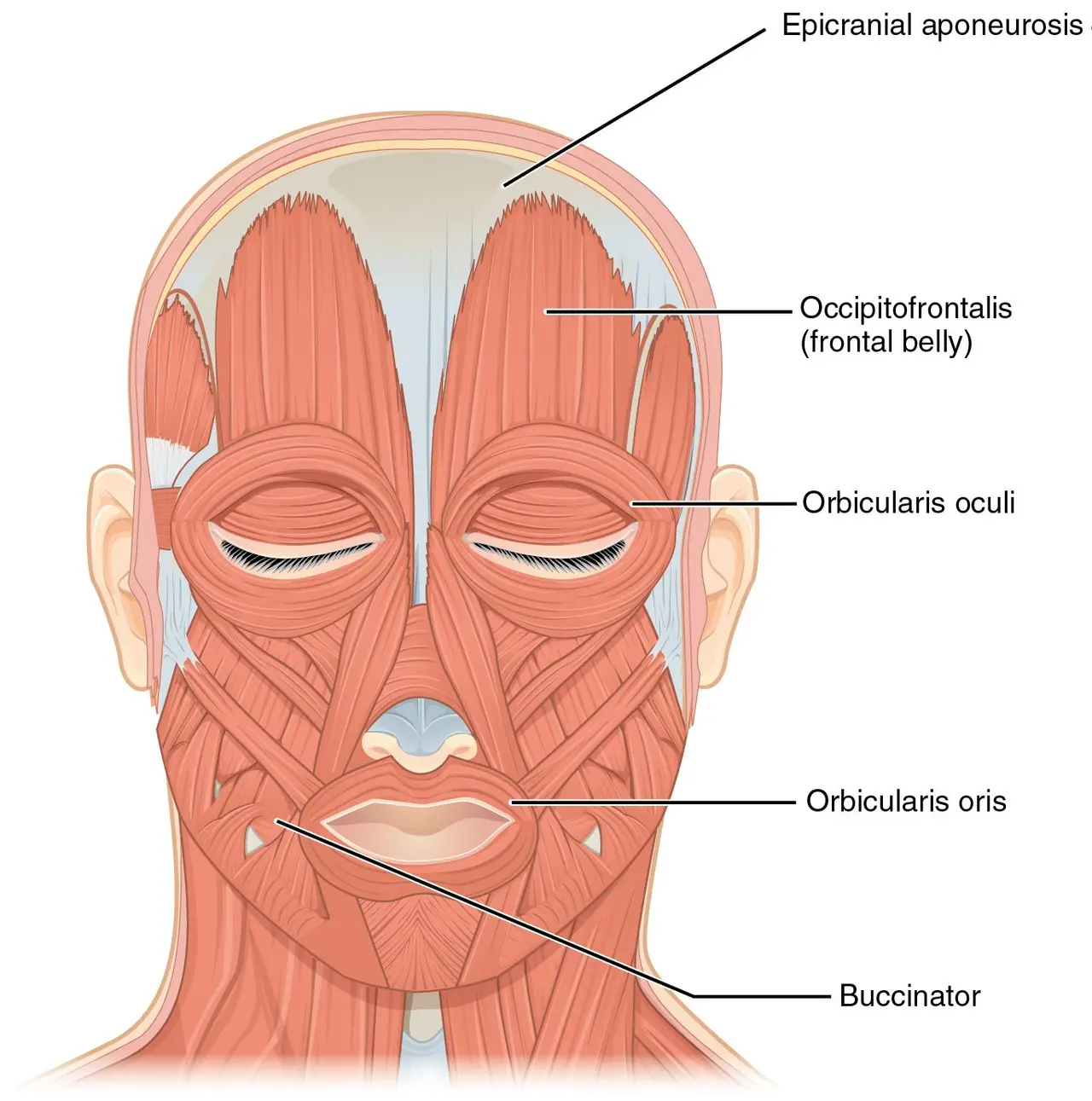
Facial muscles differ from the muscles of the trunk. Most are cutaneous muscles (muscles of facial expression): one end attaches to bone, the other attaches directly to the skin, so when they contract they pull the skin to create expressions. Facial muscles are thin, small and lie just beneath the skin; only light pressure is needed to reach them. There are also stronger chewing muscles such as the masseter and temporalis, used for chewing and often tight in people who are stressed or grind their teeth.
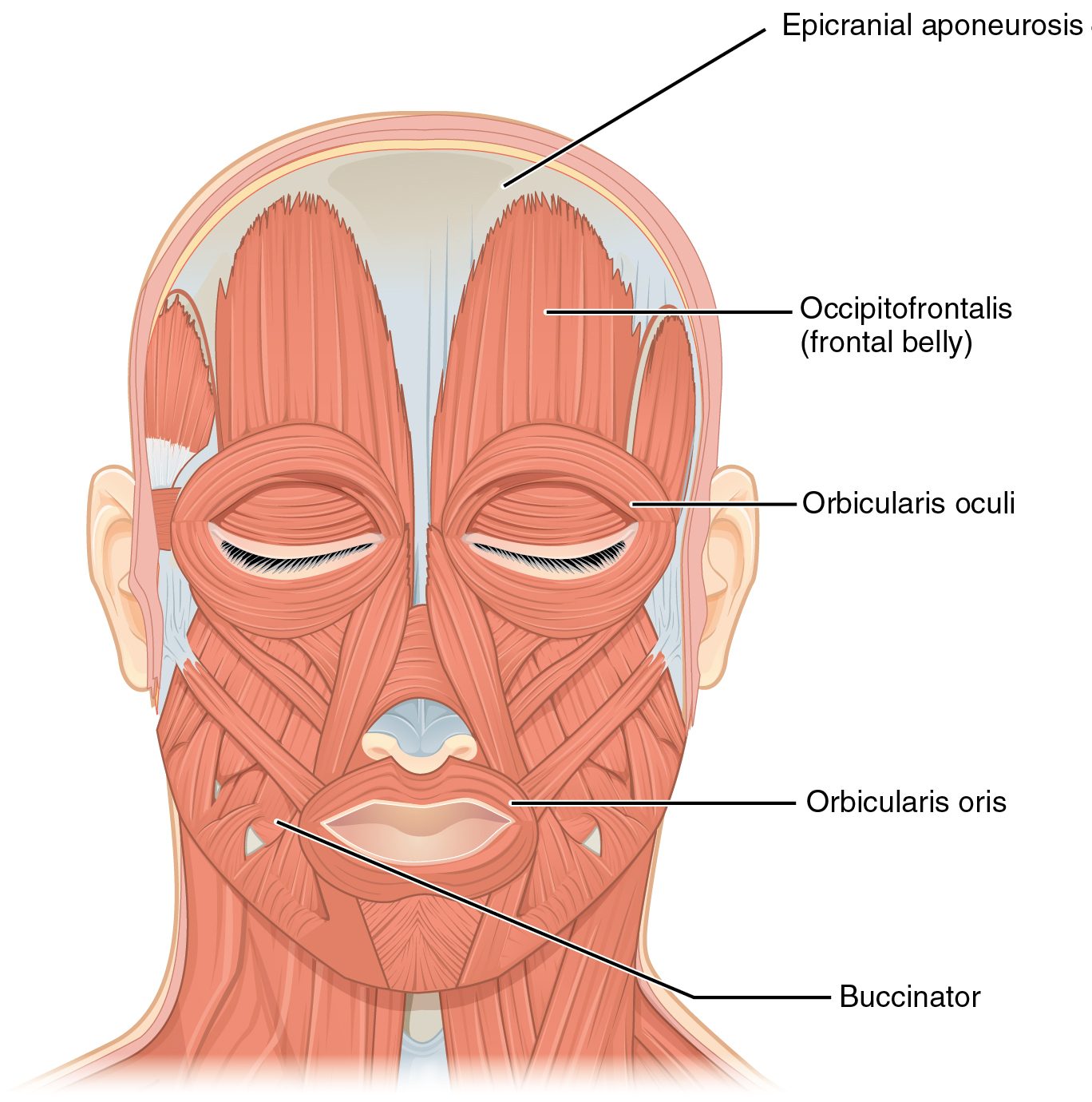
Photo: CNX Anatomy 2013 / Wikimedia Commons, CC BY 4.0

| Muscle group | Location | What it does when it contracts | Main direction of movement |
|---|---|---|---|
| Frontalis | From the eyebrows up to the top of the head | Raises the eyebrows, creates horizontal forehead lines | Stroke from the eyebrows up to the hairline |
| Corrugator | Between the inner ends of the eyebrows | Frowning, creates vertical lines between the brows | Stroke from between the brows outwards, light press and hold |
| Orbicularis oculi | Around the eye socket | Closes and narrows the eyes, creates crow's feet | Under the eye from inner to outer corner, very light touch with the ring finger |
| Zygomaticus major and minor | From the cheekbone down to the corner of the mouth | Pulls the corners of the mouth up when smiling | Diagonally from the corner of the mouth up to the temple |
| Orbicularis oris | Around the lips | Pressing and pursing the lips | From the philtrum and the centre of the chin out to the corners of the mouth |
| Masseter | Angle of the jaw, in front of the ear | Chewing, teeth grinding; often tight with stress | Small circles, light press and hold |
| Temporalis | On both temples | Assists chewing, tightens with teeth grinding | Slow small circles |
| Platysma | Front of the neck, from the chest up to the jaw | Pulls the corners of the mouth and the jawline down, creates neck bands | Light strokes from the collarbone up to the jawline |
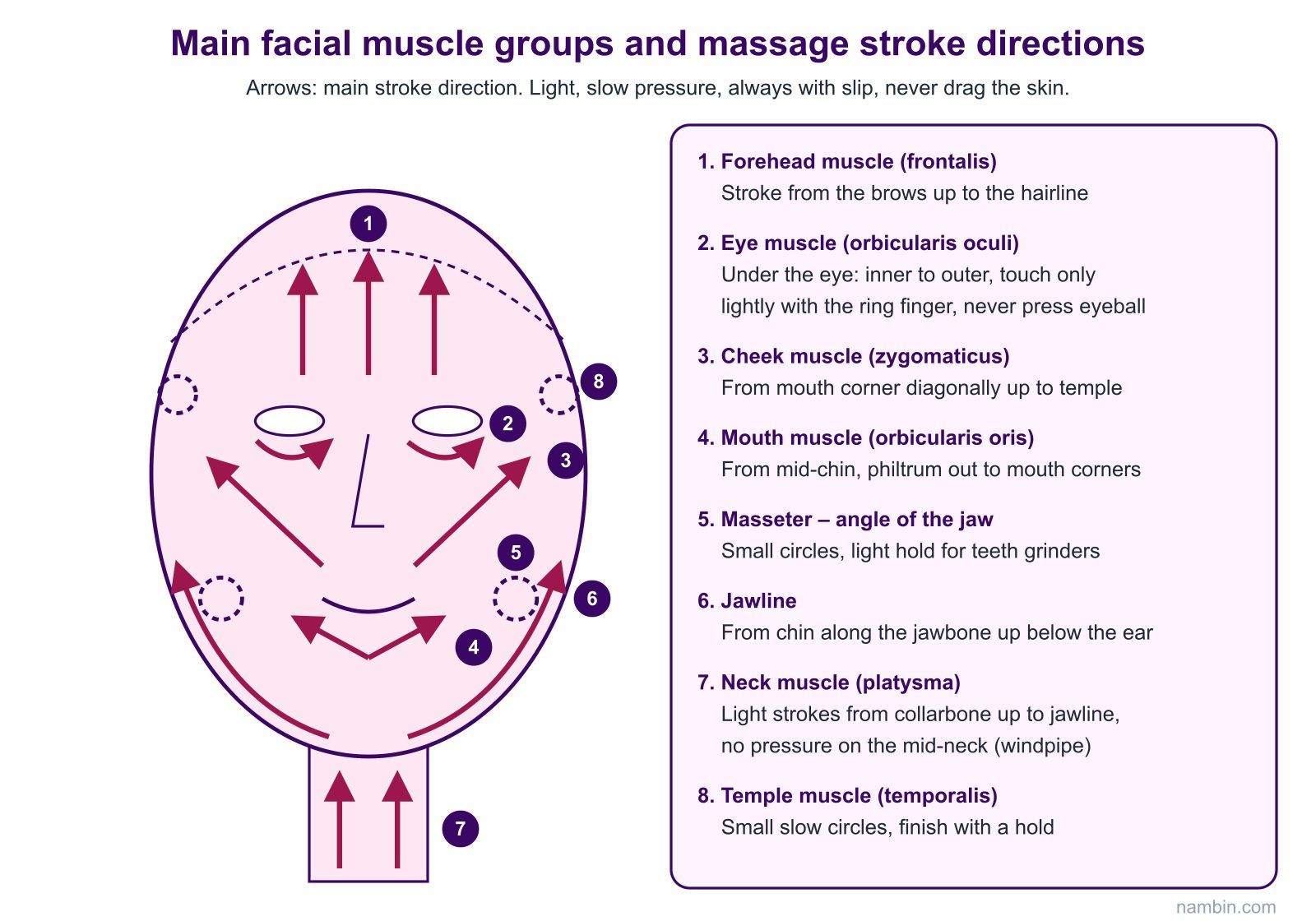
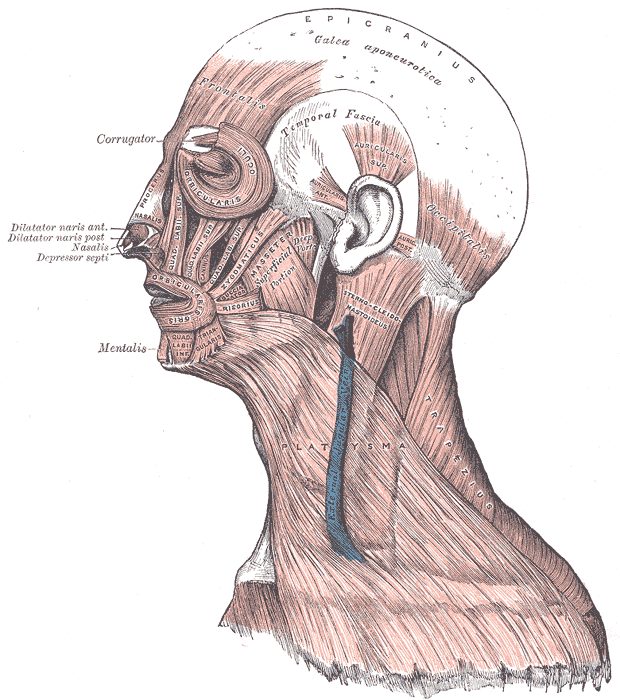
Photo: Henry Vandyke Carter / Wikimedia Commons, Public domain

Areas to avoid or touch only very lightly
- Eyeballs: never press on the eyelids or eyeballs. Around the eyes, work only on the bone of the eye socket.
- Centre of the neck: the trachea (windpipe) and thyroid gland. Do not press.
- Sides of the neck, below the angle of the jaw: the carotid arteries run here. Stroke lightly only; no deep pressure and no long press-and-hold.
- Areas recently injected or treated: see the contraindications section.
Contraindications: screen before you lay your hands on the client
Facial massage looks gentle but still has its own contraindications, in addition to the general contraindications learned at Level 1. Ask again at every session, even with regular clients, because a client may have just had an injection or procedure without thinking she needs to tell the spa.
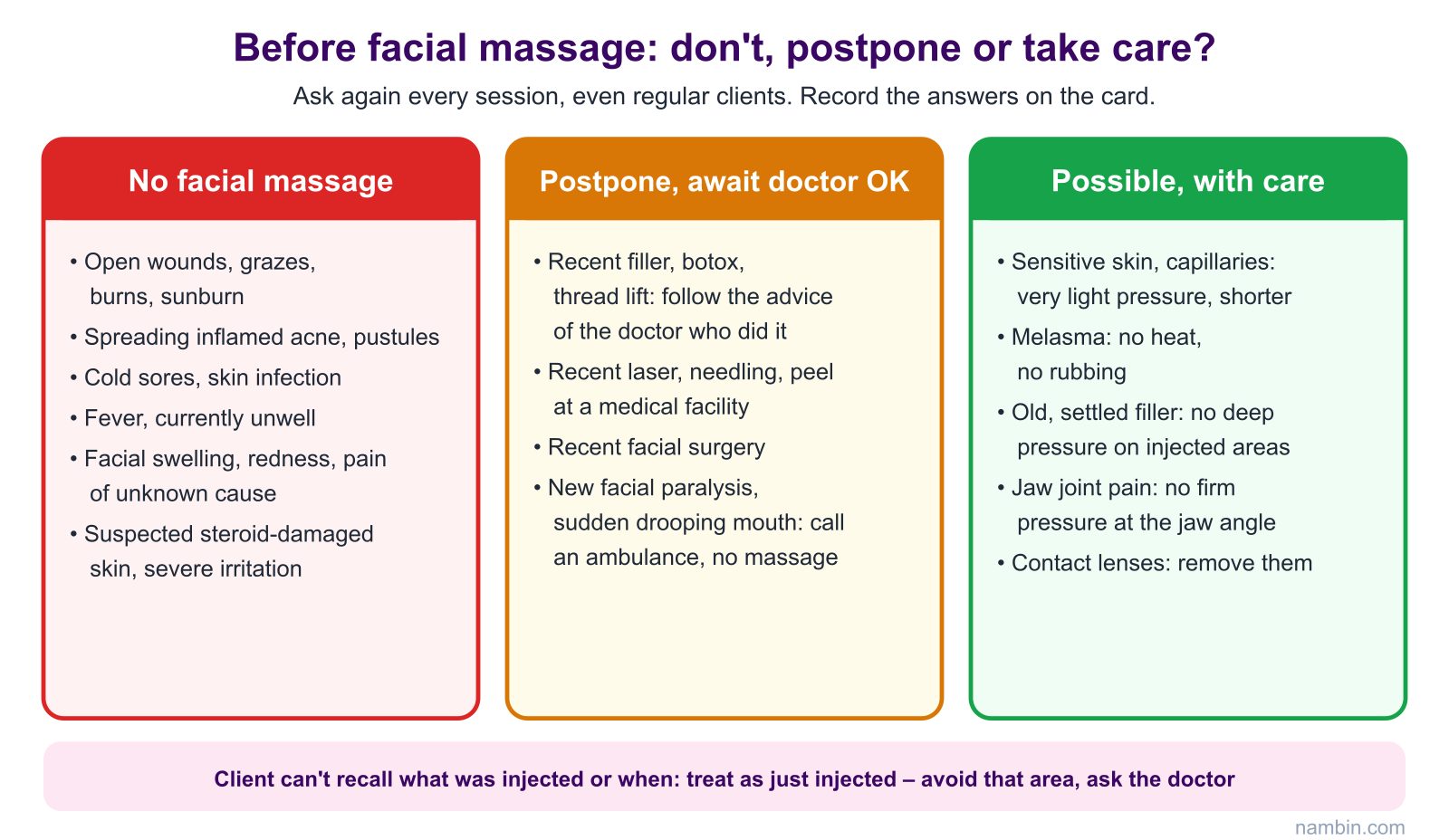
Do not massage the face
Skin with open wounds, scratches, burns or sunburn; widespread inflamed acne or pustules; active cold sores (herpes on the lips) or suspected skin infection; a client with a fever or who is unwell; a swollen, red, painful face of unknown cause; skin suspected of steroid damage or with severe irritation. In these cases, advise the client to see a doctor and rebook.
Postpone until the doctor gives permission
Filler injections (dermal fillers), Botox injections (botulinum toxin), thread lifts, laser, microneedling, peels at a medical facility, facial surgery: these are medical procedures performed by doctors under the Law on Medical Examination and Treatment No. 15/2023/QH15. After these procedures, doctors usually advise clients to avoid rubbing or pressing the treated area for a period of time, because massage can make the injected product migrate, make swelling and bruising worse, or affect the healing process.
- Ask directly: "In the last few months have you had any filler, Botox, thread lift, laser or anything done on your face? Which area, and on what date?"
- The waiting time follows the instructions of the doctor who performed the procedure, not the feeling of the client or the therapist. If the client does not remember the instructions, suggest she calls to ask before booking.
- If the client does not remember what was injected or when: treat it as a recent injection. Skip that area completely or postpone the facial massage, and do only neck and shoulders plus basic skin care.
- Even when filler was done long ago and is stable, still avoid deep pressure and long press-and-hold on the injected area.
- Record on the card: type of procedure, area, date, and the doctor's instructions (as reported by the client).
Signs that call for an ambulance, not a massage
If the client suddenly has a drooping mouth, weakness or numbness on one side of the face, difficulty speaking or blurred vision, especially with weakness in an arm or leg on one side, this may be a sign of stroke. Do not massage, do not do coin scraping, call emergency services on 115 immediately and inform the shift manager. If a client who has had filler has increasing pain at the injection site, skin turning pale or mottled purple, or blurred vision: advise her to contact the doctor who injected her immediately or go to the emergency department.
Can proceed, but with caution
Sensitive skin, broken capillaries: very light pressure, shorter duration. Melasma: no heat, no friction. Clients with temporomandibular (jaw) joint pain or pain on opening the mouth: no firm pressure at the jaw angle. Clients wearing contact lenses: ask them to remove them first. Older clients and clients on anticoagulants: light pressure, watch for bruising.
Pressure, pace and hand position
The most common mistake of new therapists is to think that "lifting" means pressing hard and pulling hard. Facial muscles are thin and lie close to the skin; strong pressure only stretches the skin, causing redness, bruising and discomfort, and on skin with melasma it can also cause dark marks.
- Pressure: light to medium. Enough for the skin and the tissue beneath to move with your hand, without the skin bunching up in front of your fingers and without pain. The neck, upper shoulders and masseter can take medium pressure; around the eyes use only a light touch, as if applying eye cream.
- Pace: slow and even, roughly matching the client's slow breathing: one long stroke takes 2–3 seconds. Working too fast makes it hard for the client to relax.
- Repetitions: repeat each movement 3–6 times and then move on; avoid working too long in one place, which causes redness.
- Keep hand contact: when changing movements, always keep at least one hand on the client. Lifting both hands suddenly startles the client and breaks the relaxation.
- Slip cream: enough for the hands to glide smoothly; when you feel your hands starting to drag or pull the skin, add a little more cream. Never keep stroking on dry skin.
- Direction: from bottom to top, from the centre outwards, lifting rather than pulling down. The exception is the gentle drainage movement at the end, stroking from in front of the ears down the sides of the neck to the hollow above the collarbone with very light pressure.
- The therapist's hands: nails cut short, no rings, hands clean and warm. The therapist sits at the head of the treatment bed, back straight, stool high enough for the forearms to be nearly parallel to the bed surface, as learned in the lesson on working posture.
After the first 1–2 minutes, ask the client: "Is this pressure all right for you, or would you like it a little lighter or firmer?" After that, do not keep asking; let the client rest. Watch the client's face: frowning, holding the breath or clenching the fists are signs of discomfort.
The 25-minute facial lifting massage routine
Facial massage usually sits in the middle of a facial treatment: after cleansing and gentle exfoliation if used, and before the mask. The client has removed make-up and washed her face, her hair is neatly wrapped in a towel, and a towel covers her chest and shoulders as in the lesson on room preparation. The timings below are a guide; you can shorten the routine to 20 minutes by reducing repetitions, or extend it to 30 minutes by adding time for the neck, shoulders and jaw muscles.
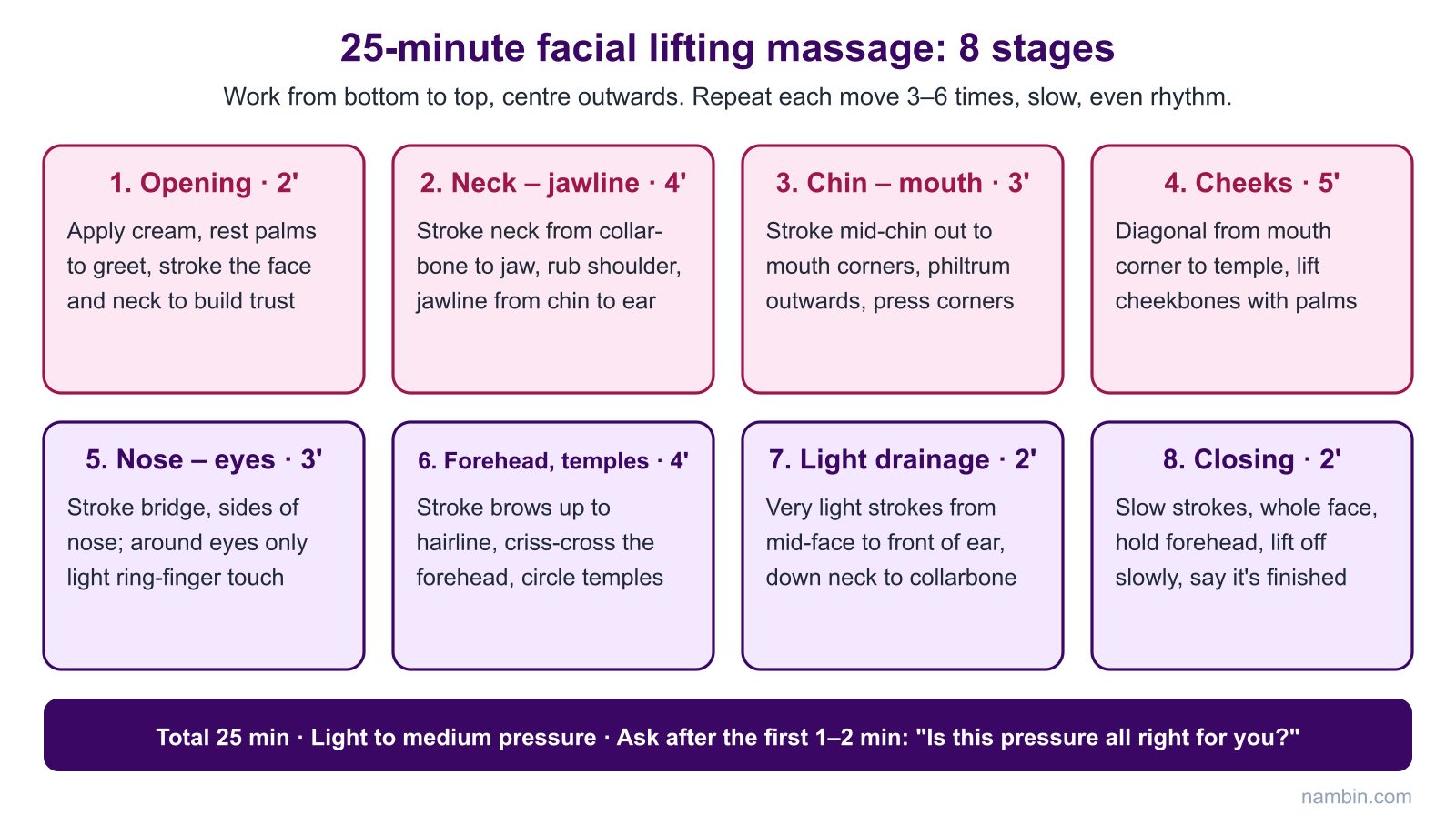
- Opening (2 minutes). Warm the cream in your palms. Rest both palms lightly on the client's cheeks for a few seconds to "greet" her. Spread the cream evenly over the face, neck and upper shoulders with long, slow strokes.
- Neck, upper shoulders, jawline (4 minutes). Stroke alternately with both hands from the collarbone up to the jawline on both sides of the neck, avoiding the centre of the neck. Make light circles on the upper shoulders and nape. Lightly hold the jawline between the index and middle fingers and stroke from the chin up to below the ear. Make small circles on the masseter and ask the client whether it is painful.
- Chin, around the mouth (3 minutes). With the tips of the middle fingers, stroke from the centre of the chin out to the corners of the mouth, and from the philtrum out to both sides. Press and hold lightly at the corners of the mouth for 2–3 seconds, then stroke diagonally upwards.
- Cheeks, cheekbones (5 minutes). Stroke diagonally from the corners of the mouth up to the temples with the full flat of the fingers. Cup the cheeks with both palms, lift gently towards the temples, hold for a few seconds and release. Make slow small circles under the cheekbones. No pinching, no stretching the skin.
- Nose, around the eyes (3 minutes). Stroke the bridge of the nose lightly upwards and stroke the sides of the nose outwards. Around the eyes: use the ring finger (the weakest finger) to stroke along the bone of the eye socket, under the eye from inner to outer corner, and above the eyebrow from inner to outer end. Press and hold lightly at the outer corner of the eye. Do not touch the eyeballs.
- Forehead, temples (4 minutes). Stroke alternately with both hands from the eyebrows up to the hairline. Interlace the fingers across the forehead and stroke from the centre of the forehead out to the temples. Stroke from between the brows outwards to soothe the corrugator. Make slow small circles on the temples.
- Gentle drainage (2 minutes). Very light pressure, just gliding over the skin: stroke from the centre of the face out to in front of the ears, then from in front of the ears down the sides of the neck to the hollow above the collarbone. This movement helps the face feel lighter and may temporarily reduce slight puffiness.
- Closing (2 minutes). Stroke over the whole face, gradually slowing down, rest both palms lightly on the forehead for a few seconds, and lift your hands away slowly. Say softly to the client: "The massage is finished; now we'll move on to the mask." Remove excess cream if the next product requires it.
In total: 2 + 4 + 3 + 5 + 3 + 4 + 2 + 2 = 25 minutes. When practising, ask a classmate to time each stage so you can learn the rhythm.
Choosing cream and tools
The facial massage cream or oil must suit the skin type: oily and acne-prone skin needs a gel or light non-comedogenic oil; dry and ageing skin needs a richer cream. Products must be labelled and have a cosmetic product notification under Circular 06/2011/TT-BYT on cosmetics management. Take cream out with a clean spatula into a small bowl; never dip your fingers into the jar.
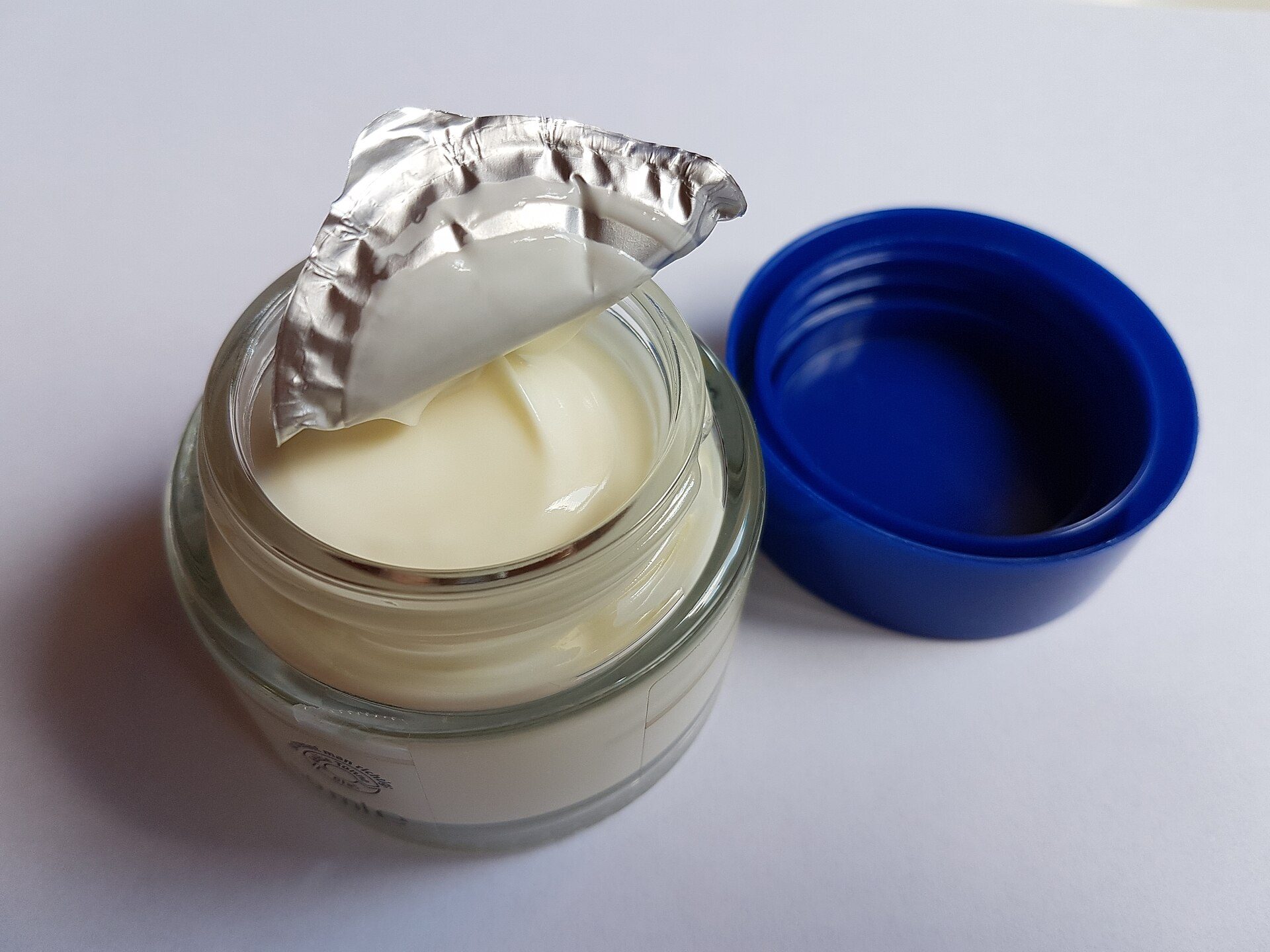
Photo: Benff / Wikimedia Commons, CC BY-SA 4.0

Stone rollers and gua sha tools (flat scraping stones) can be used to create a cooling, relaxing sensation, with light pressure and enough slip cream. Tools must be cleaned and disinfected after each client according to the procedure you have learned. Do not scrape the face so hard that it leaves red marks, and do not use them on skin with melasma or on irritated skin.
Realistic expectations: what to tell the client
Clients buy a treatment programme because they want results. You keep clients for a long time by promising correctly and delivering better than you promised.
- What facial massage can do: relax the client and reduce the feeling of tension and fatigue in the forehead, jaw and temples; temporarily increase circulation so the skin looks rosier and fresher after the session; slightly reduce puffiness for the day; and provide self-care time that clients really enjoy.
- What facial massage cannot do: erase wrinkles, fill nasolabial folds, lift permanently, slim the jawbone, or replace injections or surgery.
Sample script: "Massage helps your face relax, makes your skin fresher and eases the tension in your jaw muscles; if you have it regularly, you will feel more comfortable and your skin will look rosier. But for deep wrinkles or a lot of sagging, massage can only support – if you want a clear improvement, you should get further advice from a dermatologist."
Do not use phrases like "erase wrinkles", "10 years younger", "lifts like a thread lift" or "V-line face slimming" when consulting or advertising. Such statements promise false results and may breach the Advertising Law 2012.
Common mistakes in facial massage
| Mistake | Why it is dangerous/wrong | The correct way |
|---|---|---|
| Pressing and pulling hard to "lift" | Stretches the skin, causes redness, bruising and discomfort; skin with melasma darkens easily | Light to medium pressure, enough slip cream, ask the client after 1–2 minutes |
| Not asking about filler, Botox or recent procedures | Massage can make the injected product migrate and worsen swelling and bruising | Ask clearly at every session; postpone according to the doctor's instructions; if the client does not remember, treat it as a recent injection |
| Stroking downwards on the cheeks and jaw | Against the lifting direction; the client feels her face is being dragged down | Bottom to top, centre outwards; only the gentle drainage goes down the neck |
| Pressing on the eyelids or eyeballs | Painful and dangerous for the eyes | Work only on the eye socket bone, with the ring finger and a light touch |
| Pressing the centre of the neck or pressing deeply on the sides of the neck | Compresses the trachea and carotid arteries; the client becomes dizzy and uncomfortable | Avoid the centre of the neck; stroke only lightly on the sides |
| Lifting both hands off the face when changing movements | The client is startled and loses relaxation | Always keep one hand on the client during transitions |
| Dipping fingers into the cream jar | Contaminates the jar and spreads infection between clients | Take cream out with a clean spatula into a separate bowl |
| Promising to "erase wrinkles" or make the client "10 years younger" | Untrue, the client is disappointed, legal risk | Say "relaxing, supportive, fresher skin" and state the limits clearly |
Pass criteria for this lesson
You pass this lesson when you can do the following in front of your instructor:
- Locate 8/8 facial muscle groups correctly on a model or on a classmate's face and state the correct direction of movement for each group, in no more than 3 minutes.
- Conduct a screening interview with a role-play client, asking fully about filler, Botox, thread lifts, laser, date and area treated; correctly identify 100% of the pre-set situations that require postponement.
- Perform all 8/8 stages of the routine in the correct order within 23–27 minutes, repeating each movement 3–6 times, without ever lifting both hands off the client's face.
- The model confirms that the pressure was comfortable and not painful; no red marks or drag marks after the session; no touching of the eyeballs and no pressure on the centre of the neck.
- Deliver the realistic-expectations consultation script, naming at least 3 things massage can do and 3 things it cannot do, without using the words "erase wrinkles".
Frequently asked questions
How often is facial massage reasonable?
Many spas suggest about once every 1–2 weeks as part of a facial treatment programme. Daily massage with strong pressure is not better; it easily causes redness and irritation. For clients with sensitive skin, space the sessions further apart and shorten them.
A client had Botox yesterday and wants a neck and shoulder massage – what then?
You can work on the neck, shoulders and nape, but do not massage the face, in particular do not touch the injected area, and position the client so that her face is not pressed. When facial massage can resume depends on the instructions of the doctor who injected her. Note this clearly on the record card.
Should we use lifting machines (microcurrent, RF)?
This lesson teaches manual massage only. Skin care machines may be used only when the spa has been trained, the device has valid documentation, it is used for its intended non-invasive care purpose and according to the manufacturer's instructions. Therapeutic devices and deep interventions fall within the scope of medical facilities. If in doubt, ask the manager before using one.
The client develops a red rash after massage – how should it be handled?
Even, slight pinkness after massage is normal and fades within a few minutes. If there is a rash, itching or patchy redness, it may be a reaction to the cream: remove the cream with cool water, apply a cool compress, do not apply any other unfamiliar product, and record the product name on the card. If the eyelids swell or the client has difficulty breathing, follow the allergy first-aid procedure learned at Level 1 and call 115.